
Pulp Fiction, 1924 · page 103 of 166
Argosy All-Story Weekly, February 23, 1924 — page 103: what you’re looking at
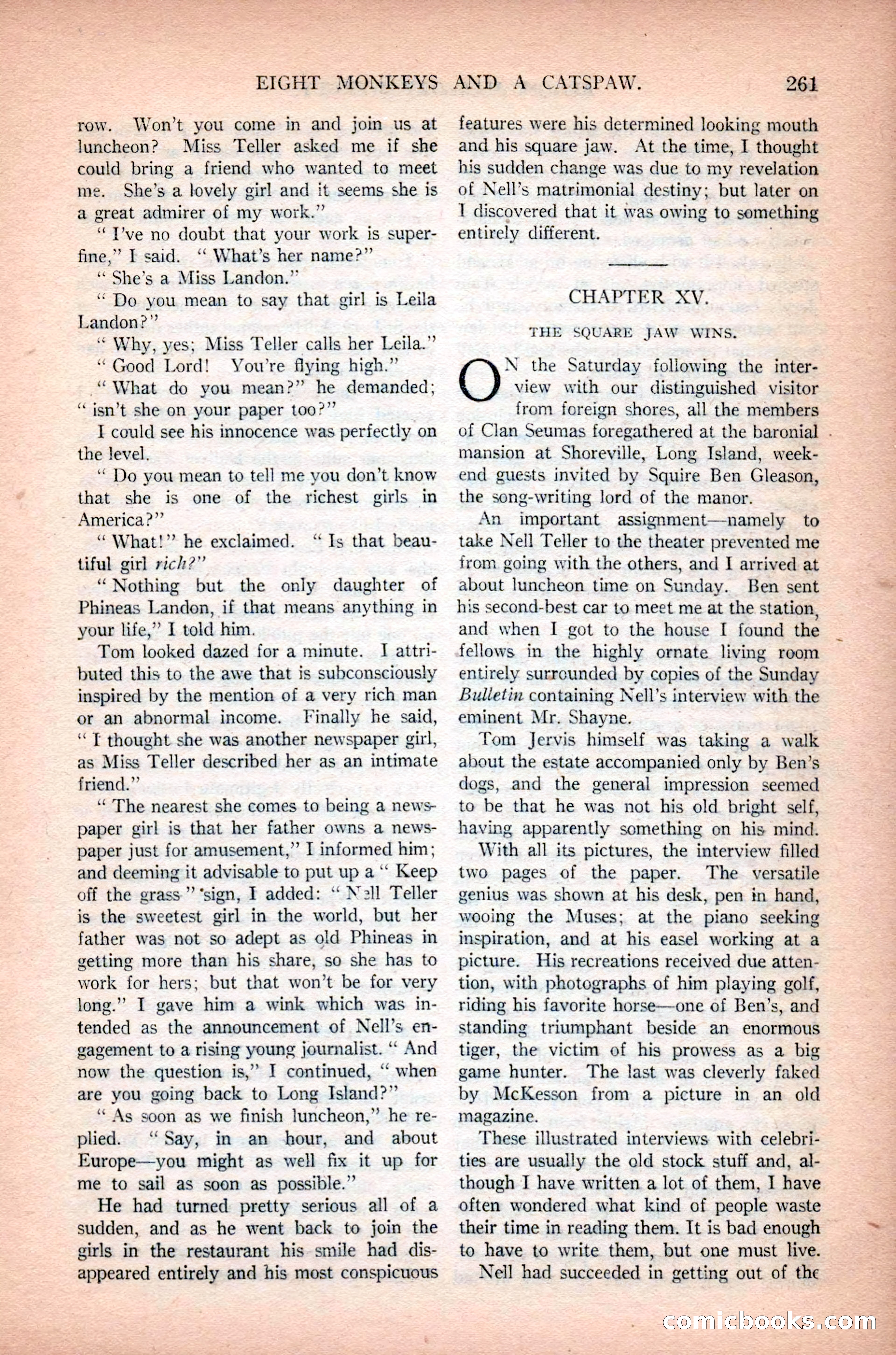
A restored page from Pulp Fiction, 1924. Page through the whole issue in the reader above.
📄 Transcribed text from this page (OCR, searchable)
Machine-transcribed from the original scan — historical spelling and the odd misread are preserved.
EIGHT MONKEYS row. Won’t you come in and join us at luncheon? Miss Teller asked me if she could bring a friend who wanted to meet me. She’s a lovely girl and it seems she is a great admirer of my work.” “T’ve no doubt that your work is super- fine,’ I said. ‘‘ What’s her name?” ‘“ She’s a Miss Landon.” “Do you mean to say that girl is Leila Landon?” ‘“ Why, yes; Miss Teller calls her Leila.” “Good Lord! You’re flying high.” “What do you mean?” he demanded; “isn’t she on your paper too?”’ I could see his innocence was perfectly on the level. ‘Do you mean to tell me you don’t know that she is one of the richest girls in ~ America?” “What!” he exclaimed. tiful girl rich?” “Nothing but the only daughter of Phineas Landon, if that means anything in your life,” I told him. Tom looked dazed for a minute. I attri- buted this to the awe that is subconsciously inspired by the mention of a very rich man or an abnormal income. Finally he said, ‘“ T thought she was another newspaper girl, as Miss Teller described her as an intimate friend.”’ ‘The nearest she comes to being a news- paper girl is that her father owns a news- paper just for amusement,” I informed him; and deeming it advisable to put up a ‘“‘ Keep off the grass” ‘sign, I added: “‘ Nall Teller is the sweetest girl in the world, but her father was not so adept as old Phineas in getting more than his share, so she has to work for hers; but that won’t be for very long.” I gave him a wink which was in- tended as the announcement of Nell’s en- gagement to a rising young journalist. “ And now the question is,” I continued, “ when are you going back to Long Island?” ‘As soon as we finish luncheon,” he re- plied. ‘Say, in an hour, and about Europe—you might as well fix it up for me to sail as soon as possible.” He had turned pretty serious all of a sudden, and as he went back to join the girls in the restaurant his smile had dis- appeared entirely and his most conspicuous “Ts that beau- AND A CATSPAW. 261 features were his determined looking mouth and his square jaw. At the time, I thought his sudden change was due to my revelation of Nell’s matrimonial destiny; but later on I discovered that it was owing to something entirely different. CHAPTER XV. THE SQUARE JAW WINS. N the Saturday following the inter- view with our distinguished visitor from foreign shores, all the members of Clan Seumas foregathered at the baronial . mansion at Shoreville, Long Island, week- end guests invited by Squire Ben Gleason, the song-writing lord of the manor. An important assignment—namely to take Nell Teller to the theater prevented me from. going with the others, and I arrived at about luncheon time on Sunday. Ben sent his second-best car to meet me at the station, and when I got to the house I found the fellows in the highly ornate living room entirely surrounded by copies of the Sunday Bulletin containing Nell’s interview with the eminent Mr. Shayne. fom Jervis himself was taking a walk about the estate accompanied only by Ben’s dogs, and the general impression seemed to be that he was not his old bright self, having apparently something on his mind. With all its pictures, the interview filled two pages of the paper. The versatile genius was shown at his desk, pen in hand, wooing the Muses; at the piano seeking inspiration, and at his easel working at a picture. His recreations received due atten- tion, with photographs of him playing golf, riding his favorite horse—one of Ben’s, and standing triumphant beside an enormous tiger, the victim of his prowess as a big game hunter. The last was cleverly faked by McKesson from a picture in an old magazine. These illustrated interviews with celebri- ties are usually the old stock stuff and, al- though I have written a lot of them, I have often wondered what kind of people waste their time in reading them. It is bad enough to have to write them, but one must live. Nell had succeeded in getting out of the CORMICLOO© (c cS) (E@) ; é ? per ; Penslen! atte yt ELAM Pte gw fe) Pi ts Pe dee ee tend Pp a Cet Beth RONG Syl iy / } rife 5 i i, id ieee DAD At oe SAM DS vr \ " lt te iat y 4