
Pulp Fiction, 1924 · page 101 of 166
Argosy All-Story Weekly, February 23, 1924 — page 101: what you’re looking at
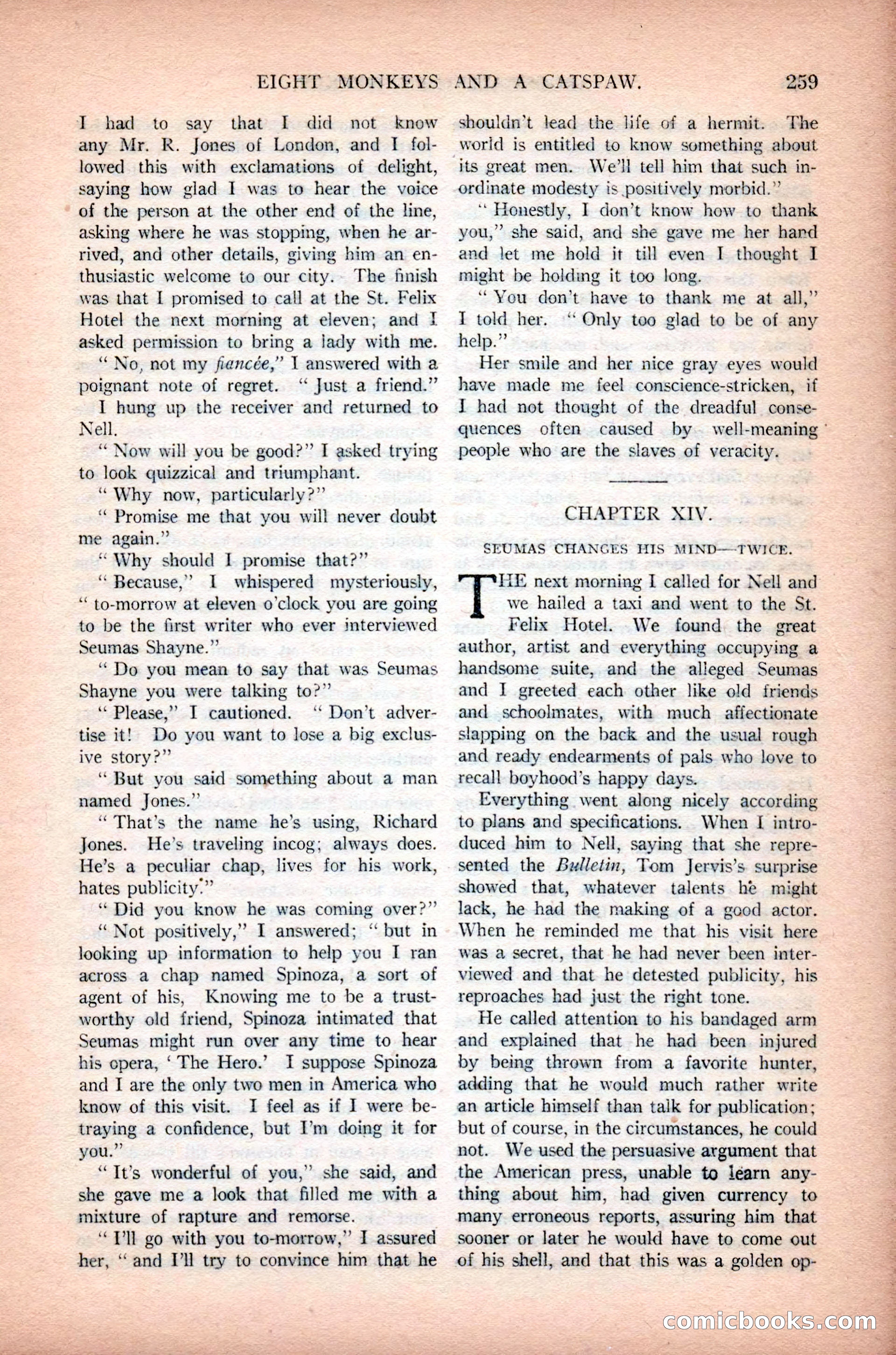
A restored page from Pulp Fiction, 1924. Page through the whole issue in the reader above.
📄 Transcribed text from this page (OCR, searchable)
Machine-transcribed from the original scan — historical spelling and the odd misread are preserved.
EIGHT MONKEYS IT had to say that I did not know any Mr. R. Jones of London, and I fol- lowed this with exclamations of delight, saying how glad I was to hear the voice of the person at the other end of the line, asking where he was stopping, when he ar- rived, and other details, giving him an en- thusiastic welcome to our city. The finish was that I promised to call at the St. Felix Hotel the next morning at eleven; and ! asked permission to bring a lady with me. “No, not my fiencée,” I answered with a poignant note of regret. “ Just a friend.” I hung up the receiver and returned to Nell. “ Now will you be good?” TI asked trying to look quizzical and triumphant. “Why now, particularly?” ‘Promise me that you will never doubt me again.” “Why should I promise that?” ‘“ Because,” I whispered mysteriously, “to-morrow at eleven o'clock you are going to be the first writer who ever interviewed Seumas Shayne.” “Do you mean to say that was Seumas Shayne you were talking to?” ‘““ Please,” I cautioned. ‘‘ Don’t adver- tise it! Do you want to lose a big exclus- ive story?” “ But you said something about a man named Jones.”’ “That’s the name he’s using, Richard Jones. He’s traveling incog; always does. He’s a peculiar chap, lives for his work, hates publicity.” ‘Did you know he was coming over?” “Not positively,” I answered; “ but in looking up information to help you I ran across a chap named Spinoza, a sort of agent of his, Knowing me to be a trust- worthy old friend, Spinoza intimated that Seumas might run over any time to hear his opera, ‘The Hero.’ I suppose Spinoza and I are the only two men in America who know of this visit. I feel as if I were be- traying a confidence, but I’m doing it for you.” “Tt’s wonderful of you,” she said, and she gave me a look that filled me with a mixture of rapture and remorse. ‘“T’ll go with you to-morrow,” I assured her, ‘‘ and I’ll try to convince him that he AND A> CATSPAW. 259 — shouldn’t lead the life of a hermit. The world is entitled to know something about its great men. We'll tell him that such in- ordinate modesty is positively morbid.” ‘‘ Honestly, I don’t know how to thank you,” she said, and she gave me her hard and let me hold it till even I thought I might be holding it too long. ‘You don’t have to thank me at all,” T told her. “ Only too glad to be of any help.” Her smile and her nice gray eyes would have made me feel conscience-stricken, if { had not thought of the dreadful conse- quences often caused by people who are the slaves of veracity. CHAPTER XIV. SEUMAS CHANGES HIS MIND—TWICE. HE next morning I called for Nell and we hailed a taxi and went to the St. Felix Hotel. We found the great author, artist and everything occupying a handsome suite, and the alleged Seumas and J greeted each other like old friends and schoolmates, with much affectionate slapping on the back and the usual rough and ready endearments of pals who love to recall boyhood’s happy days. Everything went along nicely according to plans and specifications. When I intro- duced him to Nell, saying that she repre- sented the Bulletin, Tom Jervis’s surprise showed that, whatever talents he might lack, he had the making of a good actor. When he reminded me that his visit here was a secret, that he had never been inter- viewed and that he detested publicity, his reproaches had just the right tone. He called attention to his bandaged arm and explained that he had been injured by being thrown from a favorite hunter, adding that he would much rather write an article himself than talk for publication; but of course, in the circumstances, he could not. We used the persuasive argument that the American press, unable to learn any- thing about him, had given currency to many erroneous reports, assuring him that sooner or later he would have to come out of his shell, and that this was a golden op- well-meaning ° Eomichbooks ¢ ie he ew ay Vedra Ds teed) Ghee aly SE fipide Mah Phy at os ‘ yee ae Le Pou et aw “Ale oe . y =e he ¢ ee “S ao) ieee a bore Ue