
Pulp Fiction, 1923 · page 82 of 196
Argosy All-Story Weekly, October 6, 1923 — page 82: what you’re looking at
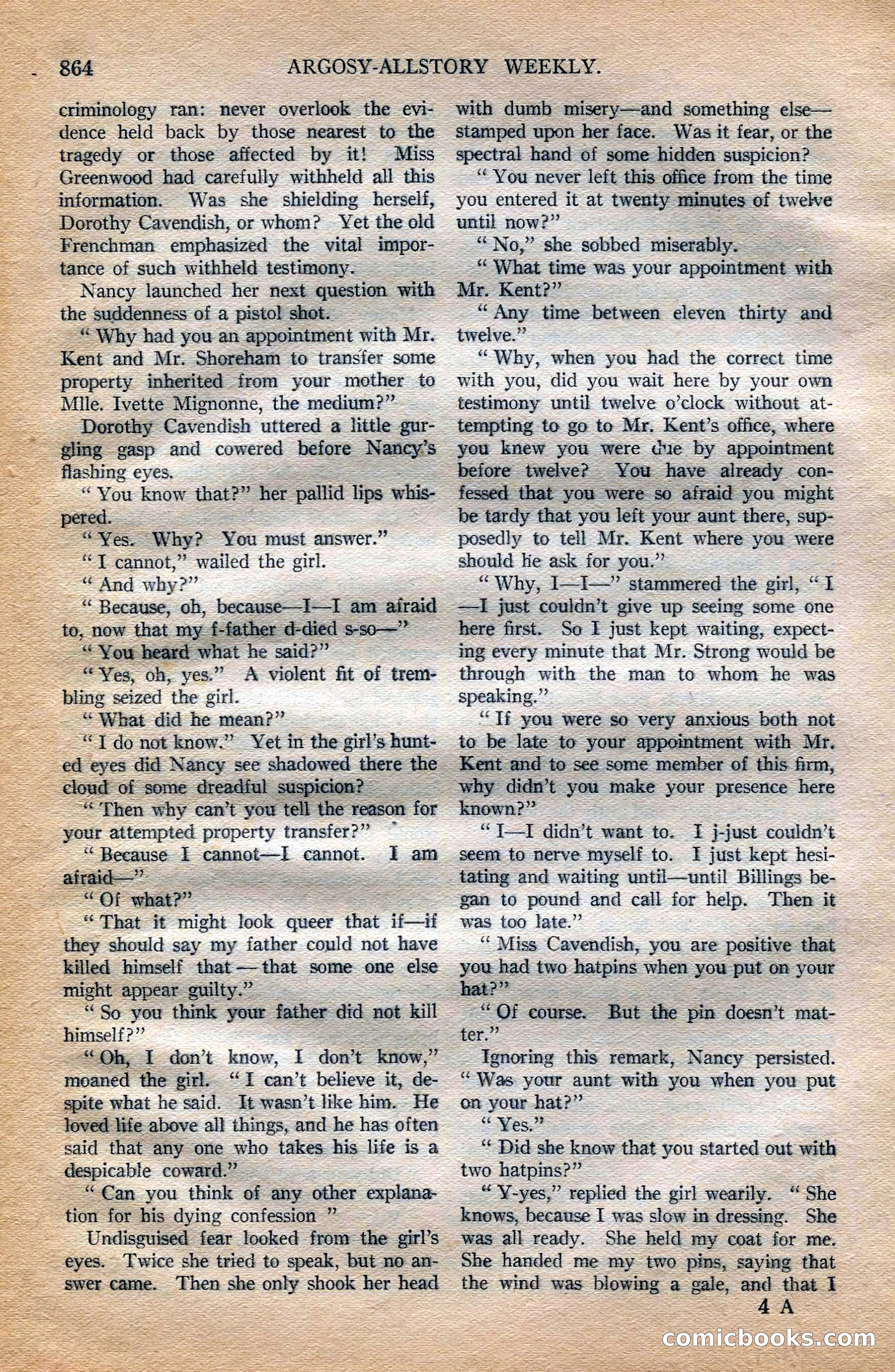
A restored page from Pulp Fiction, 1923. Page through the whole issue in the reader above.
📄 Transcribed text from this page (OCR, searchable)
Machine-transcribed from the original scan — historical spelling and the odd misread are preserved.
——— oe eg Se == —— 4 Sa > 7 = 2 SS SESS a 55 > : a — a ee - —— “ a Le SS. %. ~ = ——- dence held back by those nearest to the tragedy or those affected by it! Miss _ Greenwood had carefully withheld all this — information. Was she shielding herself, _ Dorothy Cavendish, or whom? Yet the old Frenchman emphasized the vital impor- -_ tance of such withheld testimony. - Nancy launched her next question with = the suddenness of a pistol shot. — ___ _“Why had you an appointment with Mr. ont and Mr. Shoreham to transfer some _ property inherited from your mother to 252 Mile. Ivette Mignonne, the medium?” = Dorothy Cavendish uttered a little gur- ging gasp and cowered before. _Nancy’s - flashing eyes, =“ You know that?” hier pallid lips whis- = = Ya Why? You must answer.’ = I cannot,” wailed the girl. — * And why?” ee = * Because, ob, because—I—I am afraid to, nov er d-died s-so—” : oe Yea “oh, yes.” A violent fit of trem- = ling seized the girl. _ “What did he. mean?” « at do not know. Yet in the girl’s hunt- = 2: — mye can’t you tell ae veasan f for a attempted property transfer?” ae “ Because LE cannot—I cannot. i am = ce “That it eienl look queer hat iit the ey < should say my. father could not have —— aS = = himself?” _. “Oh, I don’t know, I done now.” = eared the girl. “I can’t believe it, de- _ spite what he said. It wasn’t like him. He ~ teved life above all things, and he has often said that any one who takes his life is a _ despicable coward.” —- _“€an you think of any” aber explana- Ses for his dying confession ” : sede aE looked from. the. es = criminology ran: never overlook the evi- with Samcke <a sencthine else— stamped upon her face. Was it fear, or the spectral hand of some hidden suspicion? “You never left this office from the time you entered it at twenty suites. of tw ele until now?” =e “No,” she sobbed misesahn == = « What time was your appointment with ee Mr. Kent?” = Ey time between eleven thirty scl tweive.” “Why, when you had the correct time with you, did you wait here by your own testimony until twelve o’clock without at- tempting to go to Mr. Kent’s office, where you knew you were due by appointment before twelve? You have already con- fessed that you were so afraid you might == be tardy that you left your aunt there, sup- posedly to tell Mr. Kent where you were should He ask for you.” “ Why, I—I—” stammered the girl, “ = -—I just couldn’t give up seeing some one here first. So I just kept waiting, expect- ing every minute that Mr. Strong would be through with the man to whom he was speaking.” “Tf you were so very anxious both not to be late to your appointment with Mr. > ‘Kent and to see some member of this firm, _ why didn’t you make your presence here known?” “TJ didn’t want to. seem to nerve myself to. I j-just couldn’t T just kept hesi- _tating and waiting untili—until Billings be- gan to paring and call for Ee Then it was too late.” “Miss Cavendish, you are ase that you had two hatpins hee you put on your as ae think your father did not kil : ae Of | course. "But ‘the pin does mat- = ee Tgnormeg this emake. Nancy persisted. “Was your aunt with you when you put on your hat?” ce Yes. 32 Did she know that you started out with two hatpins?”- “ ¥-yes,” replied the girl wearily. knows, because I was slow in dressing. = She She was all ready. She held my coat for me. She handed me my two pins, saying that — the wins was lowes a - gale, See that = ARGOSY-ALLSTORY WEEKLY. = Se =