
Pulp Fiction, 1923 · page 143 of 196
Argosy All-Story Weekly, October 6, 1923 — page 143: what you’re looking at
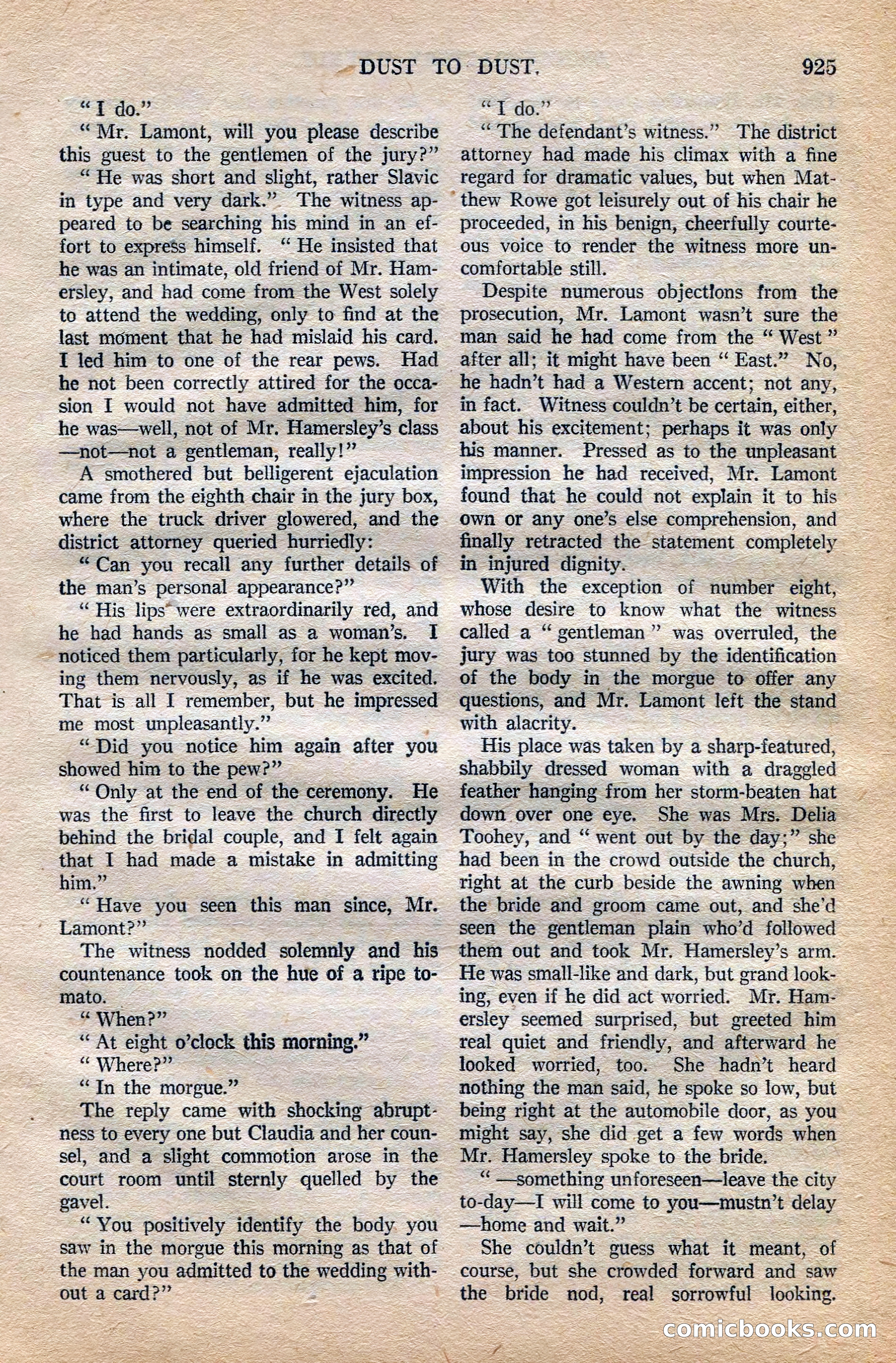
A restored page from Pulp Fiction, 1923. Page through the whole issue in the reader above.
📄 Transcribed text from this page (OCR, searchable)
Machine-transcribed from the original scan — historical spelling and the odd misread are preserved.
DUST TO: DUST. <4 IT do.” “Mr. Lamont, will you please describe this guest to the gentlemen of the jury?” “He was short and slight, rather Slavic in type and very dark.” The witness ap- peared to be searching his mind in an ef- fort to express himself. “ He insisted that he was an intimate, old friend of Mr. Ham- ersley, and had come from the West solely to attend the wedding, only to find at the last moment that he had mislaid his card. 1 led him to one of the rear pews. Had he not been correctly attired for the occa- sion I would not have admitted him, for he was—well, not of Mr. Hamersley’s class —not—not a gentleman, really!” A smothered but belligerent ejaculation came from the eighth chair in the jury box, - where the truck driver glowered, and the district attorney queried hurriedly: “Can you recall any further details of the man’s personal appearance?” “His lips’ were extraordinarily red, and he had hands as small as a woman’s. I ~ noticed them particularly, for he kept mov- ing them nervously, as if he was excited. That is all I remember, but he impressed me most unpleasantly.”’ “Did you notice him again after you showed him to the pew?” “Only at the end of the ceremony. was the first to leave the church directly behind the bridal couple, and I felt again that I had made a mistake in admitting bim. = “Have you seen this man since, Mr. Lamont?” The witness nodded sie and his countenance took on the hue of a ripe to- mato. “At eight o’clock this morning.” “ Where?” : “In the morgue.” The reply came with shocking abrant: ness to every one but Claudia and ‘her coun- sel, and a slight commotion arose in the court room until sternly quelled by the gavel. = “You positively identify the body. you _ Saw in the morgue this morning as that of. - the man you admitted to the wedding with- - outa a card?” He - ce j do.”’ “The defendant’s witness.” The district = attorney had made his climax with a fine | regard for dramatic values, but when Mat- ‘thew Rowe got leisurely out of his chair he — = proceeded, in his benign, cheerfully courte- = ous voice to render the witness more un- comfortable still. Despite numerous objections from the _ : prosecution, Mr. Lamont wasn’t sure the | man said he had come from the “ West ” _after all; it might have been “ East.” No, he hadn’t had a Western accent; not any, in fact. Witness couldn’t be certain, either, about his excitement; perhaps it was. only — his manner. Pressed as to the unpleasant — impression he had received, Mr. Lamont __ found that he could not explain it to his own or any one’s else comprehension, and finally retracted the statement ees Sea in injured dignity. , With the exception of hinber eight, whose desire to know what the witness <= = called a “ gentleman” was overruled, the jury was too stunned by the identification of the body in the morgue to offer any — = questions, and Mr. Lamont left the sand = with alacrity. His place was taken by a sharp-featured, shabbily dressed woman with a draggled feather hanging from her storm-beaten hat = down over one eye. She was Mrs. Delia Toohey, and “ went out by the day;” she — had been in the crowd outside the church, right at the curb beside the awning when =s_—- the bride and groom came out, and she’d — seen the gentleman plain who’d followed them out and took Mr. Hamersley’s arm. He was small-like and dark, but grand look- ing, even if he did act worried. Mr. Ham- ersley seemed surprised, but greeted him real quiet and friendly, and afterward he She hadn’t heard — nothing the man said, he spoke so low, but — being right at the automobile door, as you might say, she did get a few words when looked worried, too. = -Hamersley spoke to the bride. “something unforeseen—leave the city to-day—I will come to rons oeey : —home and wait.” She couldn’t guess what it. meant, “of : course, but she crowded forward and saw = the - bride nod, real sorrowful looking. — cor Ses