
Pulp Fiction, 1923 · page 106 of 196
Argosy All-Story Weekly, October 6, 1923 — page 106: what you’re looking at
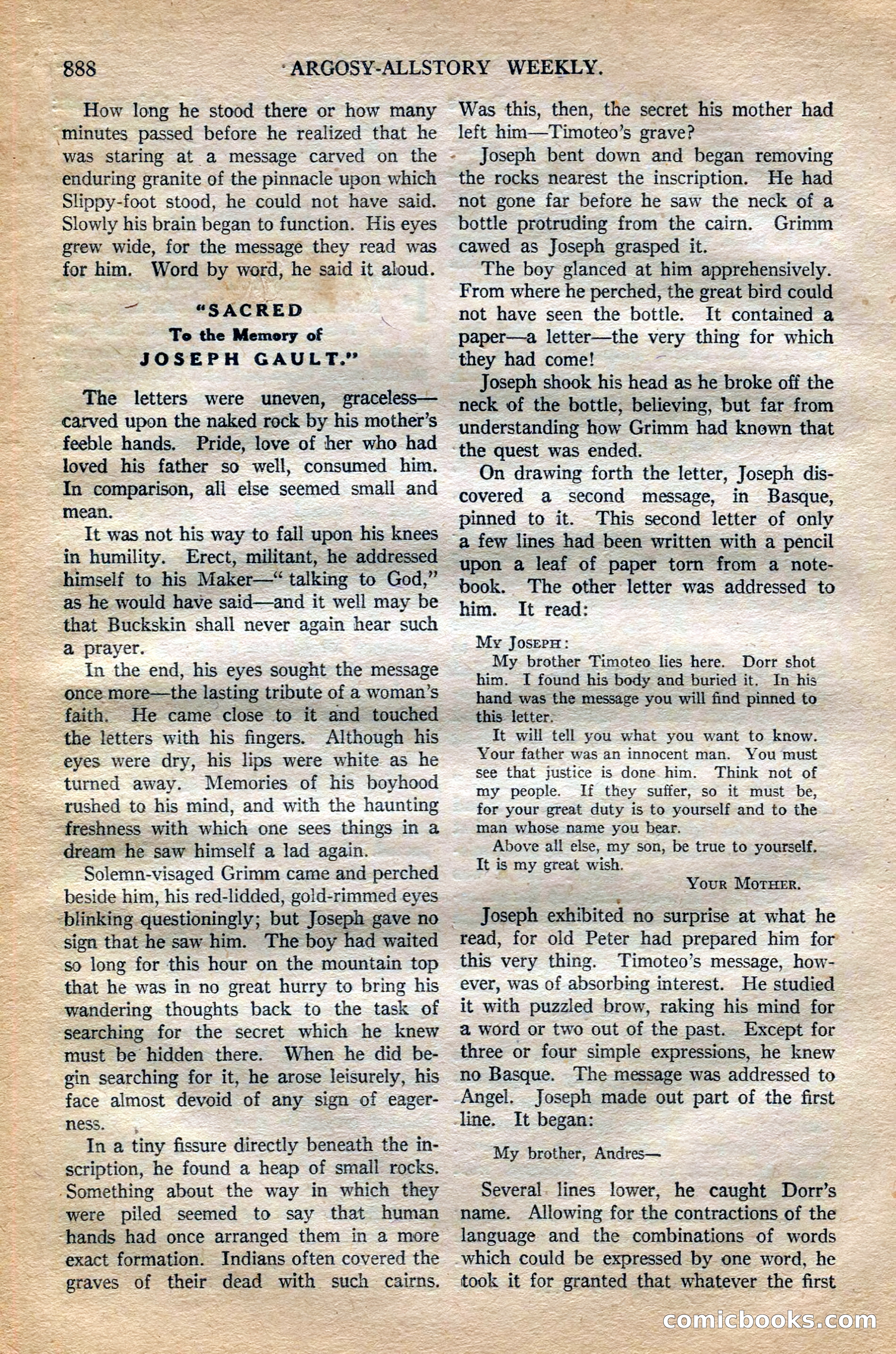
A restored page from Pulp Fiction, 1923. Page through the whole issue in the reader above.
📄 Transcribed text from this page (OCR, searchable)
Machine-transcribed from the original scan — historical spelling and the odd misread are preserved.
888 How fore he stood there or how many “minutes passed before he realized that he was staring at a message carved on the ts ~cmidinina granite of the sinnacle upon which Slippy-foot stood, he could not have said. Slowly his brain began to function. His eyes grew wide, for the message they read was - for him. Word by word, he said it aloud. ae “SACRED To the Memory of JOSEPH GAULT.” ‘ The letters were uneven, graceless— — carved upon the naked rock by his mother’s feeble hands. Pride, love of her who had loved his father so well, consumed him. In comparison, ali else seemed small and mean. It was not his way to fall upon his knees in humility. Erect, militant, he addressed himself to his Maker— talking to God,” as he would have said—and it well may be that Buckskin shall never again hear such a prayer. In the end, his eyes sought the message once. more—the lasting tribute of a woman’s faith. He came close to it and touched -. the letters with his fingers. _eyes were dry, his lips were white as he Although his turned away. Memories of his boyhood rushed to his mind, and with the haunting freshness with which one sees things in a -dream he saw himself a lad again. Solemn-visaged Grimm came and perched beside him, his red-lidded, gold-rimmed eyes 3 blinking. questioningly; but Joseph gave no - sign that he saw him. The boy had waited -- go long for this hour on the mountain top that he was in no great hurry to bring his wandering thoughts back to the task of ‘searching for the secret which he knew must be hidden there. When he did be- gin searching for it, he arose leisurely, his face almost devoid of any sign of eager- — -AESs. In a tiny fissure directly beneath the in- scription, he found a heap of small rocks. “Something about the way in which they were piled seemed to say that human -hands had once arranged them in a more exact formation. Indians often covered the graves of their dead with such cairns. - “ARGOSY- ALLSTORY WEEKLY. Was this, then, the secret “his mother had left ins —Pimotent S grave? Joseph bent down and began removing the rocks nearest the inscription. He had not gone far before he saw the neck of a bottle protruding from the cairn. Grimm cawed as Joseph grasped it. The boy glanced at him apprehensively. From where he perched, the great bird could not have seen the bottle. It contained a paper—a letter—the very thing for which they had come! a Joseph shook his head as he broke off the neck of the bottle, believing, but far from understanding how Grimm had knewn that ‘the quest was ended. On drawing forth the letter, Joseph dis- covered a second message, in Basque, pinned to it. This second letter of only a few lines had been written with a pencil upon a leaf of paper torn from a note- book. The other letter was addressed to him. It read: My Joserzx: My. brother Timoteo lies here. Dorr shot him. I found his body and buried it. In his hand was the message you will find pinned to this letter: Tt will tell you what you want to know. Your father was an innocent man. You must see that justice is done him. Think not of my people. If they suffer, so it must be, for your great duty is to yourself and to the man whose name you bear. Above all else, my son, be true to yourself. It is my great wish. Your Moruer, Joseph exhibited no surprise at what he read, for old Peter had prepared him for — this very thing. Timoteo’s message, how- ever, was of absorbing interest. He studied it with puzzled brow, raking his mind for a word or two out of the past. Except for three or four simple expressions, he knew no Basque. The message was addressed to Angel. Joseph made out part of the first line. It began: My brother, Andres— Several. lines lower, he caught Dorr’s name. Allowing for the contractions of the language and the combinations of words -which could be expressed by one word, he took it for granted that whatever the first SS 1¢boo