
Pulp Fiction, 1923 · page 73 of 196
Argosy All-Story Weekly, October 6, 1923 — page 73: what you’re looking at
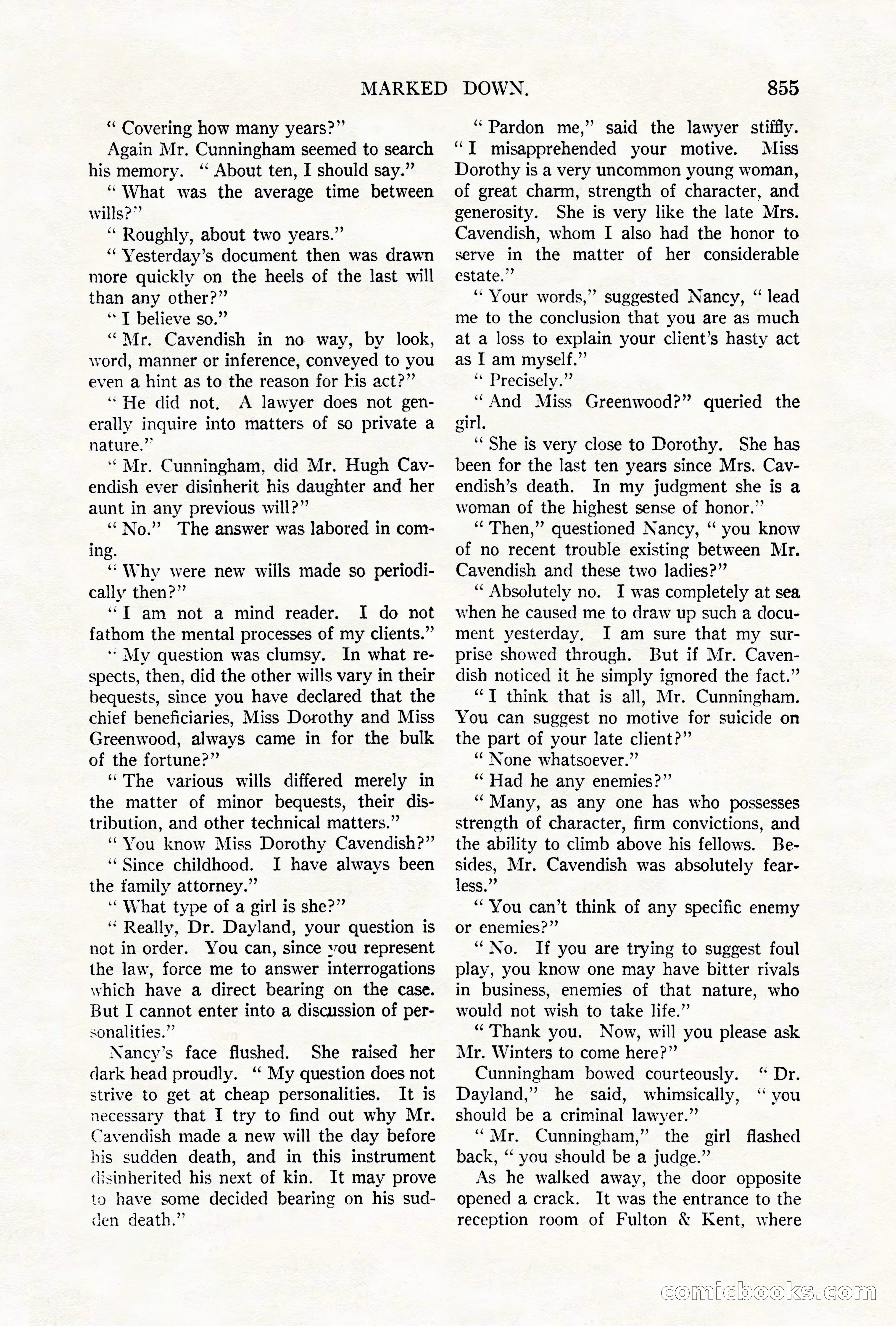
A restored page from Pulp Fiction, 1923. Page through the whole issue in the reader above.
📄 Transcribed text from this page (OCR, searchable)
Machine-transcribed from the original scan — historical spelling and the odd misread are preserved.
MARKED DOWN. “* Covering how many years?” Again Mr. Cunningham seemed to search his memory. ‘‘ About ten, I should say.” “What was the average time between wills?” “ Roughly, about two years.” ‘““Yesterday’s document then was drawn more quickly on the heels of the last will than any other?” ‘‘ T believe so.” “Mr. Cavendish in no way, by look, word, manner or inference, conveyed to you even a hint as to the reason for Fis act?” ‘He did not. A lawyer does not gen- erally inquire into matters of so private a nature.”’ ‘“Mr. Cunningham, did Mr. Hugh Cav- endish ever disinherit his daughter and her aunt in any previous will?” “No.” The answer was labored in com- ing. ‘“Why were new wills made so periodi- cally then?” ‘Tam not a mind reader. I do not fathom the mental processes of my clients.” * Mv question was clumsy. In what re- spects, then, did the other wills vary in their bequests, since you have declared that the chief beneficiaries, Miss Dorothy and Miss Greenwood, always came in for the bulk of the fortune?” “The various wills differed merely in the matter of minor bequests, their dis- tribution, and other technical matters.” “You know Miss Dorothy Cavendish?” ‘Since childhood. I have always been the family attorney.” ‘‘ What type of a girl is she?” “ Really, Dr. Dayland, your question is not in order. You can, since vou represent the law, force me to answer interrogations which have a direct bearing on the case. But I cannot enter into a discussion of per- sonalities.”’ Nancy’s face flushed. She raised her dark head proudly. “‘ My question does not strive to get at cheap personalities. It is necessary that I try to find out why Mr. Cavendish made a new will the day before his sudden death, and in this instrument disinherited his next of kin. It may prove ty have some decided bearing on his sud- den death.” 859 “Pardon me,” said the lawyer stiffly. ‘“I misapprehended your motive. Miss Dorothy is a very uncommon young woman, of great charm, strength of character, and generosity. She is very like the late Mrs. Cavendish, whom I also had the honor to serve in the matter of her considerable estate.” ‘Your words,” suggested Nancy, “ lead me to the conclusion that you are as much at a loss to explain your client’s hasty act as I am myself.” ‘* Precisely.” ‘““And Miss Greenwood?” queried the girl, ‘“ She is very close to Dorothy. She has been for the last ten years since Mrs. Cav- endish’s death. In my judgment she is a woman of the highest sense of honor.” “Then,” questioned Nancy, ‘‘ you know of no recent trouble existing between Mr. Cavendish and these two ladies?” ‘“‘ Absolutely no. I was completely at sea when he caused me to draw up such a docu- ment yesterday. I am sure that my sur- prise showed through. But if Mr. Caven- dish noticed it he simply ignored the fact.” “T think that is all, Mr. Cunningham. You can suggest no motive for suicide on the part of your late client?” ‘¢ None whatsoever.” ‘“‘ Had he any enemies?” ‘Many, as any one has who possesses strength of character, firm convictions, and the ability to climb above his fellows. Be- sides, Mr. Cavendish was absolutely fear- less.” “You can’t think of any specific enemy or enemies?” ‘““No. If you are trying to suggest foul play, you know one may have bitter rivals in business, enemies of that nature, who would not wish to take life.” “Thank you. Now, will you please ask Mr. Winters to come here?” Cunningham bowed courteously. ‘“ Dr. Dayland,” he said, whimsically, ‘“ you should be a criminal lawyer.” “Mr. Cunningham,” the girl flashed back, ‘ you should be a judge.” As he walked away, the door opposite opened a crack. It was the entrance to the reception room of Fulton & Kent, where COMiIiclooe (©