
Pulp Fiction, 1923 · page 60 of 196
Argosy All-Story Weekly, October 6, 1923 — page 60: what you’re looking at
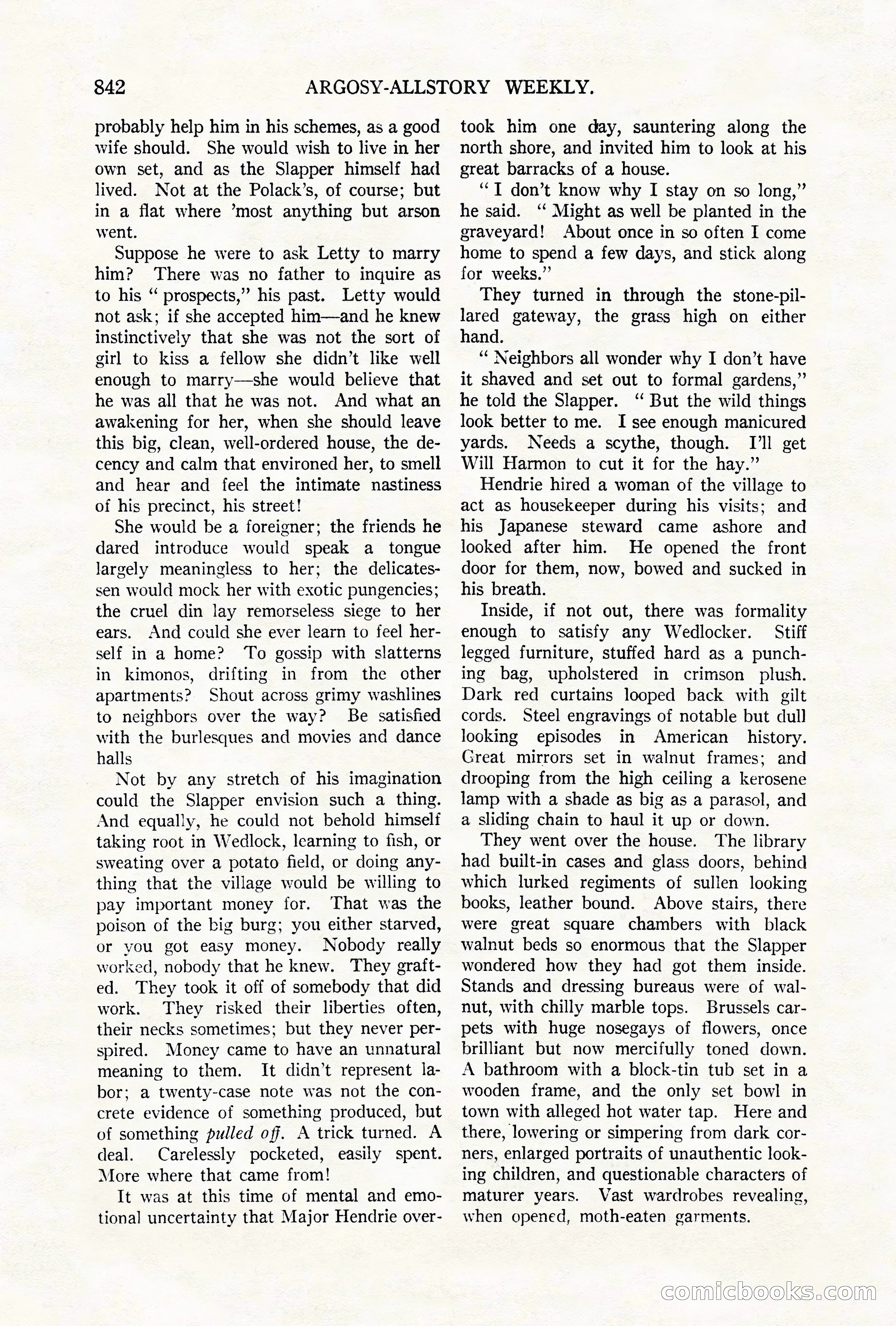
A restored page from Pulp Fiction, 1923. Page through the whole issue in the reader above.
📄 Transcribed text from this page (OCR, searchable)
Machine-transcribed from the original scan — historical spelling and the odd misread are preserved.
842 probably help him in his schemes, as a good wife should. She would wish to live in her own set, and as the Slapper himself had lived. Not at the Polack’s, of course; but in a flat where ’most anything but arson went. Suppose he were to ask Letty to marry him? There was no father to inquire as to his ‘‘ prospects,” his past. Letty would not ask; if she accepted him—and he knew instinctively that she was not the sort of girl to kiss a fellow she didn’t like well enough to marry—she would believe that he was all that he was not. And what an awakening for her, when she should leave this big, clean, well-ordered house, the de- cency and calm that environed her, to smell and hear and feel the intimate nastiness of his precinct, his street! She would be a foreigner; the friends he dared introduce would speak a_ tongue largely meaningless to her; the delicates- sen would mock her with exotic pungencies; the cruel din lay remorseless siege to her ears. And could she ever learn to feel her- self in a home? To gossip with slatterns in kimonos, drifting in from the other apartments? Shout across grimy washlines to neighbors over the way? Be satisfied with the burlesques and movies and dance halls Not by any stretch of his imagination could the Slapper envision such a thing. And equally, he could not behold himself taking root in Wedlock, learning to fish, or sweating over a potato field, or doing any- thing that the village would be willing to pay important money for. That was the poison of the big burg; you either starved, or you got easy money. Nobody really worked, nobody that he knew. They graft- ed. They took it off of somebody that did work. They risked their liberties often, their necks sometimes; but they never per- spired. Money came to have an unnatural meaning to them. It didn’t represent la- bor; a twenty-case note was not the con- crete evidence of something produced, but of something pulled off. A trick turned. A deal. Carelessly pocketed, easily spent. More where that came from! It was at this time of mental and emo- tional uncertainty that Major Hendrie over- ARGOSY-ALLSTORY WEEKLY. took him one day, sauntering along the north shore, and invited him to look at his great barracks of a house. ‘““T don’t know why I stay on so long,” he said. ‘“‘ Might as well be planted in the graveyard! About once in so often I come home to spend a few days, and stick along for weeks.” They turned in through the stone-pil- lared gateway, the grass high on either hand. ‘“ Neighbors all wonder why I don’t have it shaved and set out to formal gardens,” he told the Slapper. “ But the wild things look better to me. I see enough manicured yards. Needs a scythe, though. I'll get Will Harmon to cut it for the hay.” Hendrie hired a woman of the village to act as housekeeper during his visits; and his Japanese steward came ashore and looked after him. He opened the front door for them, now, bowed and sucked in his breath. Inside, if not out, there was formality enough to satisfy any Wedlocker. Stiff legged furniture, stuffed hard as a punch- ing bag, upholstered in crimson plush. Dark red curtains looped back with gilt cords. Steel engravings of notable but dull looking episodes in American history. Great mirrors set in walnut frames; and drooping from the high ceiling a kerosene lamp with a shade as big as a parasol, and a sliding chain to haul it up or down. They went over the house. The library had built-in cases and glass doors, behind which lurked regiments of sullen looking books, leather bound. Above stairs, there were great square chambers with black walnut beds so enormous that the Slapper wondered how they had got them inside. Stands and dressing bureaus were of wal- nut, with chilly marble tops. Brussels car- pets with huge nosegays of flowers, once brilliant but now mercifully toned down. A bathroom with a block-tin tub set in a wooden frame, and the only set bowl in town with alleged hot water tap. Here and there, lowering or simpering from dark cor- ners, enlarged portraits of unauthentic look- ing children, and questionable characters of maturer years. Vast wardrobes revealing, when opened, moth-eaten garments. COMiIcloOoe (©