
Pulp Fiction, 1923 · page 46 of 196
Argosy All-Story Weekly, October 6, 1923 — page 46: what you’re looking at
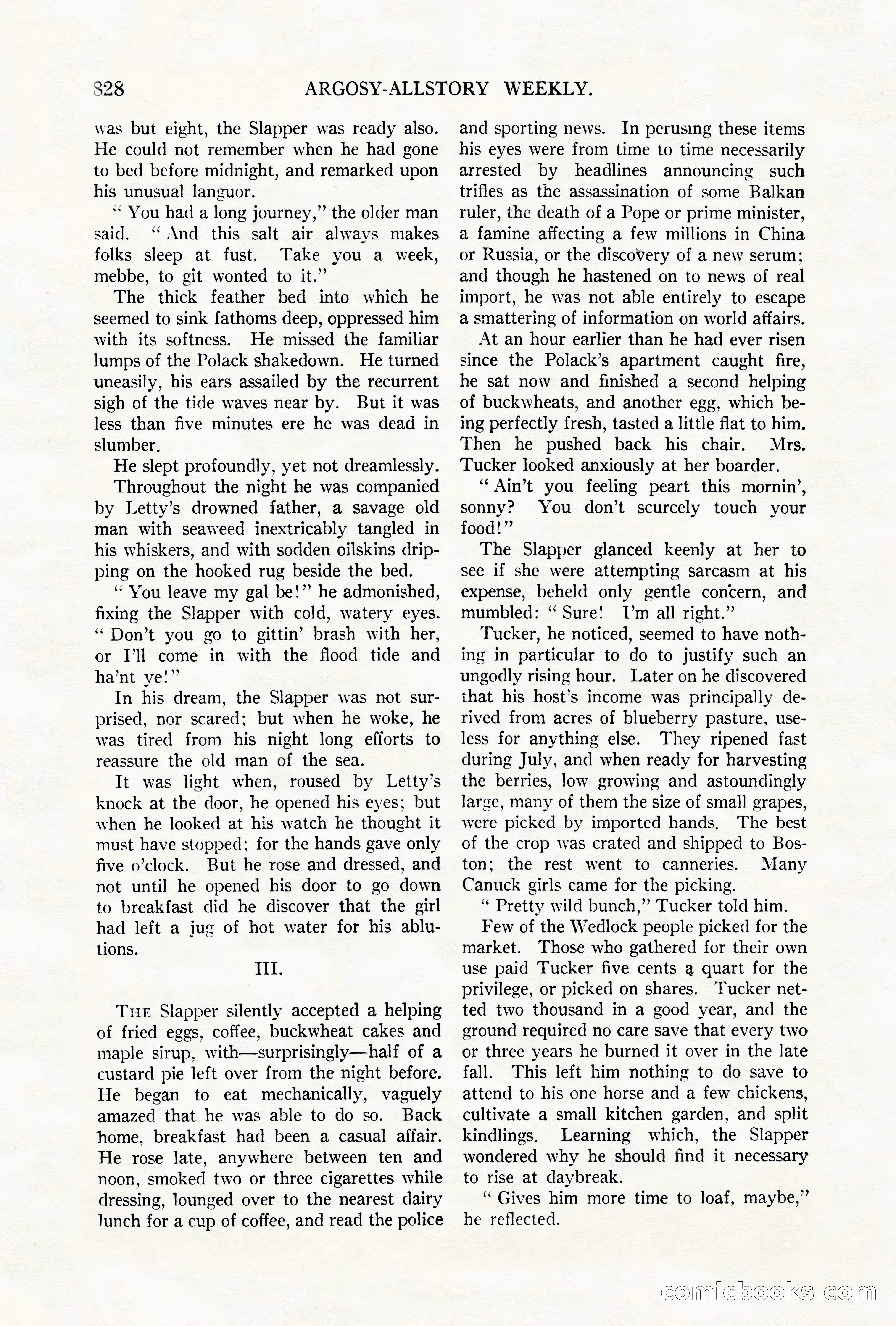
A restored page from Pulp Fiction, 1923. Page through the whole issue in the reader above.
📄 Transcribed text from this page (OCR, searchable)
Machine-transcribed from the original scan — historical spelling and the odd misread are preserved.
828 was but eight, the Slapper was ready also. He could not remember when he had gone to bed before midnight, and remarked upon his unusual languor. ‘You had a long journey,” the older man said. “And this salt air always makes folks sleep at fust. Take you a week, mebbe, to git wonted to it.” The thick feather bed into which he seemed to sink fathoms deep, oppressed him with its softness. He missed the familiar lumps of the Polack shakedown. He turned uneasily, his ears assailed by the recurrent Sigh of the tide waves near by. But it was less than five minutes ere he was dead in slumber, He slept profoundly, yet not dreamlessly. Throughout the night he was companied by Letty’s drowned father, a savage old man with seaweed inextricably tangled in his whiskers, and with sodden oilskins drip- ping on the hooked rug beside the bed. “You leave my gal be!” he admonished, fixing the Slapper with cold, watery eyes. “Don’t you go to gittin’ brash with her, or I'll come in with the flood tide and ha’nt ye!” In his dream, the Slapper was not sur- prised, nor scared; but when he woke, he was tired from his night long efforts to reassure the old man of the sea. It was light when, roused by Letty’s knock at the door, he opened his eyes; but when he looked at his watch he thought it must have stopped; for the hands gave only five o’clock. But he rose and dressed, and not until he opened his door to go down to breakfast did he discover that the girl had left a jug of hot water for his ablu- tions. IIf. Tue Slapper silently accepted a helping of fried eggs, coffee, buckwheat cakes and maple sirup, with—surprisingly—half of a custard pie left over from the night before. He began to eat mechanically, vaguely amazed that he was able to do so. Back home, breakfast had been a casual affair. He rose late, anywhere between ten and noon, smoked two or three cigarettes while dressing, lounged over to the nearest dairy lunch for a cup of coffee, and read the police ARGOSY-ALLSTORY WEEKLY. and sporting news. In perusing these items his eyes were from time to time necessarily arrested by headlines announcing such trifles as the assassination of some Balkan ruler, the death of a Pope or prime minister, a famine affecting a few millions in China or Russia, or the discovery of a new serum; and though he hastened on to news of real import, he was not able entirely to escape a smattering of information on world affairs. At an hour earlier than he had ever risen since the Polack’s apartment caught fire, he sat now and finished a second helping of buckwheats, and another egg, which be- ing perfectly fresh, tasted a little flat to him. Then he pushed back his chair. Mrs. Tucker looked anxiously at her boarder. ‘“‘ Ain’t you feeling peart this mornin’, sonny? You don’t scurcely touch your food!” The Slapper glanced keenly at her to see if she were attempting sarcasm at his expense, beheld only gentle concern, and mumbled: ‘Sure! I’m all right.” Tucker, he noticed, seemed to have noth- ing in particular to do to justify such an ungodly rising hour. Later on he discovered that his host’s income was principally de- rived from acres of blueberry pasture, use- less for anything else. They ripened fast during July, and when ready for harvesting the berries, low growing and astoundingly large, many of them the size of small grapes, were picked by imported hands. The best of the crop was crated and shipped to Bos- ton; the rest went to canneries. Many Canuck girls came for the picking. ‘Pretty wild bunch,” Tucker told him. Few of the Wedlock people picked for the market. Those who gathered for their own use paid Tucker five cents a quart for the privilege, or picked on shares. Tucker net- ted two thousand in a good year, and the eround required no care save that every two or three years he burned it over in the late fall. This left him nothing to do save to attend to his one horse and a few chickens, cultivate a small kitchen garden, and split kindlings. Learning which, the Slapper wondered why he should find it necessary to rise at daybreak. “ Gives him more time to loaf, maybe,” he reflected. COMmiclboo (©