
Pulp Fiction, 1923 · page 42 of 196
Argosy All-Story Weekly, October 6, 1923 — page 42: what you’re looking at
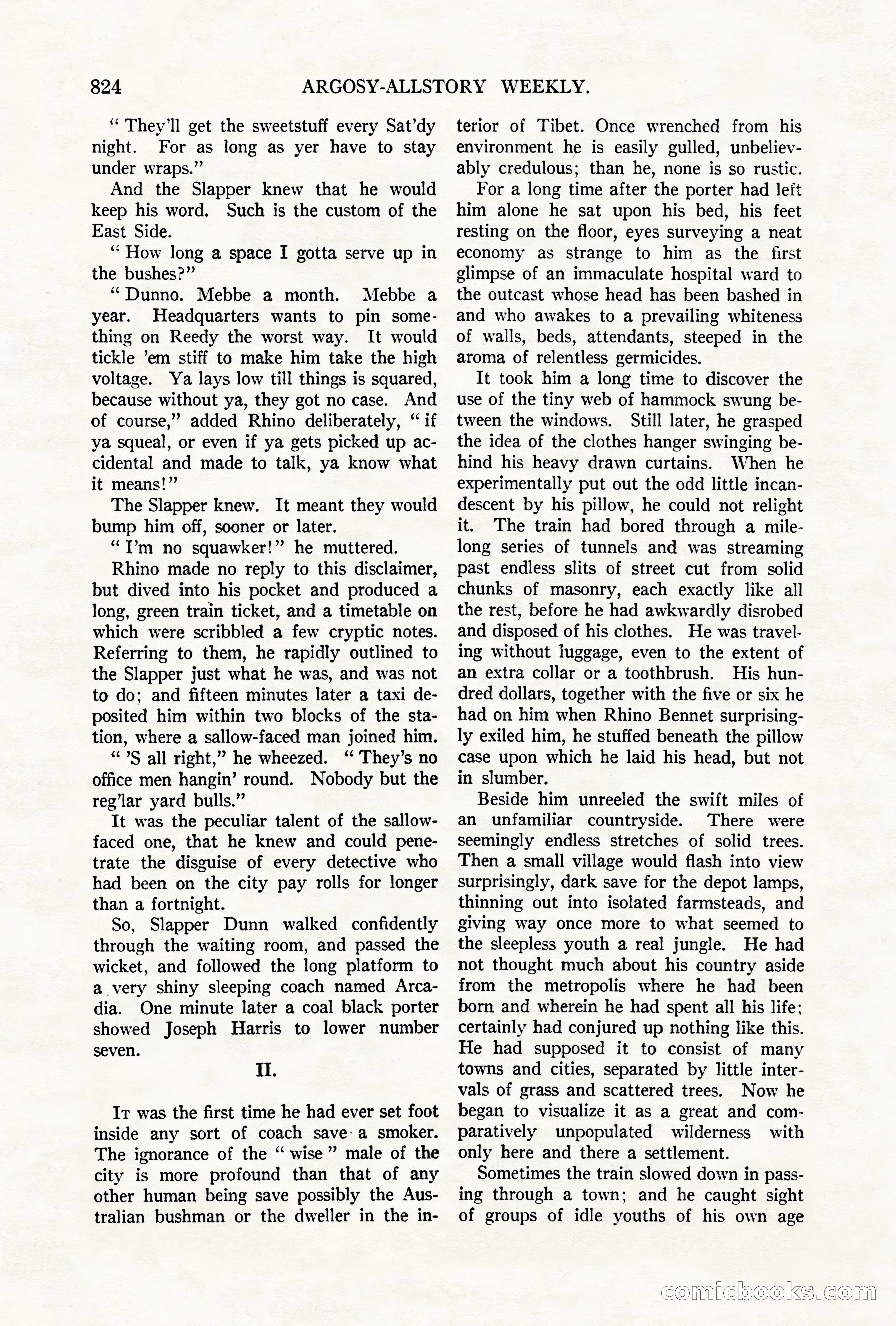
A restored page from Pulp Fiction, 1923. Page through the whole issue in the reader above.
📄 Transcribed text from this page (OCR, searchable)
Machine-transcribed from the original scan — historical spelling and the odd misread are preserved.
824 ‘““ They'll get the sweetstuff every Sat’dy night. For as long as yer have to stay under wraps.” And the Slapper knew that he would keep his word. Such is the custom of the East Side. ‘How long a space I gotta serve up in the bushes?” ‘““Dunno. Mebbe a month. Mebbe a year. Headquarters wants to pin some- thing on Reedy the worst way. It would tickle ’em stiff to make him take the high voltage. Ya lays low till things is squared, because without ya, they got no case. And of course,” added Rhino deliberately, “ if ya squeal, or even if ya gets picked up ac- cidental and made to talk, ya know what it means!” The Slapper knew. It meant they would bump him off, sooner or later. ‘“‘1’m no squawker!” he muttered. Rhino made no reply to this disclaimer, but dived into his pocket and produced a long, green train ticket, and a timetable on which were scribbled a few cryptic notes. Referring to them, he rapidly outlined to the Slapper just what he was, and was not to do; and fifteen minutes later a taxi de- posited him within two blocks of the sta- tion, where a sallow-faced man joined him. “°S all right,” he wheezed. ‘‘ They’s no office men hangin’ round. Nobody but the reg’lar yard bulls.” It was the peculiar talent of the sallow- faced one, that he knew and could pene- trate the disguise of every detective who had been on the city pay rolls for longer than a fortnight. So, Slapper Dunn walked confidently through the waiting room, and passed the wicket, and followed the long platform to a very shiny sleeping coach named Arca- dia. One minute later a coal black porter showed Joseph Harris to lower number seven. II. It was the first time he had ever set foot inside any sort of coach save-a smoker. The ignorance of the “ wise’ male of the city is more profound than that of any other human being save possibly the Aus- tralian bushman or the dweller in the in- ARGOSY-ALLSTORY WEEKLY. terior of Tibet. Once wrenched from his environment he is easily gulled, unbeliev- ably credulous; than he, none is so rustic. For a long time after the porter had leit him alone he sat upon his bed, his feet resting on the floor, eyes surveying a neat economy as strange to him as the first glimpse of an immaculate hospital ward to the outcast whose head has been bashed in and who awakes to a prevailing whiteness of wails, beds, attendants, steeped in the aroma of relentless germicides. It took him a long time to discover the use of the tiny web of hammock swung be- tween the windows. Still later, he grasped the idea of the clothes hanger swinging be- hind his heavy drawn curtains. When he experimentally put out the odd little incan- descent by his pillow, he could not relight it. The train had bored through a mile- long series of tunnels and was streaming past endless slits of street cut from solid chunks of masonry, each exactly like all the rest, before he had awkwardly disrobed and disposed of his clothes. He was travel- ing without luggage, even to the extent of an extra collar or a toothbrush. His hun- dred dollars, together with the five or six he had on him when Rhino Bennet surprising- ly exiled him, he stuffed beneath the pillow case upon which he laid his head, but not in slumber. Beside him unreeled the swift miles of an unfamiliar countryside. There were seemingly endless stretches of solid trees. Then a small village would flash into view surprisingly, dark save for the depot lamps, thinning out into isolated farmsteads, and giving way once more to what seemed to the sleepless youth a real jungle. He had not thought much about his country aside from the metropolis where he had been born and wherein he had spent all his life; certainly had conjured up nothing like this. He had supposed it to consist of many towns and cities, separated by little inter- vals of grass and scattered trees. Now he began to visualize it as a great and com- paratively unpopulated wilderness with only here and there a settlement. Sometimes the train slowed down in pass- ing through a town; and he caught sight of groups of idle youths of his own age COMmiclooe (©