
Pulp Fiction, 1923 · page 40 of 196
Argosy All-Story Weekly, October 6, 1923 — page 40: what you’re looking at
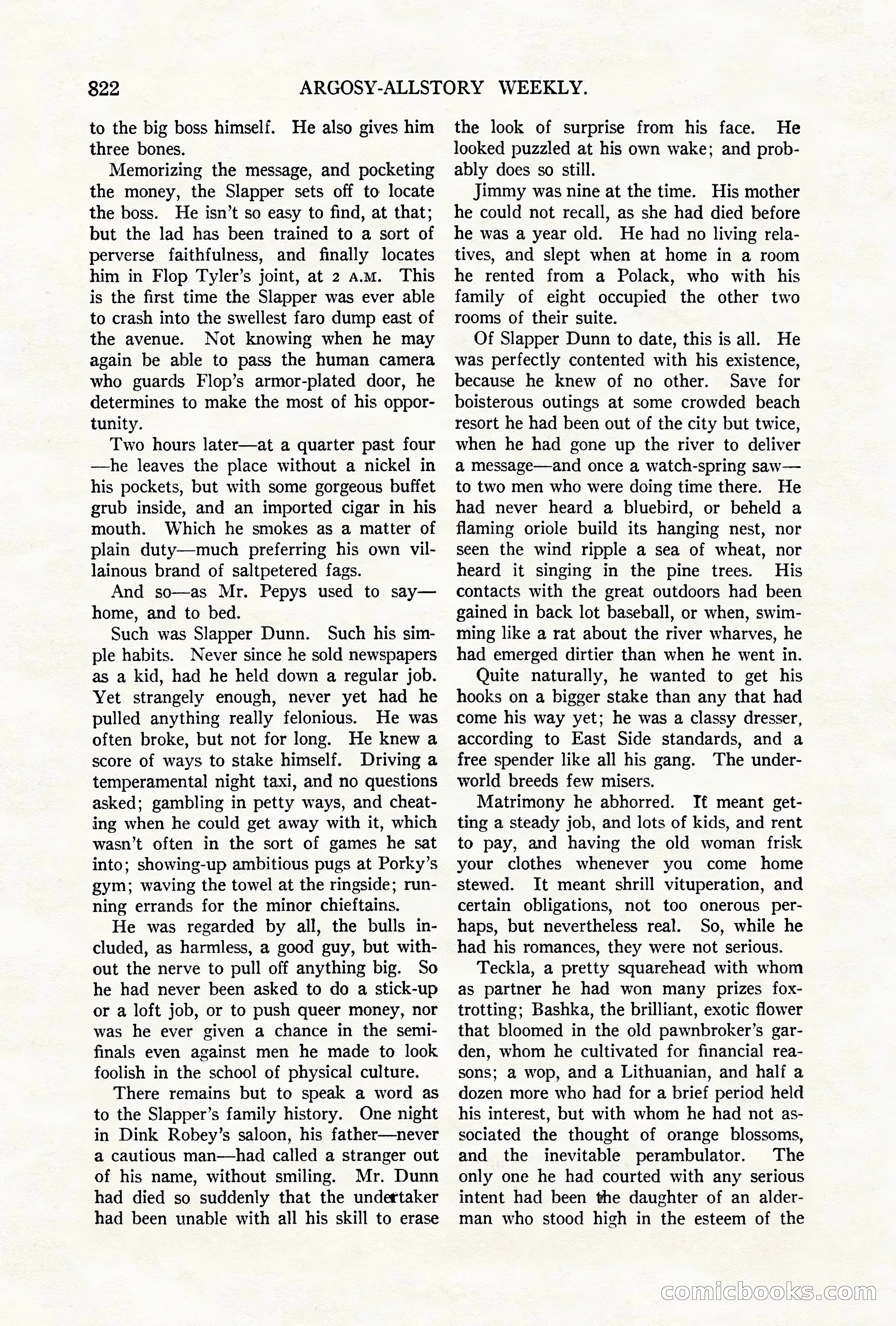
A restored page from Pulp Fiction, 1923. Page through the whole issue in the reader above.
📄 Transcribed text from this page (OCR, searchable)
Machine-transcribed from the original scan — historical spelling and the odd misread are preserved.
$22 to the big boss himself. He also gives him three bones. Memorizing the message, and pocketing the money, the Slapper sets off to locate the boss. He isn’t so easy to find, at that; but the lad has been trained to a sort of perverse faithfulness, and finally locates him in Flop Tyler’s joint, at 2 a.m. This is the first time the Slapper was ever able to crash into the swellest faro dump east of the avenue. Not knowing when he may again be able to pass the human camera who guards Flop’s armor-plated door, he determines to make the most of his oppor- tunity. Two hours later—at a quarter past four —he leaves the place without a nickel in his pockets, but with some gorgeous buffet grub inside, and an imported cigar in his mouth. Which he smokes as a matter of plain duty—much preferring his own vil- lainous brand of saltpetered fags. And so—as Mr. Pepys used to say— home, and to bed. Such was Slapper Dunn. Such his sim- ple habits. Never since he sold newspapers as a kid, had he held down a regular job. Yet strangely enough, never yet had he pulled anything really felonious. He was often broke, but not for long. He knew a score of ways to stake himself. Driving a temperamental night taxi, and no questions asked; gambling in petty ways, and cheat- ing when he could get away with it, which wasn’t often in the sort of games he sat into; showing-up ambitious pugs at Porky’s gym; waving the towel at the ringside; run- ning errands for the minor chieftains. He was regarded by all, the bulls in- cluded, as harmless, a good guy, but with- out the nerve to pull off anything big. So he had never been asked to do a stick-up or a loft job, or to push queer money, nor was he ever given a chance in the semi- finals even against men he made to look foolish in the school of physical culture. There remains but to speak a word as to the Slapper’s family history. One night in Dink Robey’s saloon, his father—never a cautious man—had called a stranger out of his name, without smiling. Mr. Dunn had died so suddenly that the undertaker had been unable with all his skill to erase ARGOSY-ALLSTORY WEEKLY. the look of surprise from his face. He looked puzzled at his own wake; and prob- ably does so still. Jimmy was nine at the time. His mother he could not recall, as she had died before he was a year old. He had no living rela- tives, and slept when at home in a room he rented from a Polack, who with his family of eight occupied the other two rooms of their suite. Of Slapper Dunn to date, this is all. He was perfectly contented with his existence, because he knew of no other. Save for boisterous outings at some crowded beach resort he had been out of the city but twice, when he had gone up the river to deliver a message—and once a watch-spring saw— to two men who were doing time there. He had never heard a bluebird, or beheld a flaming oriole build its hanging nest, nor seen the wind ripple a sea of wheat, nor heard it singing in the pine trees. His contacts with the great outdoors had been gained in back lot baseball, or when, swim- ming like a rat about the river wharves, he had emerged dirtier than when he went in. Quite naturally, he wanted to get his hooks on a bigger stake than any that had come his way yet; he was a classy dresser, according to East Side standards, and a free spender like all his gang. The under- world breeds few misers. Matrimony he abhorred. If meant get- ting a steady job, and lots of kids, and rent to pay, and having the old woman frisk your clothes whenever you come home stewed. It meant shrill vituperation, and certain obligations, not too onerous per- haps, but nevertheless real. So, while he had his romances, they were not serious. Teckla, a pretty squarehead with whom as partner he had won many prizes fox- trotting; Bashka, the brilliant, exotic flower that bloomed in the old pawnbroker’s gar- den, whom he cultivated for financial rea- sons; a wop, and a Lithuanian, and half a dozen more who had for a brief period held his interest, but with whom he had not as- sociated the thought of orange blossoms, and the inevitable perambulator. The only one he had courted with any serious intent had been the daughter of an alder- man who stood high in the esteem of the EO OO AMUC (©