
Pulp Fiction, 1923 · page 24 of 196
Argosy All-Story Weekly, October 6, 1923 — page 24: what you’re looking at
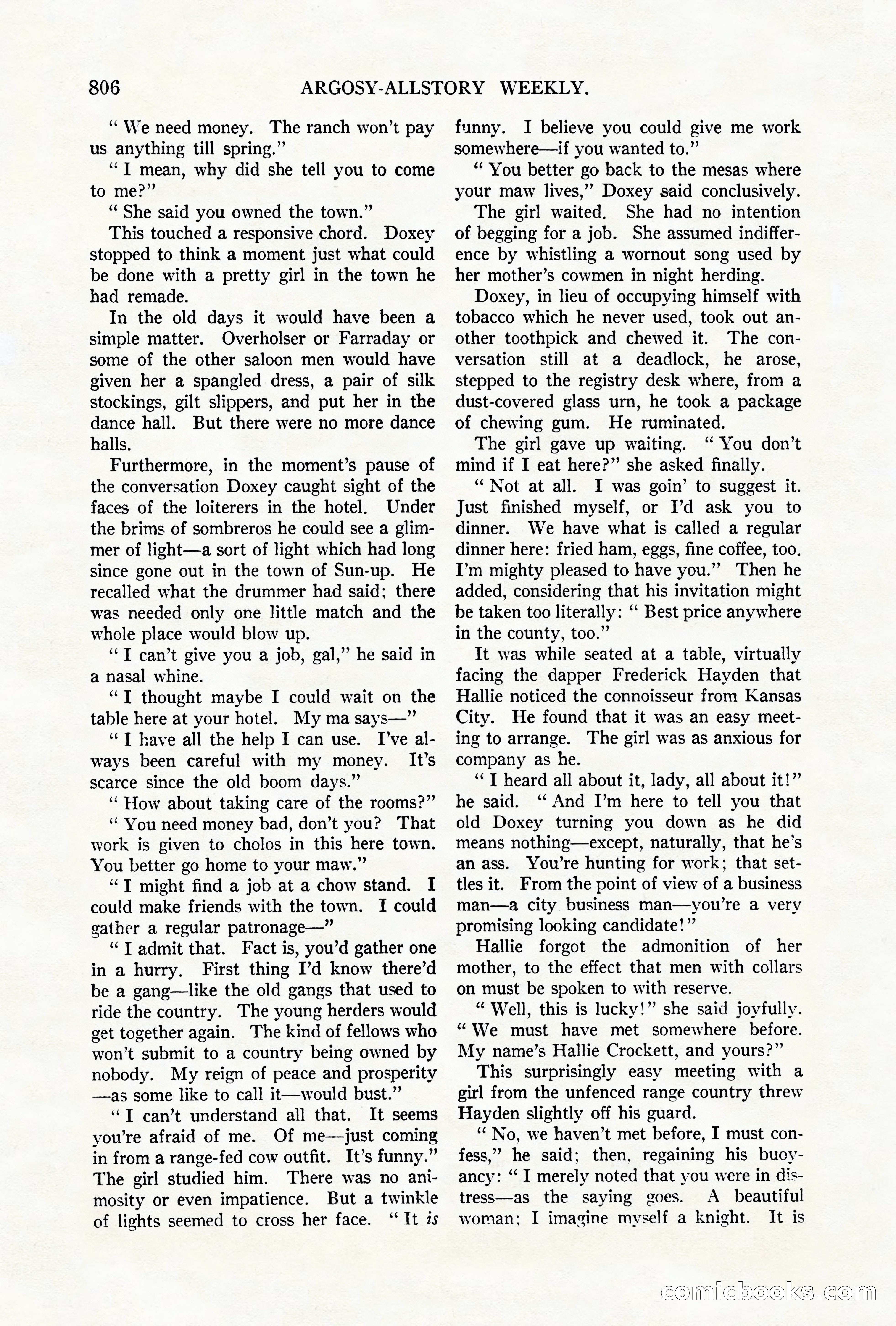
A restored page from Pulp Fiction, 1923. Page through the whole issue in the reader above.
📄 Transcribed text from this page (OCR, searchable)
Machine-transcribed from the original scan — historical spelling and the odd misread are preserved.
806 ‘We need money. The ranch won’t pay us anything till spring.” “IT mean, why did she tell you to come to me?” “‘ She said you owned the town.” This touched a responsive chord. Doxey stopped to think a moment just what could be done with a pretty girl in the town he had remade. In the old days it would have been a simple matter. Overholser or Farraday or some of the other saloon men would have given her a spangled dress, a pair of silk stockings, gilt slippers, and put her in the dance hall. But there were no more dance halls. Furthermore, in the moment’s pause of the conversation Doxey caught sight of the faces of the loiterers in the hotel. Under the brims of sombreros he could see a glim- mer of light—a sort of light which had long since gone out in the town of Sun-up. He recalled what the drummer had said; there was needed only one little match and the whole place would blow up. ‘““T can’t give you a job, gal,” he said in a nasal whine. ‘“T thought maybe I could wait on the table here at your hotel. My ma says—” ‘‘T have all the help I can use. I've al- ways been careful with my money. It’s scarce since the old boom days.” “ How about taking care of the rooms?” “Vou need money bad, don’t you? That work is given to cholos in this here town. You better go home to your maw.” “T might find a job at a chow stand. I could make friends with the town. I could gather a regular patronage—” “T admit that. Fact is, you’d gather one in a hurry. First thing I’d know there’d be a gang—like the old gangs that used to ride the country. The young herders would get together again. The kind of fellows who won’t submit to a country being owned by nobody. My reign of peace and prosperity —as some like to call it—would bust.” “IT can’t understand all that. It seems you're afraid of me. Of me—just coming in from a range-fed cow outfit. It’s funny.” The girl studied him. There was no ani- mosity or even impatience. But a twinkle of lights seemed to cross her face. “It 7s ARGOSY-ALLSTORY WEEKLY. funny. I believe you could give me work somewhere—if you wanted to.” “You better go back to the mesas where your maw lives,” Doxey said conclusively. The girl waited. She had no intention of begging for a job. She assumed indiffer- ence by whistling a wornout song used by her mother’s cowmen in night herding. Doxey, in lieu of occupying himself with tobacco which he never used, took out an- other toothpick and chewed it. The con- versation still at a deadlock, he arose, stepped to the registry desk where, from a dust-covered glass urn, he took a package of chewing gum. He ruminated. The girl gave up waiting. ‘“ You don’t mind if I eat here?” she asked finally. “Not at all. I was goin’ to suggest it. Just finished myself, or I’d ask you to dinner. We have what is called a regular dinner here: fried ham, eggs, fine coffee, too. I’m mighty pleased to have you.”” Then he added, considering that his invitation might be taken too literally: ‘‘ Best price anywhere in the county, too.” It was while seated at a table, virtually facing the dapper Frederick Hayden that Hallie noticed the connoisseur from Kansas City. He found that it was an easy meet- ing to arrange. The girl was as anxious for company as he. ‘“‘T heard all about it, lady, all about it!” he said. ‘‘ And I’m here to tell you that old Doxey turning you down as he did means nothing—except, naturally, that he’s an ass. You’re hunting for work; that set- tles it. From the point of view of a business man—a city business man—you’re a very promising looking candidate!”’ Hallie forgot the admonition of her mother, to the effect that men with collars on must be spoken to with reserve. “ Well, this is lucky!” she said joyfully. “We must have met somewhere before. My name’s Hallie Crockett, and yours?”’ This surprisingly easy meeting with a girl from the unfenced range country threw Hayden slightly off his guard. ‘“‘ No, we haven’t met before, I must con- fess,” he said; then, regaining his buoy- ancy: “‘ I merely noted that vou were in dis- tress—as the saying goes. A_ beautiful woman; I imagine myself a knight. It is COMmiclooe (©