
Pulp Fiction, 1923 · page 129 of 196
Argosy All-Story Weekly, October 6, 1923 — page 129: what you’re looking at
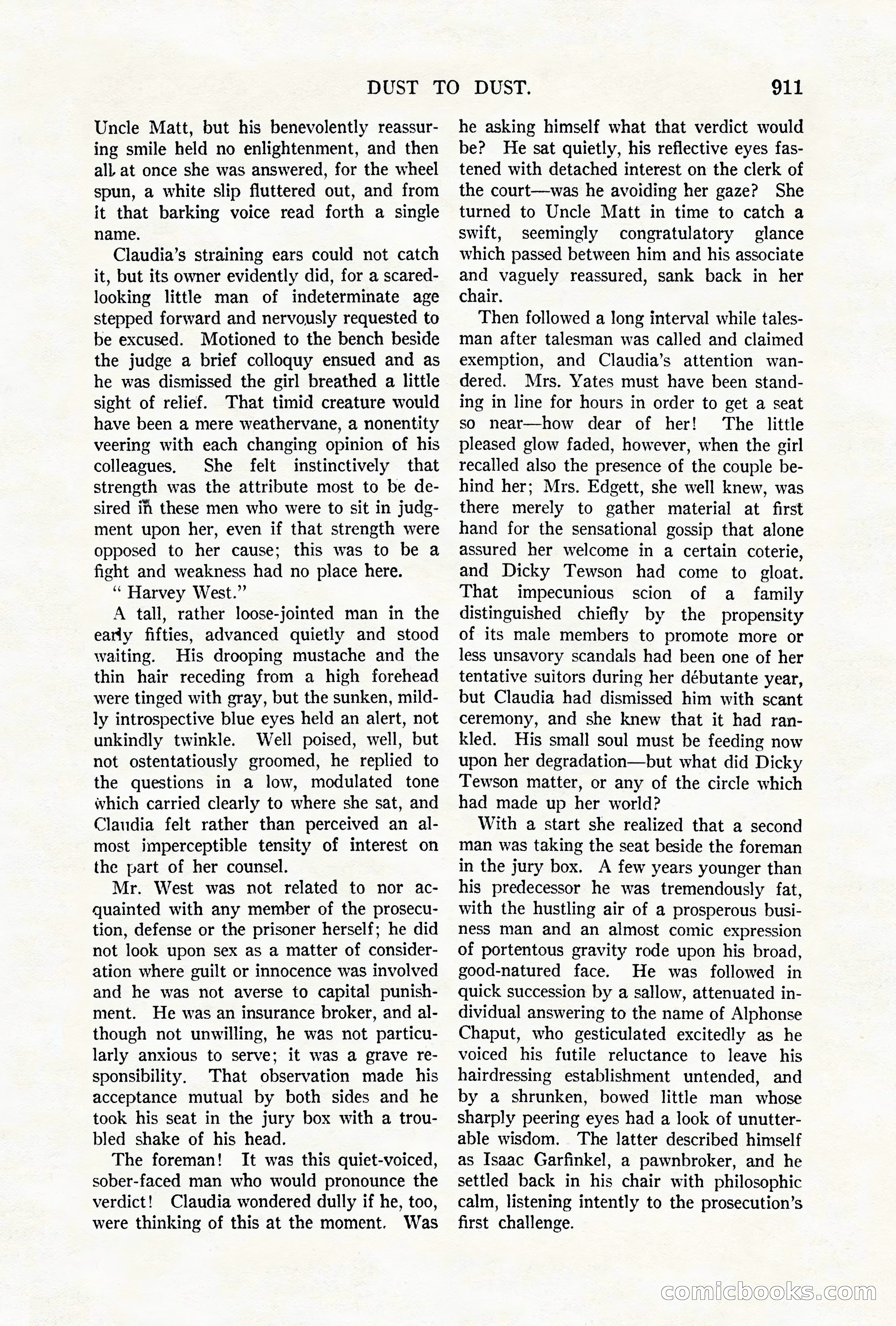
A restored page from Pulp Fiction, 1923. Page through the whole issue in the reader above.
📄 Transcribed text from this page (OCR, searchable)
Machine-transcribed from the original scan — historical spelling and the odd misread are preserved.
DUST TO DUST. Uncle Matt, but his benevolently reassur- ing smile held no enlightenment, and then all at once she was answered, for the wheel spun, a white slip fluttered out, and from it that barking voice read forth a single name. Claudia’s straining ears could not catch it, but its owner evidently did, for a scared- looking little man of indeterminate age stepped forward and nervously requested to be excused. Motioned to the bench beside the judge a brief colloquy ensued and as he was dismissed the girl breathed a little sight of relief. That timid creature would have been a mere weathervane, a nonentity veering with each changing opinion of his colleagues, She felt instinctively that strength was the attribute most to be de- sired in these men who were to sit in judg- ment upon her, even if that strength were opposed to her cause; this was to be a fight and weakness had no place here. ‘Harvey West.” A tall, rather loose-jointed man in the early fifties, advanced quietly and stood waiting. His drooping mustache and the thin hair receding from a high forehead were tinged with gray, but the sunken, mild- ly introspective blue eyes held an alert, not unkindly twinkle. Well poised, well, but not ostentatiously groomed, he replied to the questions in a low, modulated tone which carried clearly to where she sat, and Claudia felt rather than perceived an al- most imperceptible tensity of interest on the part of her counsel. Mr. West was not related to nor ac- quainted with any member of the prosecu- tion, defense or the prisoner herself; he did not look upon sex as a matter of consider- ation where guilt or innocence was involved and he was not averse to capital punish- ment. He was an insurance broker, and al- though not unwilling, he was not particu- larly anxious to serve; it was a grave re- sponsibility. That observation made his acceptance mutual by both sides and he took his seat in the jury box with a trou- bled shake of his head. The foreman! It was this quiet-voiced, sober-faced man who would pronounce the verdict! Claudia wondered dully if he, too, were thinking of this at the moment. Was 911 he asking himself what that verdict would be? He sat quietly, his reflective eyes fas- tened with detached interest on the clerk of the court—was he avoiding her gaze? She turned to Uncle Matt in time to catch a swift, seemingly congratulatory glance which passed between him and his associate and vaguely reassured, sank back in her chair. Then followed a long interval while tales- man after talesman was called and claimed exemption, and Claudia’s attention wan- dered. Mrs. Yates must have been stand- ing in line for hours in order to get a seat so near—how dear of her! The little pleased glow faded, however, when the girl recalled also the presence of the couple be- hind her; Mrs. Edgett, she well knew, was there merely to gather material at first hand for the sensational gossip that alone assured her welcome in a certain coterie, and Dicky Tewson had come to gloat. That impecunious scion of a family distinguished chiefly by the propensity of its male members to promote more or less unsavory scandals had been one of her tentative suitors during her débutante year, but Claudia had dismissed him with scant ceremony, and she knew that it had ran- kled. His small soul must be feeding now upon her degradation—but what did Dicky Tewson matter, or any of the circle which had made up her world? With a start she realized that a second man was taking the seat beside the foreman in the jury box. A few years younger than his predecessor he was tremendously fat, with the hustling air of a prosperous busi- ness man and an almost comic expression of portentous gravity rode upon his broad, good-natured face. He was followed in quick succession by a sallow, attenuated in- dividual answering to the name of Alphonse Chaput, who gesticulated excitedly as he voiced his futile reluctance to leave his hairdressing establishment untended, and by a shrunken, bowed little man whose sharply peering eyes had a look of unutter- able wisdom. The latter described himself as Isaac Garfinkel, a pawnbroker, and he settled back in his chair with philosophic calm, listening intently to the prosecution’s first challenge. COMiIcloOo® (©