
Pulp Fiction, 1923 · page 33 of 184
Argosy All-Story Weekly, January 13, 1923 — page 33: what you’re looking at
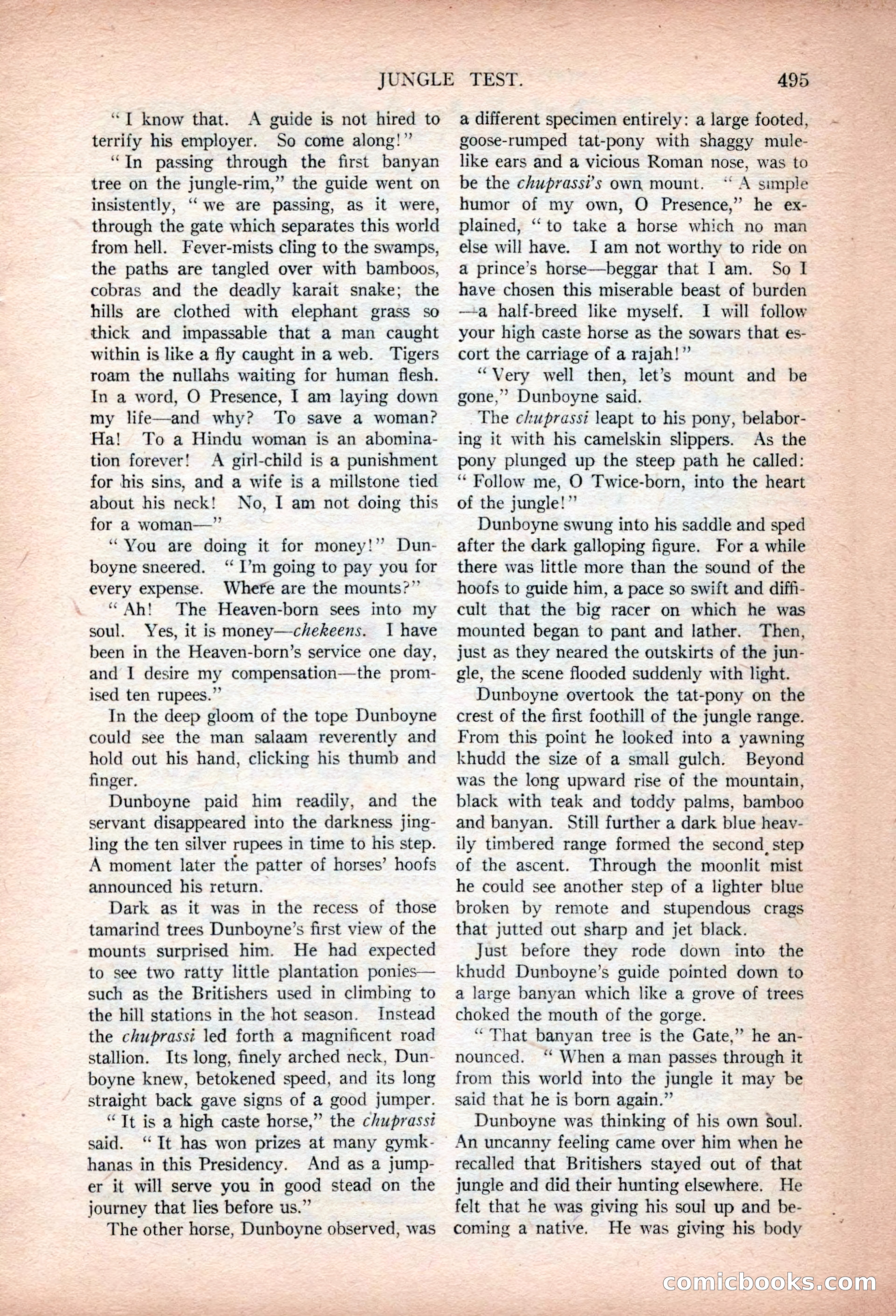
A restored page from Pulp Fiction, 1923. Page through the whole issue in the reader above.
📄 Transcribed text from this page (OCR, searchable)
Machine-transcribed from the original scan — historical spelling and the odd misread are preserved.
JUNGLE TEST. “T know that. <A guide is not hired to terrify his employer. So come along!” “In passing through the first banyan tree on the jungle-rim,” the guide went on insistently, ‘we are passing, as it were, through the gate which separates this world from hell. Fever-mists cling to the swamps, the paths are tangled over with bamboos, cobras and the deadly karait snake; the hills are clothed with elephant grass so thick and impassable that a man caught within is like a fly caught in a web. ‘Tigers roam the nullahs waiting for human flesh. In a word, O Presence, [ am laying down my life—and why? To save a woman? Ha! To a Hindu woman is an abomina- tion forever! A girl-child is a punishment for his sins, and a wife is a millstone tied about his neck! No, I am not doing this for a woman—”’ “You are doing it for money!” Dun- boyne sneered. “I’m going to pay you for every expense. Where are the mounts?” ‘““Ah! The Heaven-born sees into my soul. Yes, it is money—chekeens. I have been in the Heaven-born’s service one day, and I desire my compensation—the prom- ised ten rupees.”’ In the deep gloom of the tope Dunboyne could see the man salaam reverently and hold out his hand, clicking his thumb and finger. Dunboyne paid him readily, and the servant disappeared into the darkness jing- ling the ten silver rupees in time to his step. A moment later the patter of horses’ hoofs announced his return. Dark as it was in the recess of those tamarind trees Dunboyne’s first view of the mounts surprised him. He had expected to see two ratty little plantation ponies— such as the Britishers used in climbing to the hill stations in the hot season. Instead the chuprassi led forth a magnificent road stallion. Its long, finely arched neck, Dun- boyne knew, betokened speed, and its long straight back gave signs of a good jumper. “Tt is a high caste horse,” the chuprasst said. ‘“ It has won prizes at many gymk- hanas in this Presidency. And as a jump- er it will serve you in good stead on the journey that lies before us.”’ The other horse, Dunboyne observed, was - — Rang = . ~~. en en 495 a different specimen entirely: a large footed, goose-rumped tat-pony with shaggy mule- like ears and a vicious Roman nose, was to be the chuprassi’s own mount. “‘ A simple humor of my own, O Presence,” he ex- plained, “to take a horse which no man else will have. Iam not worthy to ride on a prince’s horse—beggar that | am. So I have chosen this miserable beast of burden —a half-breed like myself. I will follow your high caste horse as the sowars that es- cort the carriage of a rajah!”’ “Very well then, let’s mount and be gone,’ Dunboyne said. The chuprassi leapt to his pony, belabor- ing it with his camelskin slippers. As the pony plunged up the steep path he called: ‘“ Follow me, O Twice-born, into the heart of the jungle!” Dunboyne swung into his saddle and sped after the dark galloping figure. For a while there was little more than the sound of the hoofs to guide him, a pace so swift and diffi- cult that the big racer on which he was mounted began to pant and lather. Then, just as they neared the outskirts of the jun- gle, the scene flooded suddenly with light. Dunboyne overtook the tat-pony on the crest of the first foothill of the jungle range. From this point he looked into a yawning khudd the size of a small gulch. Beyond was the long upward rise of the mountain, black with teak and toddy palms, bamboo and banyan. Still further a dark blue heav- ily timbered range formed the second, step of the ascent. Through the moonlit mist he could see another step of a lighter blue broken by remote and stupendous crags that jutted out sharp and jet black. Just before they rode down into the khudd Dunboyne’s guide pointed down to a large banyan which like a grove of trees choked the mouth of the gorge. “That banyan tree is the Gate,” he an- nounced. ‘“* When a man passes through it from this world into the jungle it may be said that he is born again.” Dunboyne was thinking of his own Soul. An uncanny feeling came over him when he recalled that Britishers stayed out of that jungle and did their hunting elsewhere. He felt that he was giving his soul up and be- coming a native. He was giving his body COPMIE OOO KS