
Pulp Fiction, 1923 · page 158 of 184
Argosy All-Story Weekly, January 13, 1923 — page 158: what you’re looking at
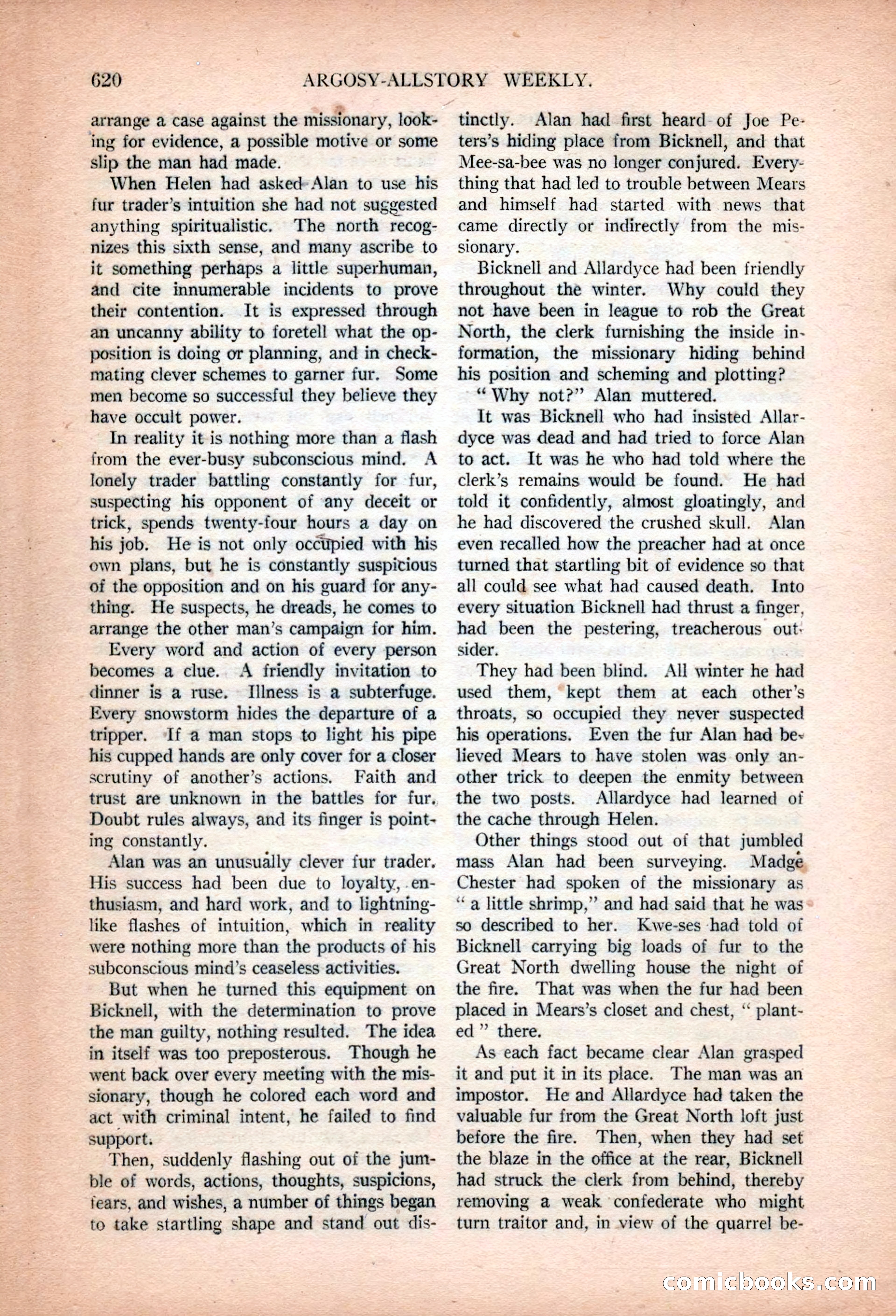
A restored page from Pulp Fiction, 1923. Page through the whole issue in the reader above.
📄 Transcribed text from this page (OCR, searchable)
Machine-transcribed from the original scan — historical spelling and the odd misread are preserved.
620 arrange a case against the missionary, look- ing for evidence, a possible motive or some slip the man had made. When Helen had asked Alan to use his _ fur trader’s intuition she had not suggested anything spiritualistic. The north recog- -nizes this sixth sense, and many ascribe to it something perhaps a little superhuman, and cite innumerable incidents to prove their contention. It is expressed through an uncanny ability to foretell what the op- position is doing or planning, and in check- mating clever schemes to garner fur. Some men become so successful they believe they have occult power. In reality it is nothing more than a flash from the ever-busy subconscious mind. A lonely trader battling constantly for fur, suspecting his opponent of any deceit or trick, spends twenty-four hours a day on his job. He is not only occtipied with his own plans, but he is constantly suspitious of the opposition and on his guard for any- thing. He suspects, he dreads, he comes to arrange the other man’s campaign for him. Every word and action of every person becomes a clue. A friendly invitation to dinner is a ruse. Illness is a subterfuge. Every snowstorm hides the departure of a tripper. If a man stops to light his pipe his cupped hands are only cover for a closer scrutiny of another’s actions. Faith and trust are unknown in the battles for fur. Doubt rules always, and its finger is point- ing constantly. Alan was an unusually clever fur trader, His success had been due to loyalty, .en- thusiasm, and hard work, and to lightning- like flashes of intuition, which in reality were nothing more than the products of his subconscious mind’s ceaseless activities. But when he turned this equipment on Bicknell, with the determination to prove the man guilty, nothing resulted. The idea in itself was too preposterous. Though he went back over every meeting with the mis- sionary, though he colored each word and act with criminal intent, he failed to find support. Then, suddenly flashing out of the jum- ble of words, actions, thoughts, suspicions, fears, and wishes, a number of things began to take startling shape and stand out dis- ARGOSY-ALLSTORY WEEKLY. tinctly. Alan had first heard-of Joe Pe- ters’s hiding place from Bicknell, and that Mee-sa-bee was no longer conjured. Every- thing that had led to trouble between Mears and himself had started with news that came directly or indirectly from the mis- sionary. Bicknell and Allardyce had been friendly throughout the winter. Why could they not have been in league to rob the Great North, the clerk furnishing the inside in- formation, the missionary hiding behind his position and scheming and plotting? “Why not?” Alan muttered. It was Bicknell who had insisted Allar- dyce was dead and had tried to force Alan to act. It was he who had told where the clerk’s remains would be found. He had told it confidently, almost gloatingly, and he had discovered the crushed skull. Alan even recalled how the preacher had at once turned that startling bit of evidence so that all could see what had caused death. Into every situation Bicknell had thrust a finger, had been the pestering, treacherous out: sider. They had been blind. All winter he had used them, kept them at each other’s throats, so occupied they never suspected his operations. Even the fur Alan had be-~ lieved Mears to have stolen was only an- other trick to deepen the enmity between the two posts. Allardyce had learned of the cache through Helen. Other things stood out of that jumbled mass Alan had been surveying. Chester had spoken of the missionary as “a little shrimp,” and had said that he was: so described to her. Kwe-ses had told of Bicknell carrying big loads of fur to the Great North dwelling house the night of the fire. That was when the fur had been placed in Mears’s closet and chest, “ plant- ed ” there. As each fact became clear Alan grasped it and put it in its place. The man was an impostor. He and Allardyce had taken the valuable fur from the Great North loft just before the fire. Then, when they had set the blaze in the office at the rear, Bicknell had struck the clerk from behind, thereby removing a weak confederate who might turn traitor and, in view of the quarrel be- COPMICOOOKS Madge (EC)