
Pulp Fiction, 1923 · page 132 of 184
Argosy All-Story Weekly, January 13, 1923 — page 132: what you’re looking at
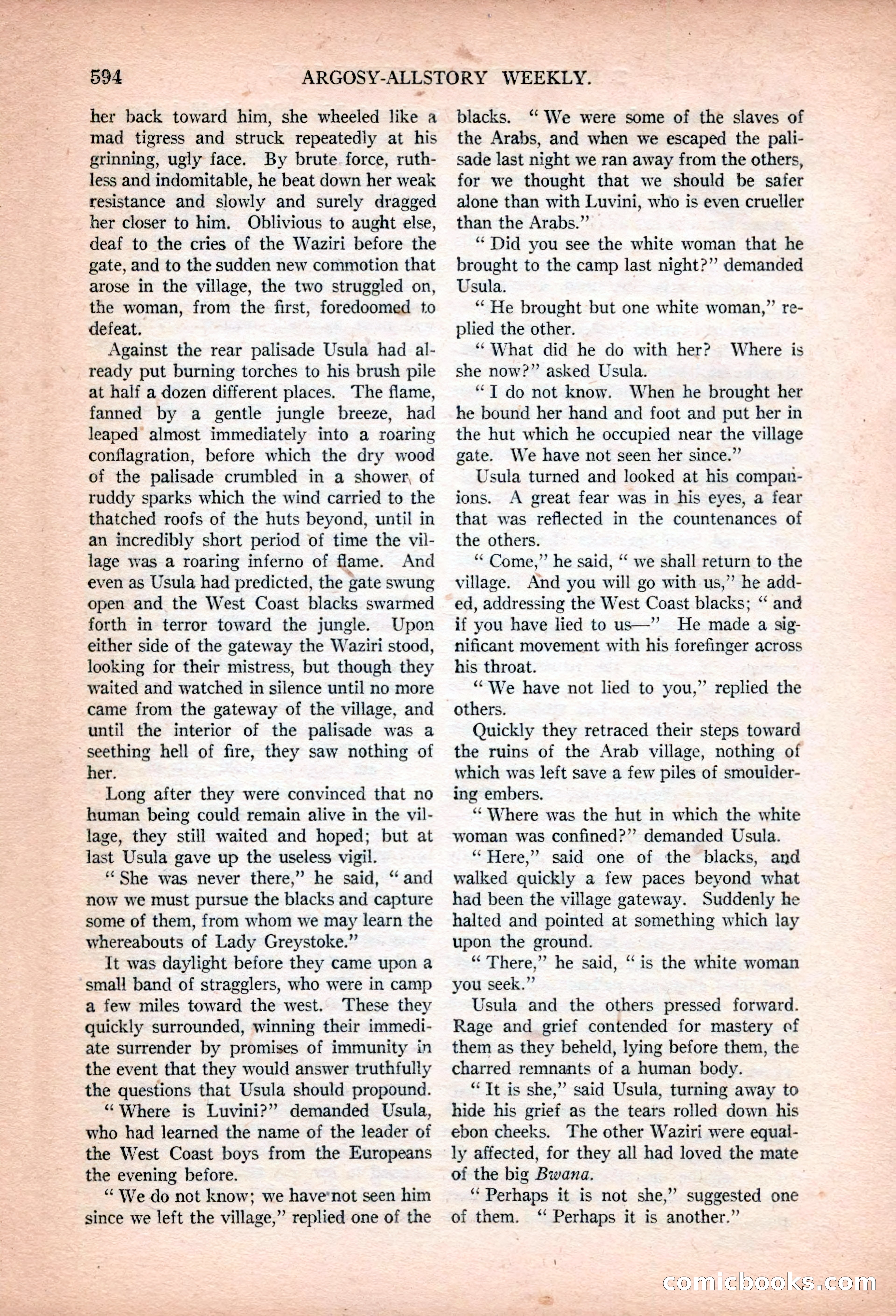
A restored page from Pulp Fiction, 1923. Page through the whole issue in the reader above.
📄 Transcribed text from this page (OCR, searchable)
Machine-transcribed from the original scan — historical spelling and the odd misread are preserved.
—— 594 her back toward him, she wheeled like a mad tigress and struck repeatedly at his grinning, ugly face. By brute force, ruth- less and indomitable, he beat down her weak resistance and slowly and surely dragged her closer to him. Oblivious to aught else, deaf to the cries of the Waziri before the gate, and to the sudden new commotion that arose in the village, the two struggled on, the woman, from the first, foredoomed to defeat. Against the rear palisade Usula had al- ready put burning torches to his brush pile at half a dozen different places. The flame, fanned by a gentle jungle breeze, had leaped almost immediately into a roaring conflagration, before which the dry wood of the palisade crumbled in a shower, of ruddy sparks which the wind carried to the thatched roofs of the huts beyond, until in an incredibly short period of time the vil- lage was a roaring inferno of flame. And even as Usula had predicted, the gate swung open and the West Coast blacks swarmed forth in terror toward the jungle. Upon either side of the gateway the Waziri stood, looking for their mistress, but though they waited and watched in silence until no more came from the gateway of the village, and until the interior of the palisade was a seething hell of fire, they saw nothing of her. Long after they were convinced that no human being could remain alive in the vil- lage, they still waited and hoped; but at last Usula gave up the useless vigil. ‘She was never there,” he said, “ and now we must pursue the blacks and capture some of them, from whom we may learn the whereabouts of Lady Greystoke.” It was daylight before they came upon a small band of stragglers, who were in camp a few miles toward the west. ‘These they quickly surrounded, winning their immedi- ate surrender by promises of immunity in the event that they would answer truthfully the questions that Usula should propound. “Where is Luvini?” demanded Usula, who had learned the name of the leader of the West Coast boys from the Europeans the evening before. “ We do not know; we have'not seen him since we left the village,” replied one of the ARGOSY-ALLSTORY WEEKLY. blacks. ‘‘ We were some of the slaves of the Arabs, and when we escaped the pali- sade last night we ran away from the others, for we thought that we should be safer alone than with Luvini, who is even crueller than the Arabs.” “Did you see the white woman that he brought to the camp last night?” demanded Usula. “He brought but one white woman,” re- plied the other. “What did he do with her? she now?” asked Usula. ‘“T do not know. When he brought her he bound her hand and foot and put her in the hut which he occupied near the village gate. We have not seen her since.” Usula turned and looked at his compan- ions. A great fear was in his eyes, a fear that was reflected in the countenances of the others. *““ Come,” he said, “‘ we shall return to the village. And you will go with us,” he add- ed, addressing the West Coast blacks; “ and if you have lied to us—”’ He made a sig- nificant movement with his forefinger across his throat. “We have not lied to you,” replied the others. Quickly they retraced their steps toward the ruins of the Arab village, nothing of which was left save a few piles of smoulder- ing embers. “Where was the hut in which the white woman was confined?” demanded Usula. “ Here,” said one of the blacks, and walked quickly a few paces beyond what had been the village gateway. Suddenly he halted and pointed at something which lay upon the ground. “There,” he said, “is the white woman you seek.” Usula and the others pressed forward. Rage and grief contended for mastery of them as they beheld, lying before them, the charred remnants of a human body. “It is she,” said Usula, turning away to hide his grief as the tears rolled down his ebon cheeks. The other Waziri were equal- ly affected, for they all had loved the mate of the big Bwana. “Perhaps it is not she,” suggested one of them. ‘ Perhaps it is another.” Where is CORMICLOOOKS COLA