
Pulp Fiction, 1922 · page 64 of 176
Argosy All-Story Weekly, December 2, 1922 — page 64: what you’re looking at
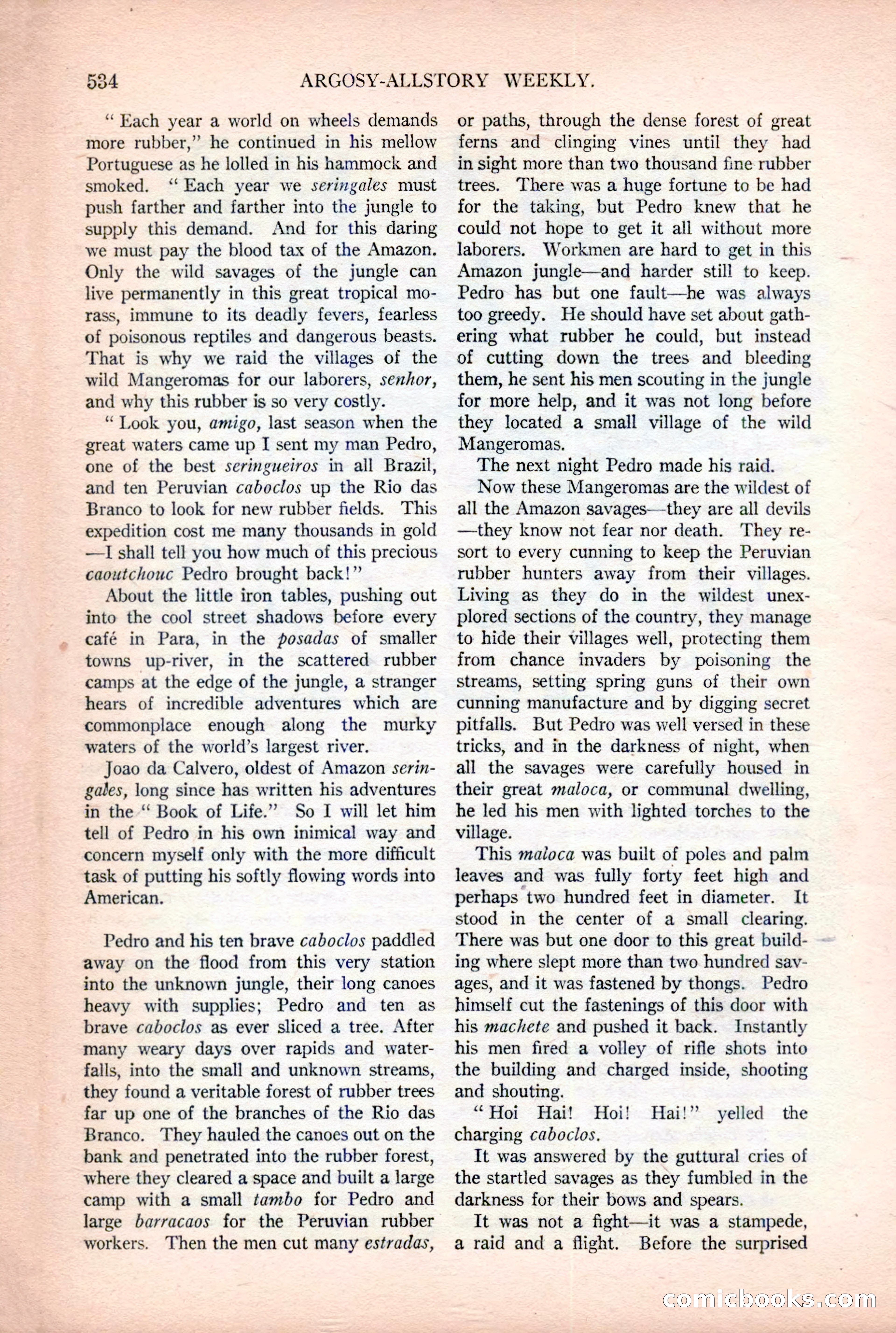
A restored page from Pulp Fiction, 1922. Page through the whole issue in the reader above.
📄 Transcribed text from this page (OCR, searchable)
Machine-transcribed from the original scan — historical spelling and the odd misread are preserved.
504 “Each year a world on wheels demands more rubber,” he continued in his mellow Portuguese as he lolled in his hammock and smoked. ‘“‘ Each year we seringales must push farther and farther into the jungle to supply this demand. And for this daring we must pay the blood tax of the Amazon. Only the wild savages of the jungle can live permanently in this great tropical mo- rass, immune to its deadly fevers, fearless of poisonous reptiles and dangerous beasts. That is why we raid the villages of the wild Mangeromas for our laborers, sezhor, and why this rubber is so very costly. “Look you, amigo, last season when the great waters came up I sent my man Pedro, one of the best seringueiros in all Brazil, and ten Peruvian caboclos up the Rio das Branco to look for new rubber fields. This expedition cost me many thousands in gold —I shall tell you how much of this precious caoutchouc Pedro brought back!” About the little iron tables, pushing out into the cool street shadows before every café in Para, in the posadas of smaller towns up-river, in the scattered rubber camps at the edge of the jungle, a stranger hears of incredible adventures which are commonplace enough along the murky waters of the world’s largest river. Joao da Calvero, oldest of Amazon serin- gales, long since has written his adventures in the “ Book of Life.” So I will let him tell of Pedro in his own inimical way and concern myself only with the more difficult task of putting his softly flowing words into American. Pedro and his ten brave caboclos paddled away on the flood from this very station into the unknown jungle, their long canoes heavy with supplies; Pedro and ten as brave caboclos as ever sliced a tree. After many weary days over rapids and water- falls, into the small and unknown streams, they found a veritable forest of rubber trees far up one of the branches of the Rio das Branco. They hauled the canoes out on the bank and penetrated into the rubber forest, where they cleared a space and built a large camp with a small tambo for Pedro and large barracaos for the Peruvian rubber workers. Then the men cut many estradas, ARGOSY-ALLSTORY WEEKLY. or paths, through the dense forest of great ferns and clinging vines until they had in sight more than two thousand fine rubber trees. There was a huge fortune to be had for the taking, but Pedro knew that he could not hope to get it all without more laborers. Workmen are hard to get in this Amazon jungle—and harder still to keep. Pedro has but one fault—he was always too greedy. He should have set about gath- ering what rubber he could, but instead of cutting down the trees and bleeding them, he sent his men scouting in the jungle for more help, and it was not long before they located a small village of the wild Mangeromas. The next night Pedro made his raid. Now these Mangeromas are the wildest of all the Amazon savages—they are all devils —they know not fear nor death. They re- sort to every cunning to keep the Peruvian rubber hunters away from their villages. Living as they do in the wildest unex- plored sections of the country, they manage to hide their villages well, protecting them from chance invaders by poisoning the streams, setting spring guns of their own cunning manufacture and by digging secret pitfalls. But Pedro was well versed in these tricks, and in the darkness of night, when all the savages were carefully housed in their great maloca, or communal dwelling, he led his men with lighted torches to the village. This maloca was built of poles and palm leaves and was fully forty feet high and perhaps two hundred feet in diameter. It stood in the center of a small clearing. There was but one door to this great build- ing where slept more than two hundred sav- ages, and it was fastened by thongs. Pedro himself cut the fastenings of this door with his machete and pushed it back. Instantly his men fired a volley of rifle shots into the building and charged inside, shooting and shouting. “Hoi Hai! Hoi! charging caboclos. It was answered by the guttural cries of the startled savages as they fumbled in the darkness for their bows and spears. It was not a fight—it was a stampede, a raid and a flight. Before the surprised Hai!” yelled the Gomichbooksrcom