
Pulp Fiction, 1922 · page 96 of 176
Argosy All-Story Weekly, Vol. 146 No. 4 — page 96: what you’re looking at
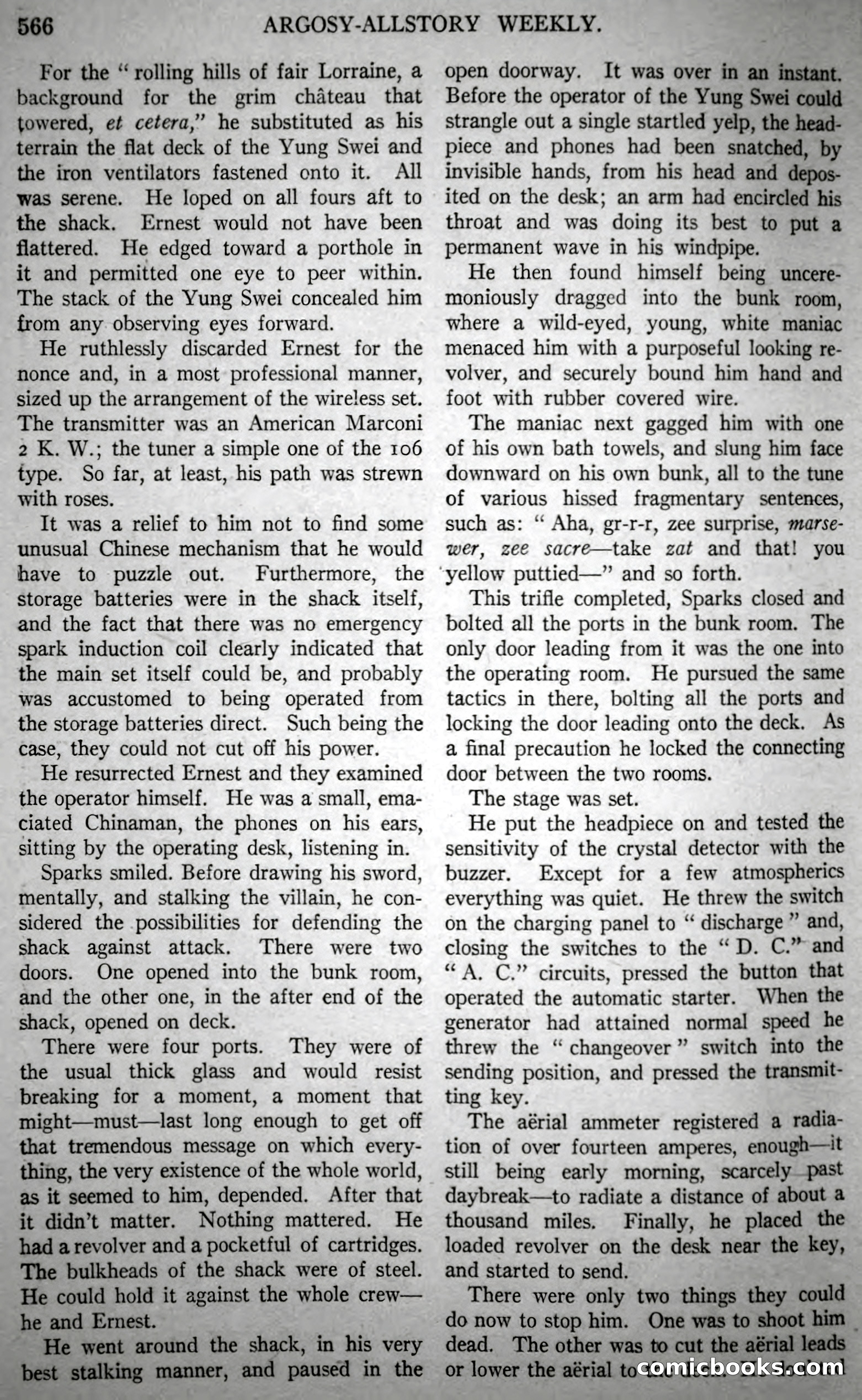
A restored page from Pulp Fiction, 1922. Page through the whole issue in the reader above.
📄 Transcribed text from this page (OCR, searchable)
Machine-transcribed from the original scan — historical spelling and the odd misread are preserved.
>: 566 For the “ rolling hills of fair Lorraine, a background for the grim chateau that towered, et cetera,” he substituted as his terrain the flat deck of the Yung Swei and the iron ventilators fastened onto it. All was serene. He loped on all fours aft to the shack. Ernest would not have been flattered. He edged toward a porthole in it and permitted one eye to peer within. The stack of the Yung Swei concealed him from any observing eyes forward. He ruthlessly discarded Ernest for the nonce and, in a most professional manner, sized up the arrangement of the wireless set. The transmitter was an American Marconi 2 K. W.; the tuner a simple one of the 106 type. So far, at least, his path was strewn with roses. It was a relief to him not to find some unusual Chinese mechanism that he would have to puzzle out. Furthermore, the storage batteries were in the shack itself, and the fact that there was no emergency spark induction coil clearly indicated that the main set itself could be, and probably was accustomed to being operated from the storage batteries direct. Such being the case, they could not cut off his power. He resurrected Ernest and they examined the operator himself. He was a small, ema- ciated Chinaman, the phones on his ears, sitting by the operating desk, listening in. Sparks smiled. Before drawing his sword, mentally, and stalking the villain, he con- sidered the possibilities for defending the shack against attack. There were two doors. One opened into the bunk room, and the other one, in the after end of the shack, opened on deck. There were four ports. They were of the usual thick glass and would resist breaking for a moment, a moment that might—must—last long enough to get off that tremendous message on which every- thing, the very existence of the whole world, as it seemed to him, depended. After that it didn’t matter. Nothing mattered. He had arevolver and a pocketful of cartridges. The bulkheads of the shack were of steel. Be. could hold it against the whole crew— ARGOSY-ALLSTORY WEEKLY. do now to stop him. One was to open doorway. It was over in an instant, Before the operator of the Yung Swei could strangle out a single startled yelp, the head- piece and phones had been invisible hands, from his head and d ited on the desk: an arm had encircled his throat and was doing its best to put a permanent wave in his windpipe. He then found himself being uncere- moniously dragged into the bunk room, where a wild-eyed, young, white maniac menaced him with a purposeful looking re- volver, and securely bound him hand and foot with rubber covered wire. The maniac next gagged him with one of his own bath towels, and slung him face downward on his own bunk, all to the tune of various hissed fragmentary sentences, such as: “ Aha, gr-r-r, zee surprise, marse- wer, zee sacre—take zat and that! you ‘yellow puttied—” and so forth. This trifle completed, Sparks closed and bolted all the ports in the bunk room. The only door leading from it was the one into the operating room. He pursued the same tactics in there, bolting all the ports and locking the door leading onto the deck. As a final precaution he locked the connecting door between the two rooms. The stage was set. He put the headpiece on and tested the sensitivity of the crystal detector with the buzzer. Except for a few atmospherics everything was quiet. He threw the switch on the charging panel to “ discharge ” and, closing the switches to the “ D. C.” and “A, C.” circuits, pressed the button that operated the automatic starter. When the generator had attained normal speed he threw the “ changeover” switch into the sending position, and pressed the transmit- ting key. The aérial ammeter registered a radia- tion of over fourteen amperes, enough—it still being early morning, scarcely past daybreak—to radiate a distance of about a thousand miles. Finally, he placed the loaded revolver on the desk near the key, and started to send. There were only two things they ora dead. The other — tos snie or E lower: cfm ts we U Ici