
Pulp Fiction, 1922 · page 81 of 176
Argosy All-Story Weekly, Vol. 146 No. 4 — page 81: what you’re looking at
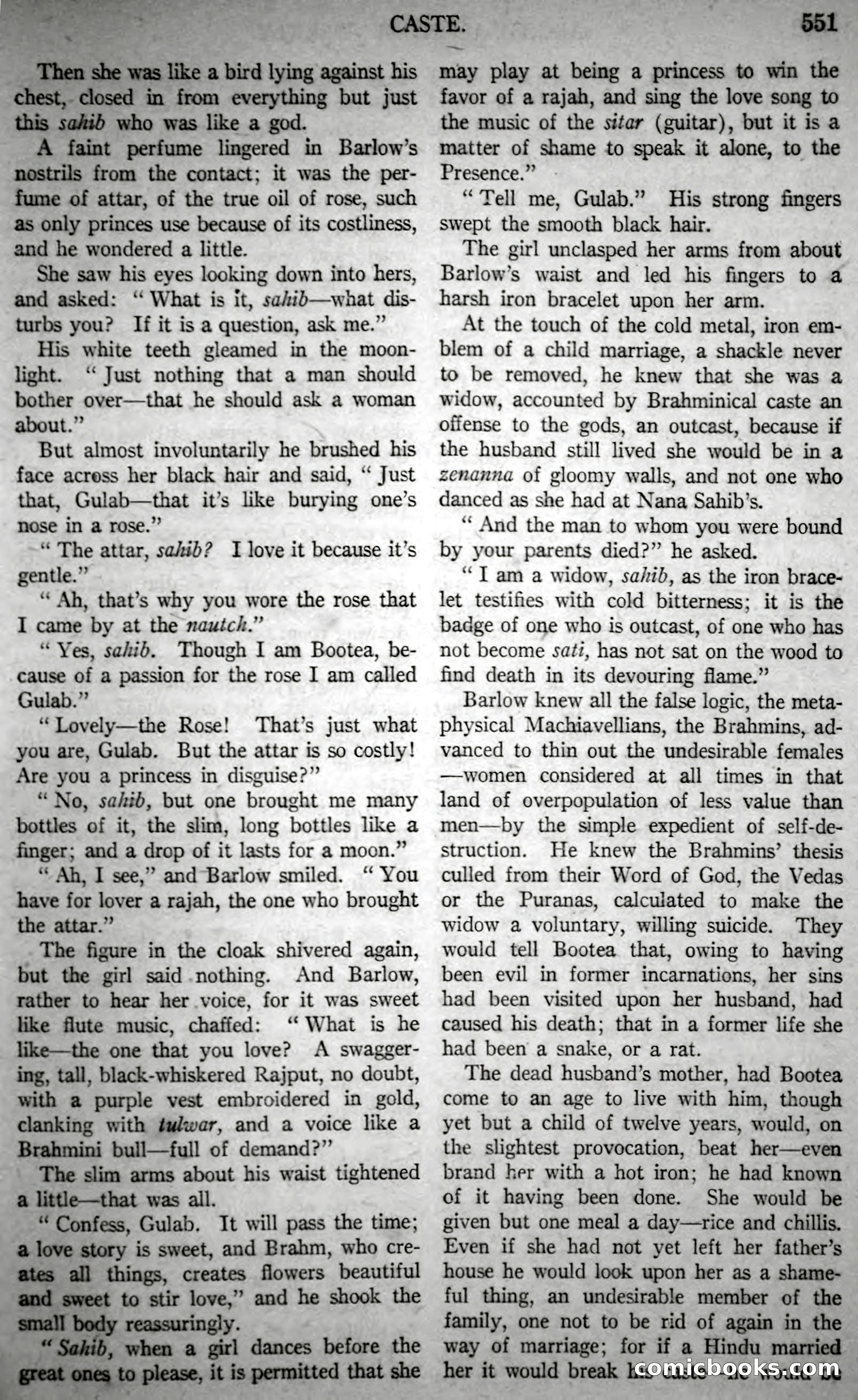
A restored page from Pulp Fiction, 1922. Page through the whole issue in the reader above.
📄 Transcribed text from this page (OCR, searchable)
Machine-transcribed from the original scan — historical spelling and the odd misread are preserved.
% faint perfume lingered in Barlow’s nostrils from the contact; it was the per- fume of attar, of the true oil of rose, such as only princes use because of its costliness, and he wondered a little. She saw his eyes looking down into hers, and asked: ‘“ What is it, sakib—what dis- turbs you? If it is a question, ask me.” His white teeth gleamed in the moon- light. “Just nothing that a man should bother over—that he should ask a woman about.” But almost involuntarily he brushed his face acress her black hair and said, “ Just that, Gulab—that it’s like burying one’s nose in a rose.” “ The attar, sazib? I love it because it’s gentle.” “ Ah, that’s why you wore the rose that I came by at the mautch.” “Yes, sakib. Though I am Bootea, be- cause of a passion for the rose I am called Gulab.” “Lovely—the Rose! That’s just what you are, Gulab. But the attar is so costly! Are you a princess in disguise?” “No, sahib, but one brought me many bottles of it, the slim, long bottles like a finger; and a drop of it lasts for a moon.” “Ah, I see,” and Barlow smiled. “ You have for lover a rajah, the one who brought the attar.” The figure in the cloak shivered again, but the girl said nothing. And Barlow, rather to hear her voice, for it was sweet like flute music, chaffed: ‘“ What is he like—the one that you love? A swagger- ing, tall, black-whiskered Rajput, no doubt, with a purple vest embroidered in gold, clanking with #wlwar, and a voice like a Brahmini bull—full of demand?”’ The slim arms about his waist tightened a little—that was all. _ “Confess, Gulab, It will pass the time; ough is sweet, and Brahm, who cre- ‘ates all things, creates flowers beautiful and sweet to stir love,” and he shook the 551 r. may play at being a princess to win the favor of a rajah, and sing the love song to the music of the sitar (guitar), but it is a matter of shame to speak it alone, to the Presence.” - “Tell me, Gulab.” His strong fingers swept the smooth black hair. The girl unclasped her arms from about Barlow’s waist and led his fingers to a harsh iron bracelet upon her arm. At the touch of the cold metal, iron em- blem of a child marriage, a shackle never to be removed, he knew that she was a widow, accounted by Brahminical caste an offense to the gods, an outcast, because if the husband still lived she would be in a zenanna of gloomy walls, and not one who danced as she had at Nana Sahib’s. ‘“‘ And the man to whom you were bound by your parents died?” he asked. ‘““T am a widow, sahib, as the iron brace- let testifies with cold bitterness; it is the badge of one who is outcast, of one who has not become sazi, has not sat on the wood to find death in its devouring flame.” Barlow knew all the false logic, the meta- physical Machiavellians, the Brahmins, ad- vanced to thin out the undesirable females —women considered at all times in that land of overpopulation of less value than men—by the simple expedient of self-de- struction. He knew the Brahmins’ thesis culled from their Word of God, the Vedas or the Puranas, calculated to make the widow a voluntary, willing suicide. They would tell Bootea that, owing to having been evil in former incarnations, her sins had been visited upon her husband, had caused his death; that in a former life she had been a snake, or a rat. The dead husband’s mother, had Bootea come to an age to live with him, though yet but a child of twelve years, would, on the slightest provocation, beat her—even brand her with a hot iron; he had known of it having been done. She would be given but one meal a day—tice and chillis. Even if she had not yet left her father’s house he would look upon her as a shame- ful thing, an undesirable member of the family, one not to be rid of again in the way of marriage; peeeBiKScom her it would break I Bis Gist “Le oat a