
Pulp Fiction, 1922 · page 79 of 176
Argosy All-Story Weekly, Vol. 146 No. 4 — page 79: what you’re looking at
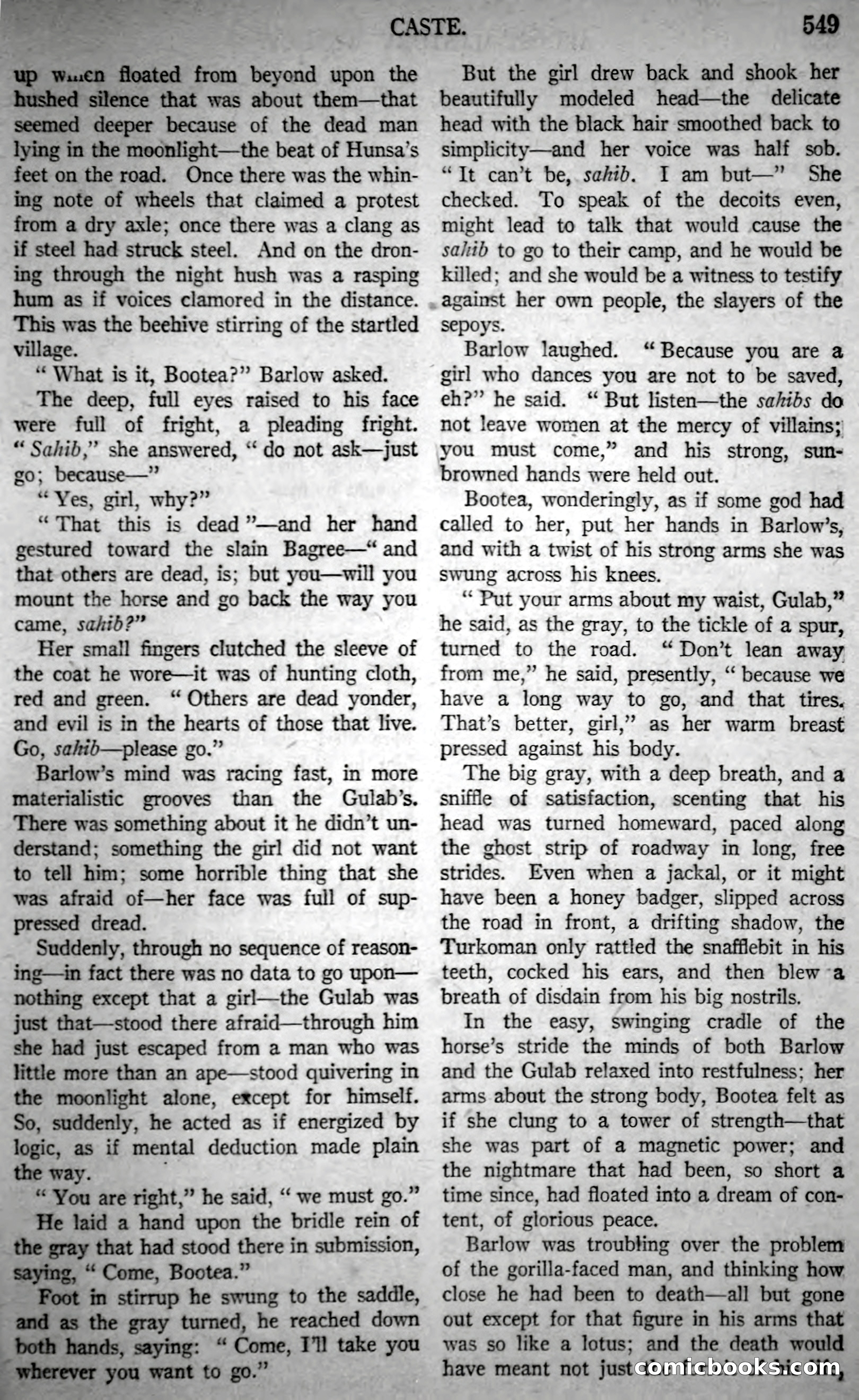
A restored page from Pulp Fiction, 1922. Page through the whole issue in the reader above.
📄 Transcribed text from this page (OCR, searchable)
Machine-transcribed from the original scan — historical spelling and the odd misread are preserved.
Ip Wu | eated from beyond upon the seemed deeper because of the dead man lying in the moonlight—the beat of Hunsa’s feet on the road. Once there was the whin- ing note of wheels that claimed a protest from a dry axle; once there was a clang as if steel had struck steel. And on the dron- ing through the night hush was a rasping hum as if voices clamored in the distance. This was the beehive stirring of the startled village. ““ What is it, Bootea?” Barlow asked. The deep, full eyes raised to his face were full of fright, a pleading fright. “ Sahib,” she answered, “‘ do not ask—just go; because—” “Yes, girl, why?” “That this is dead ”—and her hand gestured toward the slain Bagree—* and that others are dead, is; but you—will you mount the horse and go back the way you came, sahib?” Her small fingers clutched the sleeve of the coat he wore—it was of hunting cloth, red and green. “ Others are dead yonder, and evil is in the hearts of those that live. Go, sakib—please go.” Barlow’s mind was racing fast, in more materialistic grooves than the Gulab’s. There was something about it he didn’t un- derstand; something the girl did not want to tell him; some horrible thing that she was afraid of—her face was full of sup- dread. Suddenly, through no sequence of reason- ing—in fact there was no data to go upon— nothing except that a girl—the Gulab was just that—stood there afraid—through him she had just escaped from a man who was little more than an ape—stood quivering in the moonlight alone, except for himself. So, suddenly, he acted as if energized by logic, as if mental deduction made plain the way. “ You are right,” he said, ‘ we must go.” He laid a hand upon the bridle rein of the gray that had stood there in submission, _ Fe dot in stirrup he swung to the saddle, : A toe e gray turned, he reached down bo “ Come, Till take you 549 But the girl drew back and shook her beautifully modeled head—the delicate head with the black hair smoothed back to simplicity—and her voice was half sob. “It can’t be, sahib. I am but—” She checked. To speak of the decoits even, might lead to talk that would cause the sahib to go to their camp, and he would be killed; and she would be a witness to testify against her own people, the slayers of the sepoys. Barlow laughed. “ Because you are @ girl who dances you are not to be saved, eh?” he said. “ But listen—the sahibs do not leave women at the mercy of villains; you must come,” and his strong, sun- browned hands were held out. Bootea, wonderingly, as if some god had called to her, put her hands in Barlow’s, and with a twist of his strong arms she was swung across his knees. “Put your arms about my waist, Gulab,” he said, as the gray, to the tickle of a spur, turned to the road. “ Don’t lean away from me,” he said, presently, “ because we have a long way to go, and that tires. That’s better, girl,” as her warm breast pressed against his body. The big gray, with a deep breath, and a sniffle of satisfaction, scenting that his head was turned homeward, paced along the ghost strip of roadway in long, free strides. Even when a jackal, or it might have been a honey badger, slipped across the road in front, a drifting shadow, the Turkoman only rattled the snafflebit in his teeth, cocked his ears, and then blewa breath of disdain from his big nostrils, In the easy, swinging cradle of the horse’s stride the minds of both Barlow and the Gulab relaxed into restfulness: her arms about the strong body, Bootea felt as if she clung to a tower of strength—that she was part of a magnetic power; and the nightmare that had been, so short a time since, had floated into a dream of con- tent, of glorious peace. Barlow was troubling over the problem of the gorilla-faced man, and thinking how close he had been to death—all but gone out except for that figure in his arms that was so like a lotus; and the death would have meant not ieccomicbooks.com | eae a