
Pulp Fiction, 1922 · page 72 of 176
Argosy All-Story Weekly, Vol. 146 No. 4 — page 72: what you’re looking at
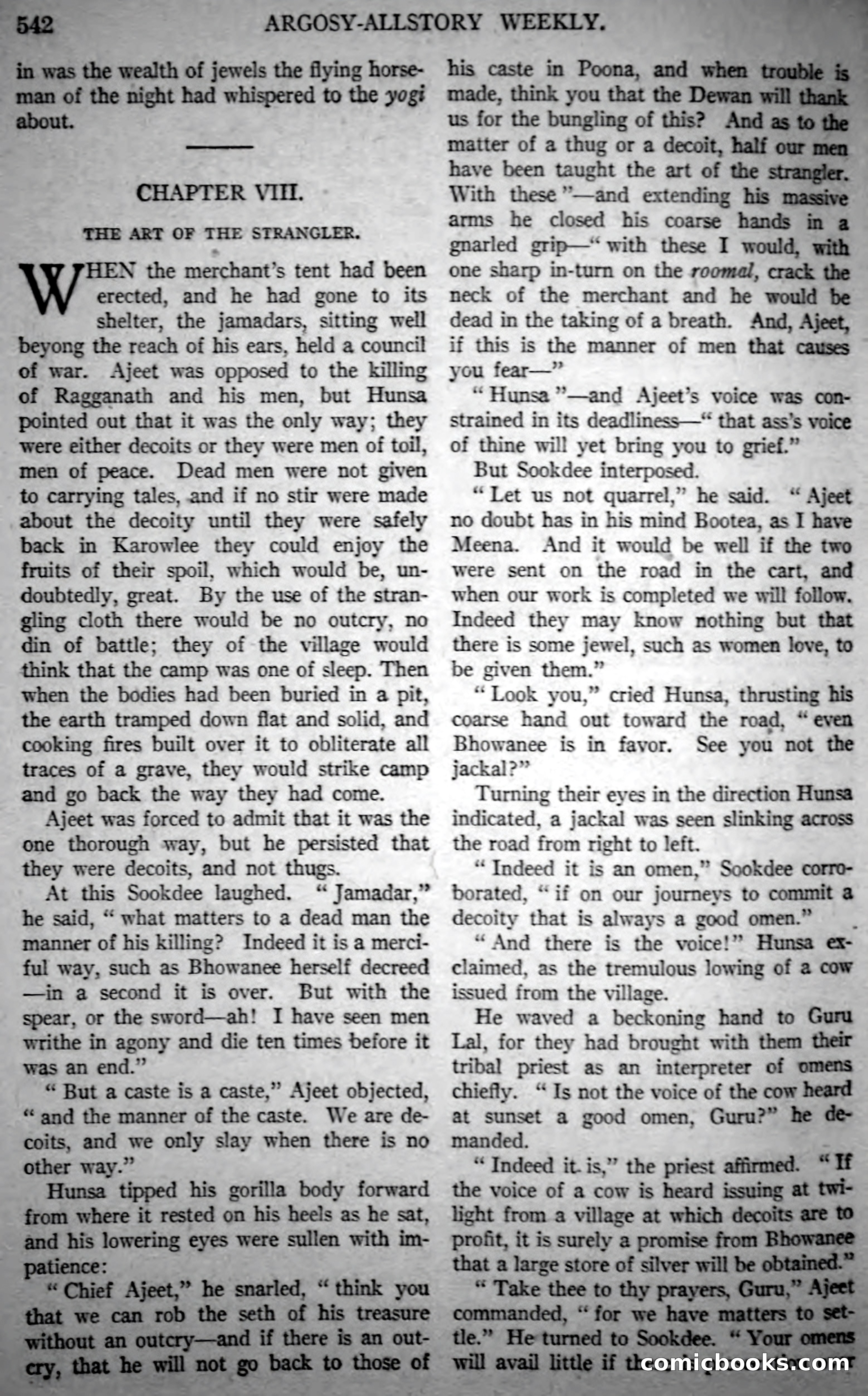
A restored page from Pulp Fiction, 1922. Page through the whole issue in the reader above.
📄 Transcribed text from this page (OCR, searchable)
Machine-transcribed from the original scan — historical spelling and the odd misread are preserved.
CHAPTER VIII. THE ART OF THE STRANGLER. the merchant’s tent had been erected, and he had gone to its shelter, the jamadars, sitting well Deyong the reach of his ears, held a council of war. Ajeet was opposed to the killing of Ragganath and his men, but Hunsa pointed out that it was the only way; they were either decoits or they were men of toil, men of peace. Dead men were not given to carrying tales, and if no stir were made about the decoity until they were safely x“ —_? back in Karowlee they could enjoy the fruits of their spoil, which would be, un- doubtedly, great. By the use of the stran- cloth there would be no outcry, no din of battle; they of the village would think that the camp was one of sleep. Then when the bodies had been buried in a pit, the earth tramped down flat and solid, and cooking fires built over it to obliterate all traces of a grave, they would strike camp and go back the way they had come. Ajeet was forced to admit that it was the one thorough way, but he persisted that they were decoits, and not thugs. At this Sookdee laughed. “ Jamadar,” he said, “ what matters to a dead man the manner of his killing? Indeed it is a merci- ful way, such as Bhowanee herself decreed —in a second it is over. But with the spear, or the sword—ah! I have seen men writhe in agony and die ten times before it was an en ” “ But a caste is a caste,” Ajeet objected, “and the manner of the caste. We are de- coits, and we only slay when there is no pate his gorilla body forward ee 2 fet Bis beats as be a, ¢ an *! od . me ial a” 7 matter of a thug or a decoit, half our men have been taught the art of the strangle With these "—and lassive arms he closed his coarse hands in a gnarled grip—* with these I would, “f one sharp in-turn on the roomal, crack neck of the merchant and he would dead in the taking of a breath. And, Ajeet, if this is the manner of men that causes you fear—” “'Hunsa ”’—and Ajeet’s voice was con- strained in its deadliness—* that ass’s voice of thine wil! yet bring you to grief.” But Sookdee interposed. “Let us not quarrel,” he said. “ Ajeet no doubt has in his mind Bootea, as I have Meena. And it would be well if the two were sent on the road in the cart, and when our work is completed we will follow. Indeed they may know nothing but that there is some jewel, such as women love, to be given them.” “Look you,” cried Hunsa, thrusting his coarse hand out toward the road, “ even Bhowanee is in favor. See you not the jackal?” Turning their eyes in the direction Hunsa indicated, a jackal was seen slinking across the road from right to left. “Indeed it is an omen,” Sookdee corro- borated, “if on our journeys to commit @ decoity that is always a good omen.” __ “And there is the voice!” Hunsa ex- claimed, as the tremulous lowing of a cow issued from the village. He waved a beckoning hand to Guru Lal, for they had brought with them their tribal priest as an interpreter of omens chiefly. “Is not the voice of the cow heard at sunset a good omen, Guru?” he de manded. “ Indeed it is,” the priest affirmed. “If tafe os a sttegs ot uich aa light from.a village at which ate, sey oe ane “)-comicbooks.com