
Pulp Fiction, 1922 · page 32 of 176
Argosy All-Story Weekly, Vol. 146 No. 4 — page 32: what you’re looking at
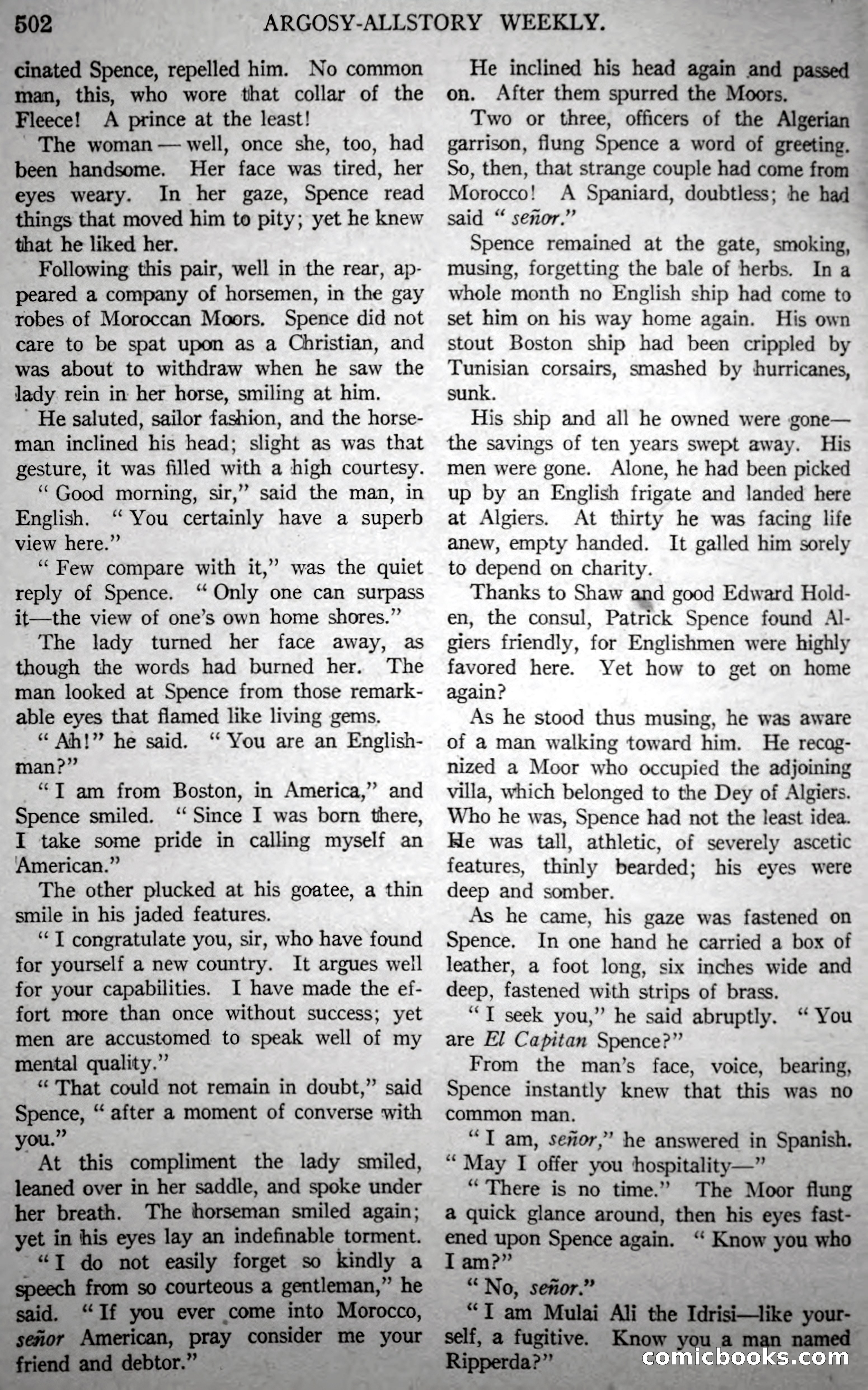
A restored page from Pulp Fiction, 1922. Page through the whole issue in the reader above.
📄 Transcribed text from this page (OCR, searchable)
Machine-transcribed from the original scan — historical spelling and the odd misread are preserved.
B02 cinated Spence, repelled him. No common man, this, who wore that collar of the Fleece! A prince at the least! The woman — well, once she, too, had been handsome. Her face was tired, her eyes weary. In her gaze, Spence read things that moved him to pity; yet he knew that he liked her. Following this pair, well in the rear, ap- peared a company of horsemen, in the gay robes of Moroccan Moors. Spence did not care to be spat upon as a Christian, and was about to withdraw when he saw the lady rein in her horse, smiling at him. ' He saluted, sailor fashion, and the horse- man inclined his head; slight as was that gesture, it was filled with a high courtesy. “Good morning, sir,” said the man, in English. “ You certainly have a superb view here.” “Few compare with it,” was the quiet reply of Spence. “ Only one can surpass it—the view of one’s own home shores.” The lady turned her face away, as though the words had burned her. The man looked at Spence from those remark- able eyes that flamed like living gems. * Ah!” he said. ‘ You are an English- man?” “T am from Boston, in America,” and Spence smiled. ‘‘ Since I was born there, I take some pride in calling myself an American.” The other plucked at his goatee, a thin smile in his jaded features. ‘“‘T congratulate you, sir, who have found for yourself a new country. It argues well for your capabilities. I have made the ef- fort more than once without success; yet men are accustomed to speak well of my mental quality.” “ That could not remain in doubt,” said Spence, “ after a moment of converse with you.” At this compliment the lady smiled, leaned over in her saddle, and spoke under her breath. The horseman smiled again; yet in his eyes lay an indefinable torment. -“T do not easily forget so kindly a speech from so courteous a gentleman,” he | come mente scomee bite, Matec, ARGOSY-ALLSTORY WEEKLY. He inclined his head again and passed on. After them spurred the Moors, Two or three, officers of the Algerian garrison, flung Spence a word of greeting. So, then, that strange couple had come from — Morocco! A Spaniard, doubtless; he had said “ senor.” Spence remained at the gate, smoking, musing, forgetting the bale of herbs. Ina whole month no English ship had come to set him on his way home again. His own stout Boston ship had been crippled by Tunisian corsairs, smashed by hurricanes, sunk. His ship and all he owned were gone— the savings of ten years swept away. His men were gone. Alone, he had been picked up by an English frigate and landed here at Algiers. At thirty he was facing life anew, empty handed. It galled him sorely to depend on charity. Thanks to Shaw and good Edward Hold- en, the consul, Patrick Spence found Al- giers friendly, for Englishmen were highly favored here. Yet how to get on home again? As he stood thus musing, he was aware of a man walking toward him. He recag- nized a Moor who occupied the adjoining villa, which belonged to the Dey of Algiers. Who he was, Spence had not the least idea. He was tall, athletic, of severely ascetic features, thinly bearded; his eyes were deep and somber. As he came, his gaze was fastened on Spence. In one hand he carried a box of leather, a foot long, six inches wide and deep, fastened with strips of brass. ‘““T seek you,” he said abruptly. are El Capitan Spence?” From the man’s face, voice, bearing, Spence instantly knew that this was no common man. “I am, sevor,” he answered in Spanish. “May I offer you hospitality—” “There is no time.” The Moor flung a quick glance around, then his eyes fast- ade as Spence again. “ Know you who am “ You