
Pulp Fiction, 1922 · page 18 of 176
Argosy All-Story Weekly, Vol. 146 No. 4 — page 18: what you’re looking at
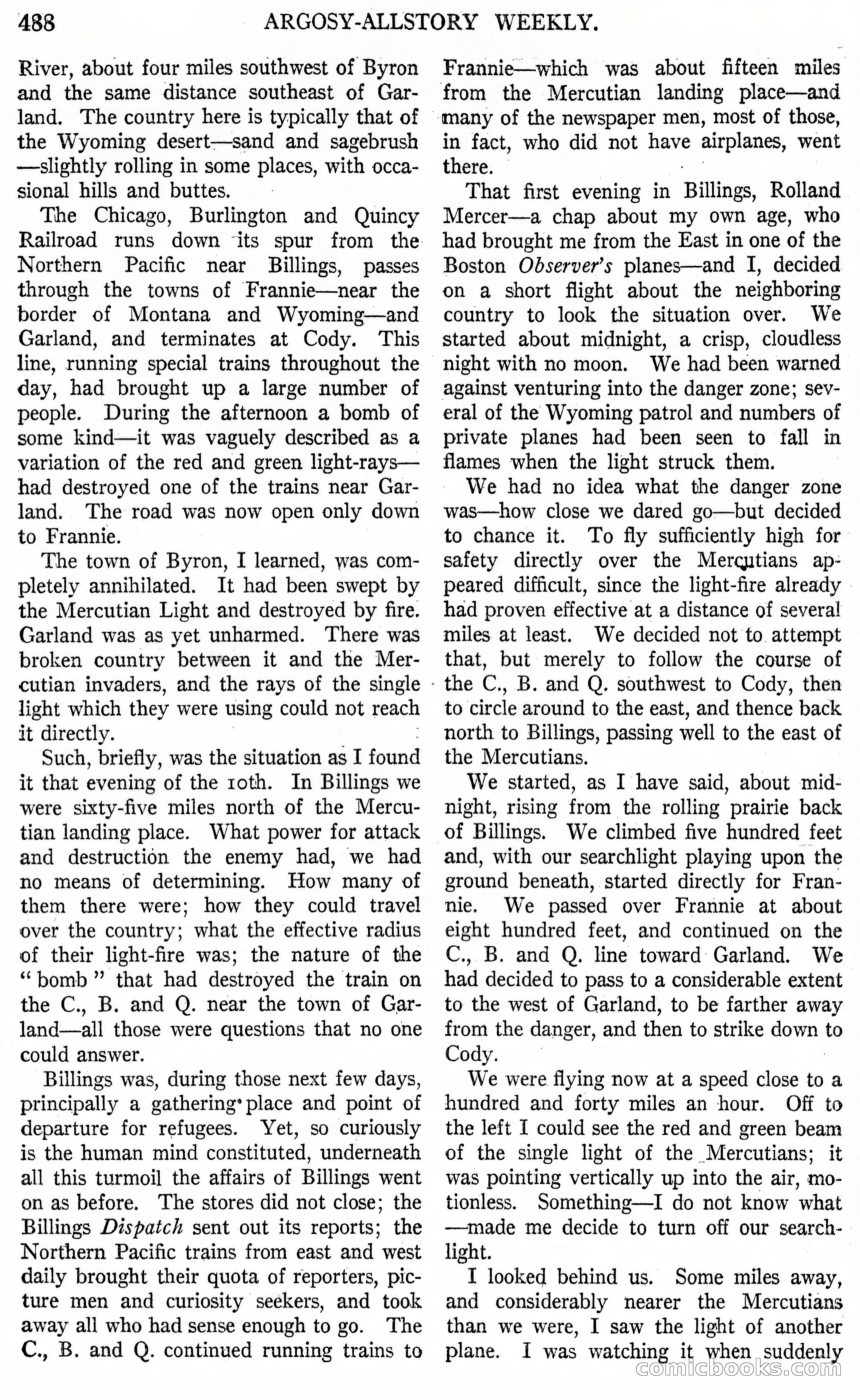
A restored page from Pulp Fiction, 1922. Page through the whole issue in the reader above.
📄 Transcribed text from this page (OCR, searchable)
Machine-transcribed from the original scan — historical spelling and the odd misread are preserved.
A88 River, about four miles southwest of Byron and the same distance southeast of Gar- land. The country here is typically that of the Wyoming desert—sand and sagebrush —slightly rolling in some places, with occa- sional hills and buttes. The Chicago, Burlington and Quincy Railroad runs down ‘its spur from the Northern Pacific near Billings, passes through the towns of Frannie—near the border of Montana and Wyoming—and Garland, and terminates at Cody. ‘This line, running special trains throughout the day, had brought up a large number of people. During the afternoon a bomb of some kind—it was vaguely described as a variation of the red and green light-rays— had destroyed one of the trains near Gar- land. The road was now open only down to Frannie. The town of Byron, I learned, was com- pletely annihilated. It had been swept by the Mercutian Light and destroyed by fire. Garland was as yet unharmed. There was broken country between it and the Mer- cutian invaders, and the rays of the single - light which they were using could not reach it directly. Such, briefly, was the situation as I found it that evening of the roth. In Billings we were sixty-five miles north of the Mercu- tian landing place. What power for attack and destruction the enemy had, we had no means of determining. How many of them there were; how they could travel over the country; what the effective radius of their light-fire was; the nature of the “bomb ” that had destroyed the train on the C., B. and Q. near the town of Gar- land—all those were questions that no one could answer. Billings was, during those next few days, principally a gathering’ place and point of departure for refugees. Yet, so curiously is the human mind constituted, underneath all this turmoil the affairs of Billings went on as before. The stores did not close; the Billings Dispatch sent out its reports; the Northern Pacific trains from east and west daily brought their quota of reporters, pic- ture men and curiosity seekers, and took away all who had sense enough to go. The C., B. and Q. continued running trains to night with no moon. against venturing into the danger zone; sev- ARGOSY-ALLSTORY WEEKLY. Frannie—which was about fifteen miles from the Mercutian landing place—and many of the newspaper men, most of those, in fact, who did not have airplanes, went there. — That first evening in Biting: Rolland Mercer—a chap about my own age, who had brought me from the East in one of the Boston Obdserver’s planes—and I, decided on a short flight about the neighboring country to look the situation over. We started about midnight, a crisp, cloudless We had been warned eral of the Wyoming patrol and numbers of private planes had been seen to fall in flames when the light struck them. We had no idea what the danger zone was—how close we dared go—but decided to chance it. To fly sufficiently high for safety directly over the Mercutians ap- peared difficult, since the light-fire already | had proven effective at a distance of several miles at least. We decided not to. attempt that, but merely to follow the course of the C., B. and Q. southwest to Cody, then to circle around to the east, and thence back north to Billings, passing well to the east of the Mercutians. We started, as I have said, about mid- night, rising from the rolling prairie back of Billings. We climbed five hundred feet and, with our searchlight playing upon the ground beneath, started directly for Fran- nie. We passed over Frannie at about eight hundred feet, and continued on the C., B. and Q. line toward Garland. We had decided to pass to a considerable extent to the west of Garland, to be farther away from the danger, and then to strike down to Cody. | We were flying now at a speed close to a hundred and forty miles an hour. Off to the left I could see the red and green beam of the single light of the Mercutians; it was pointing vertically up into the air, mo- tionless. Something—I do not know what —miade me decide to turn off our search- light. I looked behind us. Some miles away, and considerably nearer the Mercutians than we were, I saw the light of another plane. I was matching. tt ee cee Ks, Cconin