
Pulp Fiction, 1922 · page 146 of 176
Argosy All-Story Weekly, Vol. 146 No. 4 — page 146: what you’re looking at
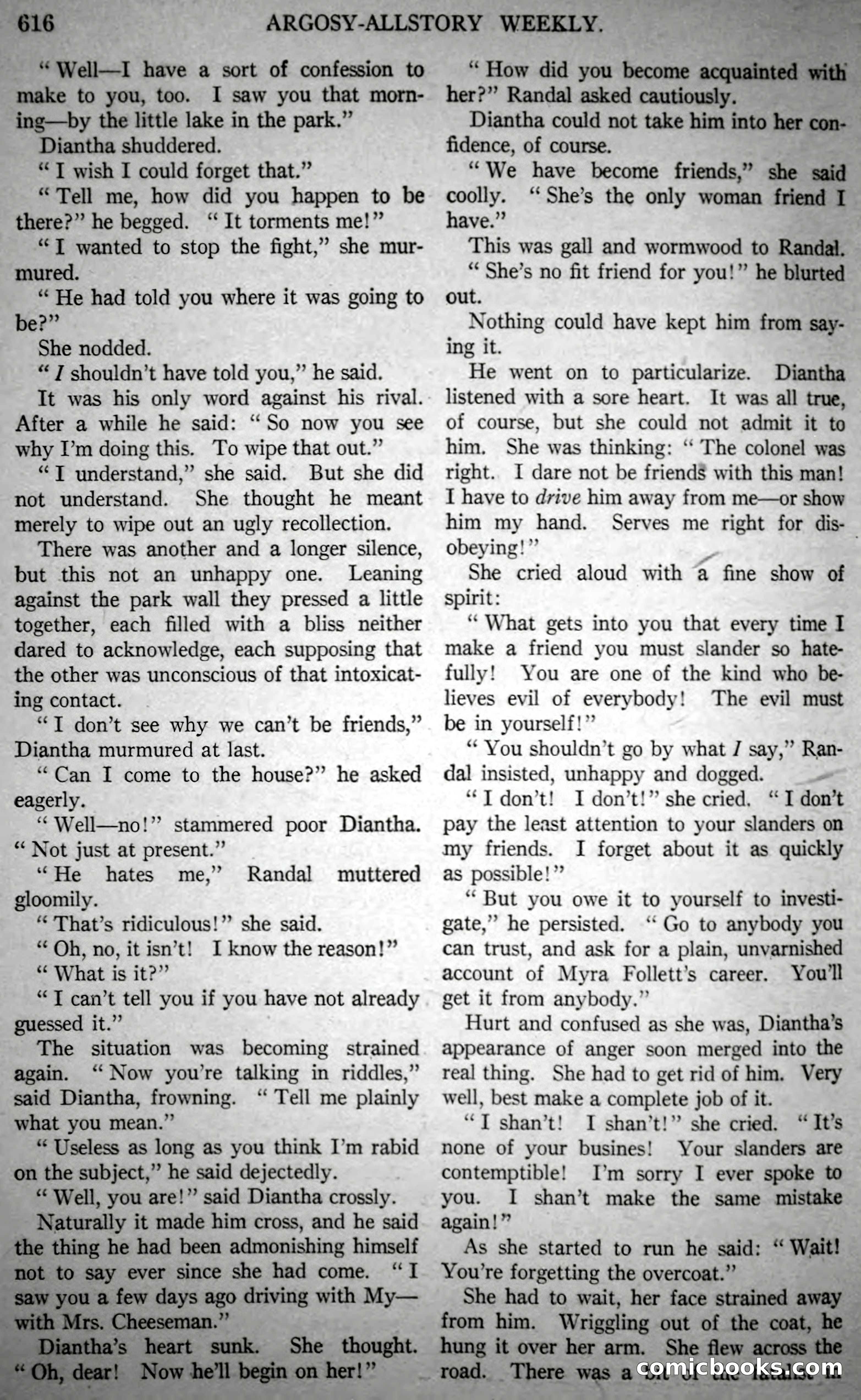
A restored page from Pulp Fiction, 1922. Page through the whole issue in the reader above.
📄 Transcribed text from this page (OCR, searchable)
Machine-transcribed from the original scan — historical spelling and the odd misread are preserved.
«Welt have a sort of confession to make to you, too. I saw you that morn- -ing—by the little lake in the park.” Diantha shuddered. *“T wish I could forget that.” “Tell me, how did you happen to be there?” he begged. “It torments me!” **T wanted to stop the fight,” she mur- mured. “He had told you where it was going to be?” She nodded. *« J shouldn’t have told you,” he said. It was his only word against his rival. After a while he said: “So now you see why I’m doing this. To wipe that out.” “T understand,” she said. But she did not understand. She thought he meant merely to wipe out an ugly recollection. There was another and a longer silence, but this not an unhappy one. Leaning against the park wall they pressed a little together, each filled with a bliss neither dared to acknowledge, each supposing that the other was unconscious of that intoxicat- ing contact. *T don’t see why we can’t be friends,” Diantha murmured at last. “Can I come to the house?” he asked eagerly. ‘“‘ Well—no!” stammered poor Diantha. * Not just at present.” “He hates me,” Randal muttered gloomily. * That’s ridiculous!” she said. “Oh, no, it isn’t! I know the reason!” What is it?” “T can’t tell you if you have not already guessed it.” The situation was becoming strained again. “Now you're talking in riddles,” said Diantha, frowning. “ Tell me plainly what you mean.” “ Useless as long as you think I’m rabid on the subject,” he said dejectedly. ek cla you are!” said Diantha crossly._ Diantha could not take him itt " ee fidence, of course. “i “We have become friends,” she sa coolly. ‘“She’s the only woman friend have.” > This was gall and wormwood to Randal, “ She’s no fit friend for you!” he blurted out. Nothing could have kept him from say- ing it. He went on to particularize. Diantha listened with a sore heart. It was all true, of course, but she could not admit it to him. She was thinking: “‘ The colonel was right. I dare not be friendS with this man! I have to drive him away from me—or show him my hand. Serves me right for dis-— obeying!”’ She cried aloud with a fine show of spirit: “What gets into you that every time I make a friend you must slander so hate- _ ret. Sy 4 fully! You are one of the kind who be- lieves evil of everybody! The evil must be in yourself!” ‘“* You shouldn’t go by what J say,” Ran- dal insisted, unhappy and dogged. a “IT don’t! I don’t!” she cried, “I don’t pay the least attention to your slanders on my friends. I forget about it as quickly as possible!” “But you owe it to yourself to investi- gate,” he persisted. “Go to anybody you can trust, and ask for a plain, unvarnished account of Myra Follett’s career. You'll get it from anybody.” Hurt and confused as she was, Diantha’s appearance of anger soon merged into the real thing. She had to get rid of him. Very well, best make a complete job of it. “T shan’t! I shan’t!” she cried. “It’s none of your busines! Your slanders are contemptible! I’m sorry I ever spoke to you. I shan’t make the same mistake again!” As she started to run he said: “Waitt You're forgetting the overcoat.” = <i She had to wait, her face strained away — » ar - -