
Pulp Fiction, 1922 · page 133 of 176
Argosy All-Story Weekly, Vol. 146 No. 4 — page 133: what you’re looking at
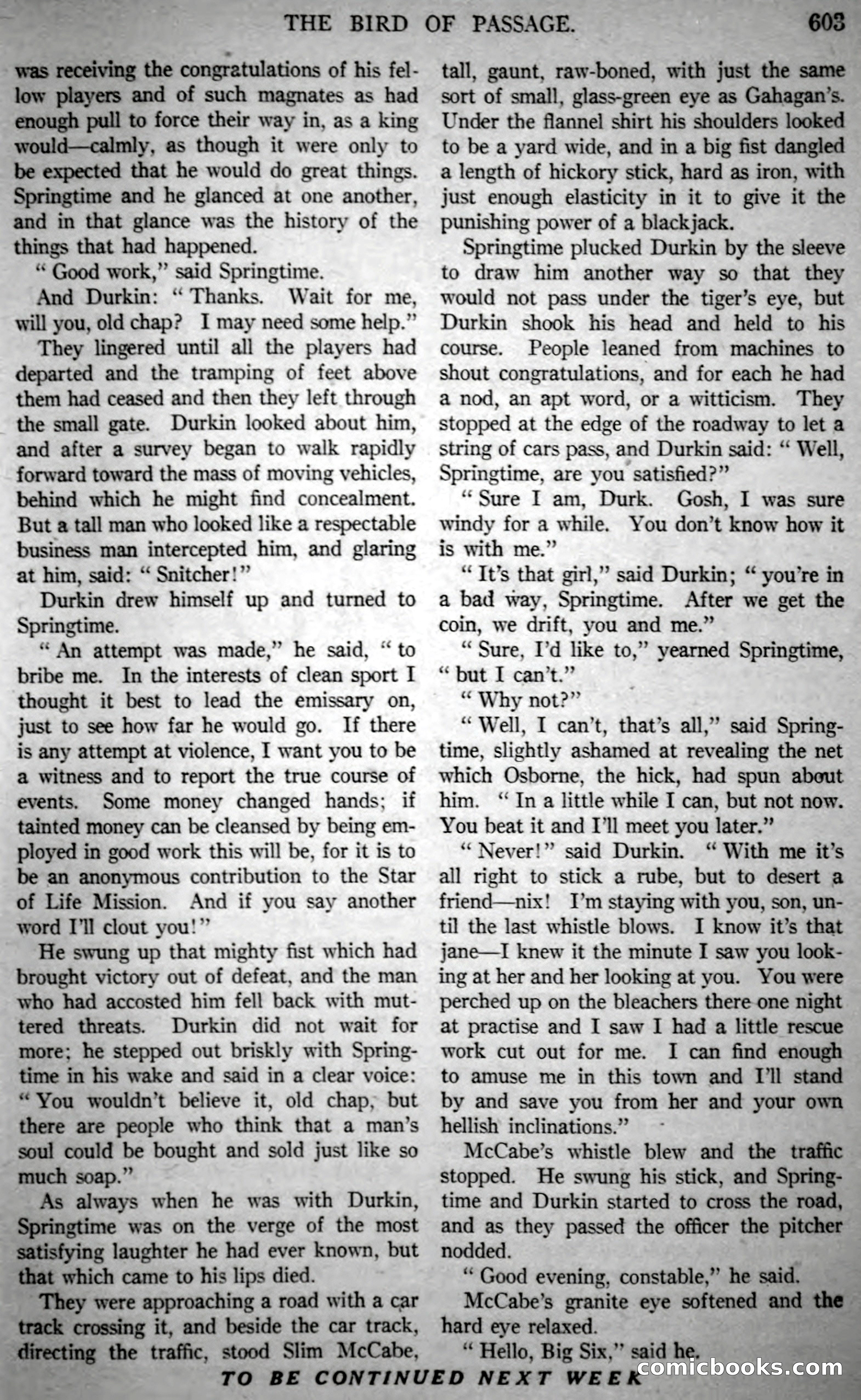
A restored page from Pulp Fiction, 1922. Page through the whole issue in the reader above.
📄 Transcribed text from this page (OCR, searchable)
Machine-transcribed from the original scan — historical spelling and the odd misread are preserved.
— = + Sai all was receiving the congratulations of his fel- low players and of such magnates as had enough pull to force their way in, as a king would—calmly, as though it were only to be expected that he would do great things. Springtime and he glanced at one another, and in that glance was the history of the things that had happened. “ Good work,” said Springtime. And Durkin: “ Thanks. Wait for me, will you, old chap? I may need some help.” They lingered until all the players had departed and the tramping of feet above them had ceased and then they left through the small gate. Durkin looked about him, and after a survey began to walk rapidly forward toward the mass of moving vehicles, behind which he might find concealment. But a tall man who looked like a respectable business man intercepted him, and glaring at him, said: “ Snitcher!”’ Durkin drew himself up and turned to Springtime. “An attempt was made,” he said, “ to bribe me. In the interests of clean sport I thought it best to lead the emissary on, just to see how far he would go. If there is any attempt at violence, I want you to be a witness and to report the true course of events. Some money changed hands; if tainted money can be cleansed by being em- ployed in good work this will be, for it is to be an anonymous contribution to the Star of Life Mission. And if you say another word I'll clout you!” He swung up that mighty fist which had brought victory out of defeat, and the man who had accosted him fell back with mut- tered threats. Durkin did not wait for more; he stepped out briskly with Spring- time in his wake and said in a clear voice: “You wouldn’t believe it, old chap; but there are people who think that a man’s soul could be bought and sold just like so much soap.” As always when he was with Durkin, i was on the verge of the most satisfying laughter he had ever known, but ‘that which came to his lips died. “They were approaching a road with a car sae wang 3 and beside the car track, the traffic, stood Slim McCabe, — >: THE BIRD OF PASSAGE. ‘a tall, gaunt, raw-boned, with just the same sort of small, glass-green eye as Gahagan’s. Under the flannel shirt his shoulders looked to be a yard wide, and in a big fist dangled a length of hickory stick, hard as iron, with just enough elasticity in it to give it the punishing power of a blackjack. Springtime plucked Durkin by the sleeve to draw him another way so that they would not pass under the tiger’s eye, but Durkin shook his head and held to his course. People leaned from machines to shout congratulations, and for each he had a nod, an apt word, or a witticism. They stopped at the edge of the roadway to let a string of cars pass, and Durkin said: “ Well, Springtime, are you satisfied?” “Sure I am, Durk. Gosh, I was sure windy for a while. You don’t know how it is with me.” “It’s that girl,” said Durkin; “ you’re in a bad way, Springtime. After we get the coin, we drift, you and me.” “Sure, I’d like to,” yearned Springtime, “ but I can’t.” “ Why not?” “Well, I can’t, that’s all,” said Spring- time, slightly ashamed at revealing the net which Osborne, the hick, had spun abeut him. “ In a little while I can, but not now. You beat it and I'll meet you later.” “Never!” said Durkin. “ With me it’s all right to stick a rube, but to desert a friend—nix! I’m staying with you, son, un- til the last whistle blows. I know it’s that jane—I knew it the minute I saw you look- ing at her and her looking at you. You were perched up on the bleachers there one night at practise and I saw I had a little rescue work cut out for me. I can find enough to amuse me in this town and I'll stand by and save you from her and your own hellish inclinations.” McCabe’s whistle blew and the traffic stopped. He swung his stick, and Spring- time and Durkin started to cross the road, = and as they passed the officer the pitcher — nodded. “Good evening, constable,” he said. McCabe’s granite eye softened m~* f hard eye relaxed. “ Hello, Big Six,” said he, TO BE CONTINUED NEXT WE EKO coe,