
Pulp Fiction, 1922 · page 131 of 176
Argosy All-Story Weekly, Vol. 146 No. 4 — page 131: what you’re looking at
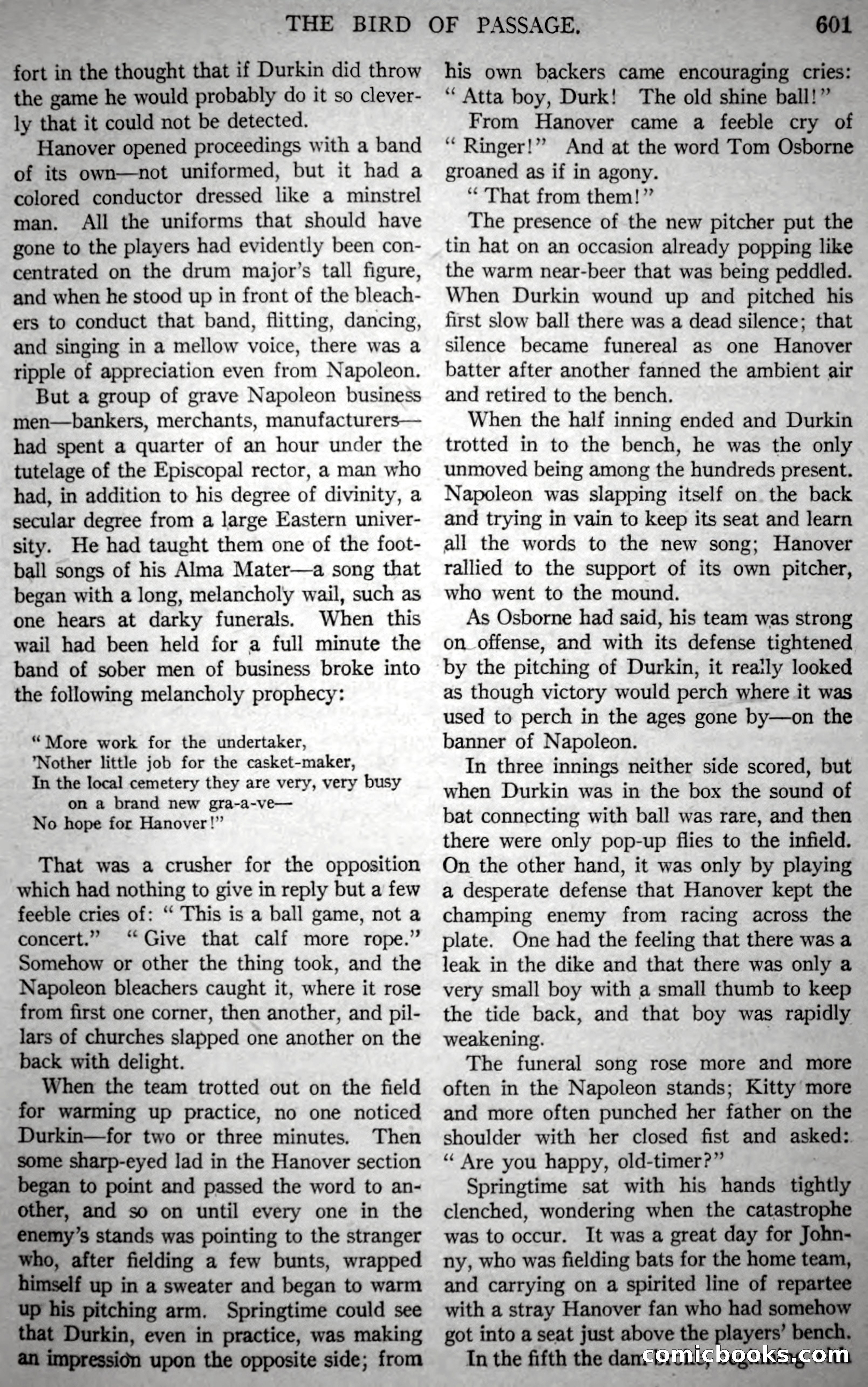
A restored page from Pulp Fiction, 1922. Page through the whole issue in the reader above.
📄 Transcribed text from this page (OCR, searchable)
Machine-transcribed from the original scan — historical spelling and the odd misread are preserved.
THE BIRD OF PASSAGE, fort in the thought that if Durkin did throw the game he would probably do it so clever- ly that it could not be detected. Hanover opened proceedings with a band of its own—not uniformed, but it had a colored conductor dressed like a minstrel man. All the uniforms that should have gone to the players had evidently been con- centrated on the drum major’s tall figure, and when he stood up in front of the bleach- ers to conduct that band, flitting, dancing, and singing in a mellow voice, there was a ripple of appreciation even from Napoleon. But a group of grave Napoleon business men—bankers, merchants, manufacturers— had spent a quarter of an hour under the tutelage of the Episcopal rector, a man who had, in addition to his degree of divinity, a secular degree from a large Eastern univer- sity. He had taught them one of the foot- ball songs of his Alma Mater—a song that began with a long, melancholy wail, such as one hears at darky funerals. When this wail had been held for a full minute the band of sober men of business broke into the following melancholy prophecy: “More work for the undertaker, "Nother little job for the casket-maker, Tn the local cemetery they are very, very busy on a brand new gra-a-ve— No hope for Hanover!” That was a crusher for the opposition which had nothing to give in reply but a few feeble cries of: “‘ This is a ball game, not a conc “Give that calf more rope.” Somehow or other the thing took, and the Napoleon bleachers caught it, where it rose from first one corner, then another, and pil- lars of churches slapped one another on the back with delight. When the team trotted out on the field for warming up practice, no one noticed Durkin—for two or three minutes. Then some sharp-eyed lad in the Hanover section began to point and passed the word to an- other, and so on until every one in the enemy’s stands was pointing to the stranger who, after fielding a few bunts, wrapped himself up in a sweater and began to warm up his pitching arm. Springtime could see that Durkin, even in practice, was making ‘an impression upon the opposite side; from his own backers came encouraging cries: ‘“ Atta boy, Durk! The old shine ball!” From Hanover came a feeble cry of ‘“ Ringer!” And at the word Tom Osborne groaned as if in agony. “That from them!” The presence of the new pitcher put the tin hat on an occasion already popping like the warm near-beer that was being peddled. When Durkin wound up and pitched his first slow ball there was a dead silence; that silence became funereal as one Hanover batter after another fanned the ambient air and retired to the bench. When the half inning ended and Durkin trotted in to the bench, he was the only unmoved being among the hundreds present. Napoleon was slapping itself on the back and trying in vain to keep its seat and learn all the words to the new song; Hanover rallied to the support of its own pitcher, who went to the mound. As Osborne had said, his team was strong on offense, and with its defense tightened by the pitching of Durkin, it reaitly looked as though victory would perch where it was used to perch in the ages gone by—on the banner of Napoleon. In three innings neither side scored, but when Durkin was in the box the sound of bat connecting with ball was rare, and then there were only pop-up flies to the infield. On the other hand, it was only by playing a desperate defense that Hanover kept the champing enemy from racing across the plate. One had the feeling that there was a leak in the dike and that there was only a very small boy with a small thumb to keep the tide back, and that boy was rapidly weakening. The funeral song rose more and more often in the Napoleon stands; Kitty more and more often punched her father on the shoulder with her closed fist and asked: “ Are you happy, old-timer?” Springtime sat with his hands tightly clenched, wondering when the catastrophe was to occur. It was a great day for John- ny, who was fielding bats for the home team, and carrying on a spirited line of repartee — with a stray Hanover fan who had somehow j Got into'e Seat Dae ayers’ , In the fifth the dans Sf S.CC