
Pulp Fiction, 1922 · page 117 of 176
Argosy All-Story Weekly, Vol. 146 No. 4 — page 117: what you’re looking at
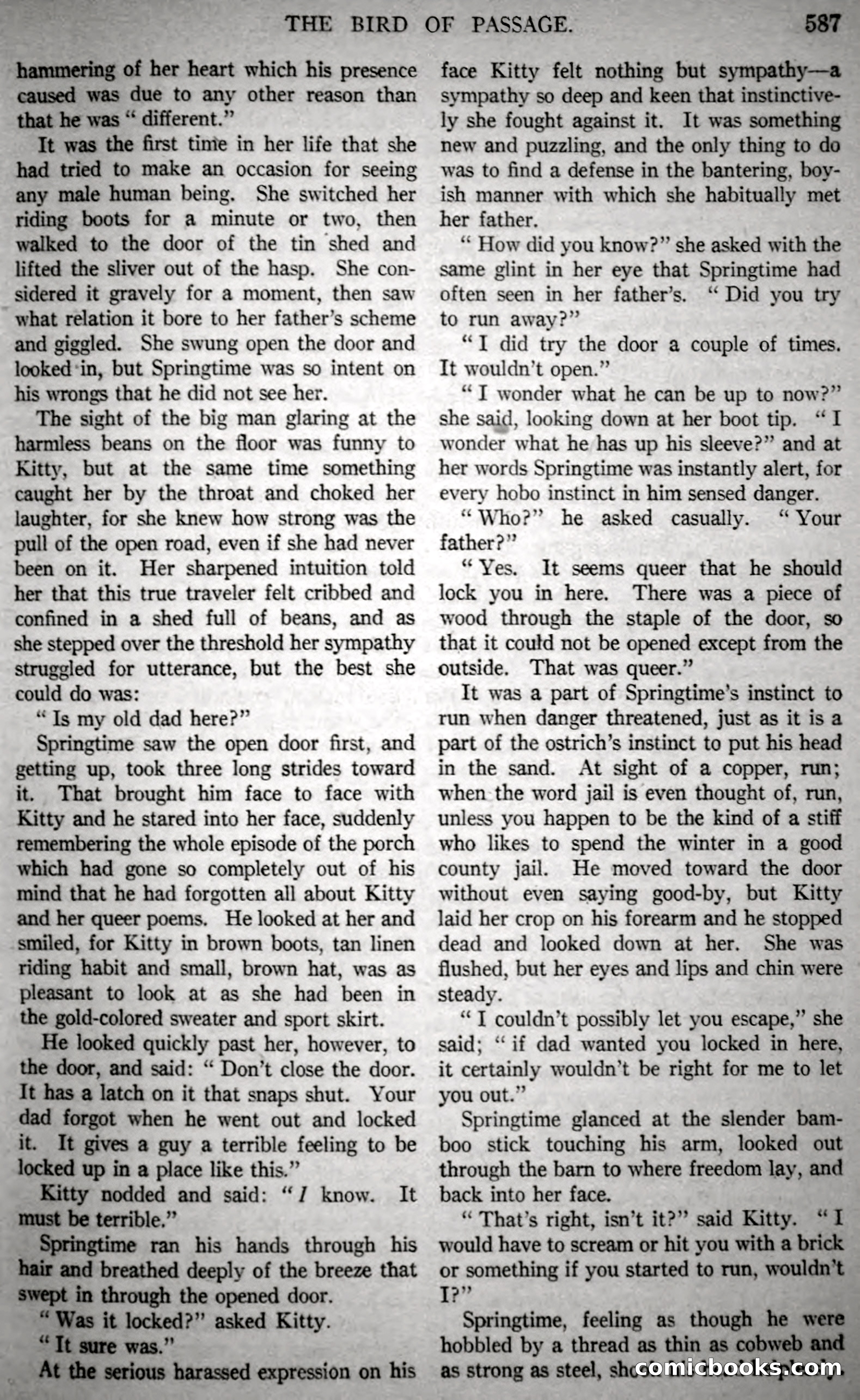
A restored page from Pulp Fiction, 1922. Page through the whole issue in the reader above.
📄 Transcribed text from this page (OCR, searchable)
Machine-transcribed from the original scan — historical spelling and the odd misread are preserved.
Pte of her heart which his presence caused was due to any other reason than that he was “ different.” It was the first tinie in her life that she had tried to make an occasion for seeing any male human being. She switched her riding boots for a minute or two, then walked to the door of the tin shed and lifted the sliver out of the hasp. She con- sidered it gravely for a moment, then saw what relation it bore to her father’s scheme and giggled. She swung open the door and looked ‘in, but Springtime was so intent on his wrongs that he did not see her. The sight of the big man glaring at the harmless beans on the floor was funny to Kitty, but at the same time something caught her by the throat and choked her laughter, for she knew how strong was the pull of the open road, even if she had never been on it. Her sharpened intuition told her that this true traveler felt cribbed and confined in a shed full of beans, and as she stepped over the threshold her sympathy struggled for utterance, but the best she could do was: “Is my old dad here?” Springtime saw the open door first, and getting up, took three long strides toward it. That brought him face to face with Kitty and he stared into her face, suddenly remembering the whole episode of the porch which had gone so completely out of his mind that he had forgotten all about Kitty and her queer poems. He looked at her and smiled, for Kitty in brown boots, tan linen riding habit and small, brown hat, was as pleasant to look at as she had been in the gold-colored sweater and sport skirt. He looked quickly past her, however, to the door, and said: “ Don’t close the door. It has a latch on it that snaps shut. Your dad forgot when he went out and locked it. It gives a guy a terrible feeling to be locked up in a place like this.” Kitty nodded and said: “J know. It naust be terrible.” Springtime ran his hands through his tai and breathed deeply of the breeze that THE BIRD OF PASSAGE. face Kitty felt nothing but sympathy—a sympathy so deep and keen that instinctive- ly she fought against it. It was something new and puzzling, and the only thing to do was to find a defense in the bantering, boy- ish manner with which she habitually met her father. ‘“ How did you know?” she asked with the same glint in her eye that Springtime had often seen in her father’s. “ Did you try to run away?” “I did try the door a couple of times. It wouldn’t open.” “J wonder what he can be up to now?” she said, looking down at her boot tip. “I wonder what he has up his sleeve?” and at her words Springtime was instantly alert, for every hobo instinct in him sensed danger. “Who?” he asked casually. “ Your father?” “Yes. It seems queer that he should lock you in here. There was a piece of wood through the staple of the door, so that it could not be opened except from the outside. That was queer.” It was a part of Springtime’s instinct to run when danger threatened, just as it is a part of the ostrich’s instinct to put his head in the sand. At sight of a copper, run; when the word jail is even thought of, run, unless you happen to be the kind of a stiff who likes to spend the winter in a good county jail. He moved toward the door without even saying good-by, but Kitty laid her crop on his forearm and he stopped dead and looked down at her. She was flushed, but her eyes and lips and chin were steady. “T couldn’t possibly let you escape,” she said; ‘if dad wanted you locked in here, it certainly wouldn’t be right for me to let you out.” Springtime glanced at the slender bam- boo stick touching his arm, looked out through the barn to where freedom lay, and back into her face. “ That’s right, isn’t it?” said Kitty. “I would have to scream or hit you with a brick or something if you started to run, online | I?” ‘-