
Pulp Fiction, 1922 · page 106 of 176
Argosy All-Story Weekly, Vol. 146 No. 4 — page 106: what you’re looking at
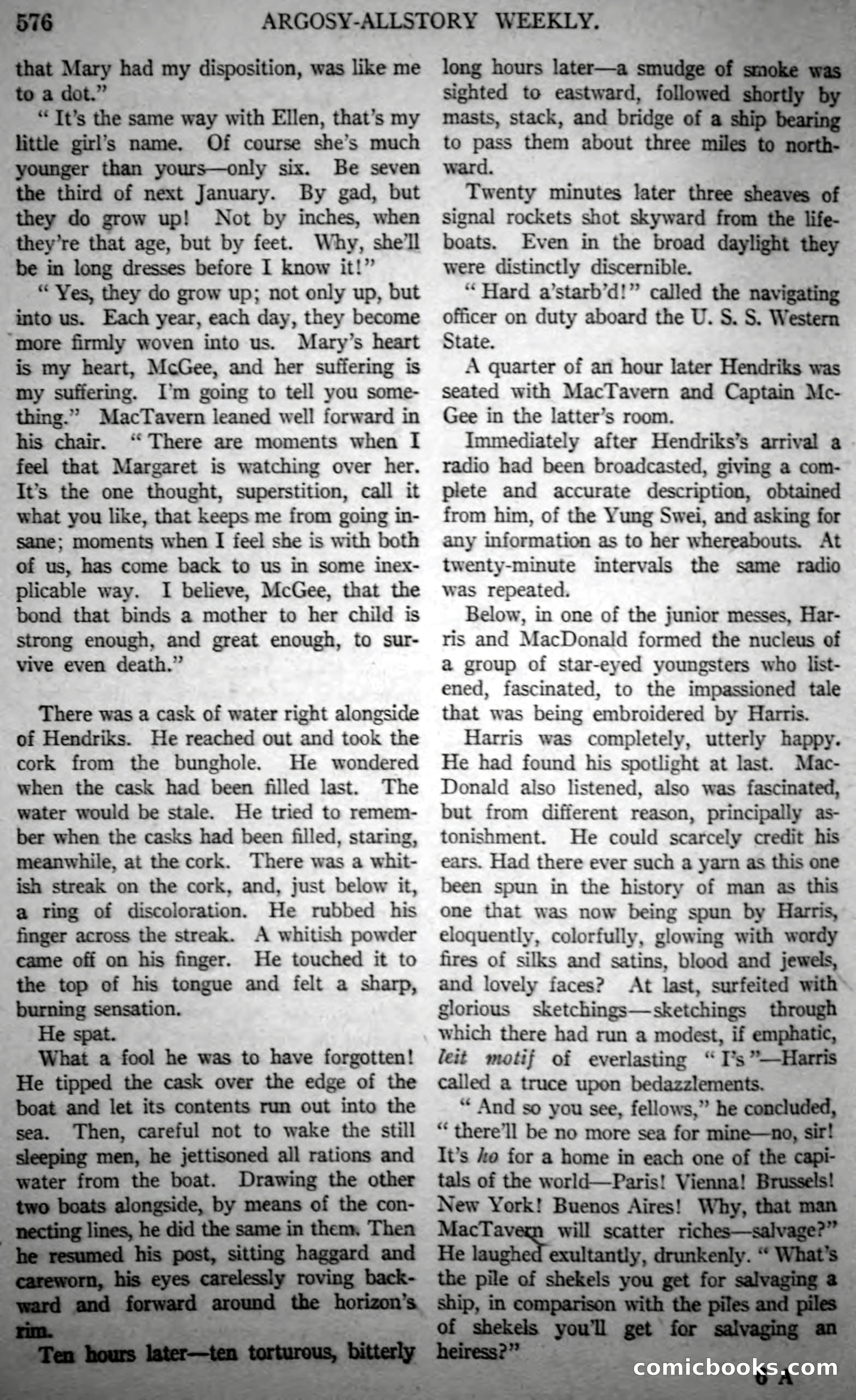
A restored page from Pulp Fiction, 1922. Page through the whole issue in the reader above.
📄 Transcribed text from this page (OCR, searchable)
Machine-transcribed from the original scan — historical spelling and the odd misread are preserved.
that Mary had my disposition, was like me — to a dot.” * Tt’s the same way with Ellen, that’s my little girl’s name. Of course she’s much younger than yours—only six. Be seven the third of next January. By gad, but they do grow up! Not by inches, when they’re that age, but by feet. Why, she'll be in long dresses before I know it!” “Yes, they do grow up; not only up, but into us. Each year, each day, they become “more firmly woven into us. Mary’s heart is my heart, McGee, and her suffering is my suffering. I’m going to tell you some- thing.” MacTavern leaned well forward in his chair. “ There are moments when I feel that Margaret is watching over her. It’s the one thought, superstition, call it what you like, that keeps me from going in- sane; moments when I feel she is with both of us, has come back to us in some inex- plicable way. I believe, McGee, that the bond that binds a mother to her child is strong enough, and great enough, to sur- vive even death.” There was a cask of water right alongside of Hendriks. He reached out and took the cork from the bunghole. He wondered when the cask had been filled last. The water would be stale. He tried to remem- ber when the casks had been filled, staring, meanwhile, at the cork. There was a whit- ish streak on the cork, and, just below it, a ring of discoloration. He rubbed his finger across the streak. A whitish powder came off on his finger. He touched it to the top of his tongue and felt a sharp, burning sensation. He spat. What a fool he was to have forgotten! He tipped the cask over the edge of the and let its contents run out into the careful not to wake the still _ boat and - Sea. _ ARGOSY-ALLSTORY WEEKLY. sighted to eastward, followed she ly y by masts, stack, and bridge of a ship k % to pass them about three miles geri ward. Twenty minutes later three sheaves of signal rockets shot skyward from the life- boats. Even in the broad daylight they were distinctly discernible. “Hard a’starb’d!” called the officer on duty aboard the U. S. S. Western State. A quarter of an hour later Hendriks was seated with MacTavern and Captain Mc- Gee in the latter’s room. Immediately after Hendriks’s arrival a radio had been broadcasted, giving a com- plete and accurate description, obtained from him, of the Yung Swei, and asking for any information as to her whereabouts. At twenty-minute intervals the same radio was repeated. Below, in one of the junior messes, Har- ris and MacDonald formed the nucleus of a@ group of star-eyed youngsters who list- ened, fascinated, to the impassioned tale that was being embroidered by Harris. Harris was completely, utterly happy. He had found his spotlight at last. Mac- Donald also listened, also was fascinated, but from different reason, principally as- tonishment. He could scarcely credit his ears. Had there ever such a yarn as this one been spun in the history of man as this one that was now being spun by Harris, eloquently, colorfully, glowing with wordy fires of silks and satins, blood and jewels, and lovely faces? At last, surfeited with» glorious sketchings—sketchings through which there had run a modest, if emphatic, leit motif of everlasting “ I’s *—Harris called a truce upon bedazzlements. “ And so you see, fellows,” he concluded, “ there'll be no more sea for mine—ano, sir! It’s ho for a home in each one of the capi- tals of the world—Paris! Vicanal J ‘ussels! MacTa’ will ou he: —s9 salvage?” — comicbooks.com