
Pulp Fiction, 1922 · page 85 of 178
Argosy All-Story Weekly, February 4, 1922 — page 85: what you’re looking at
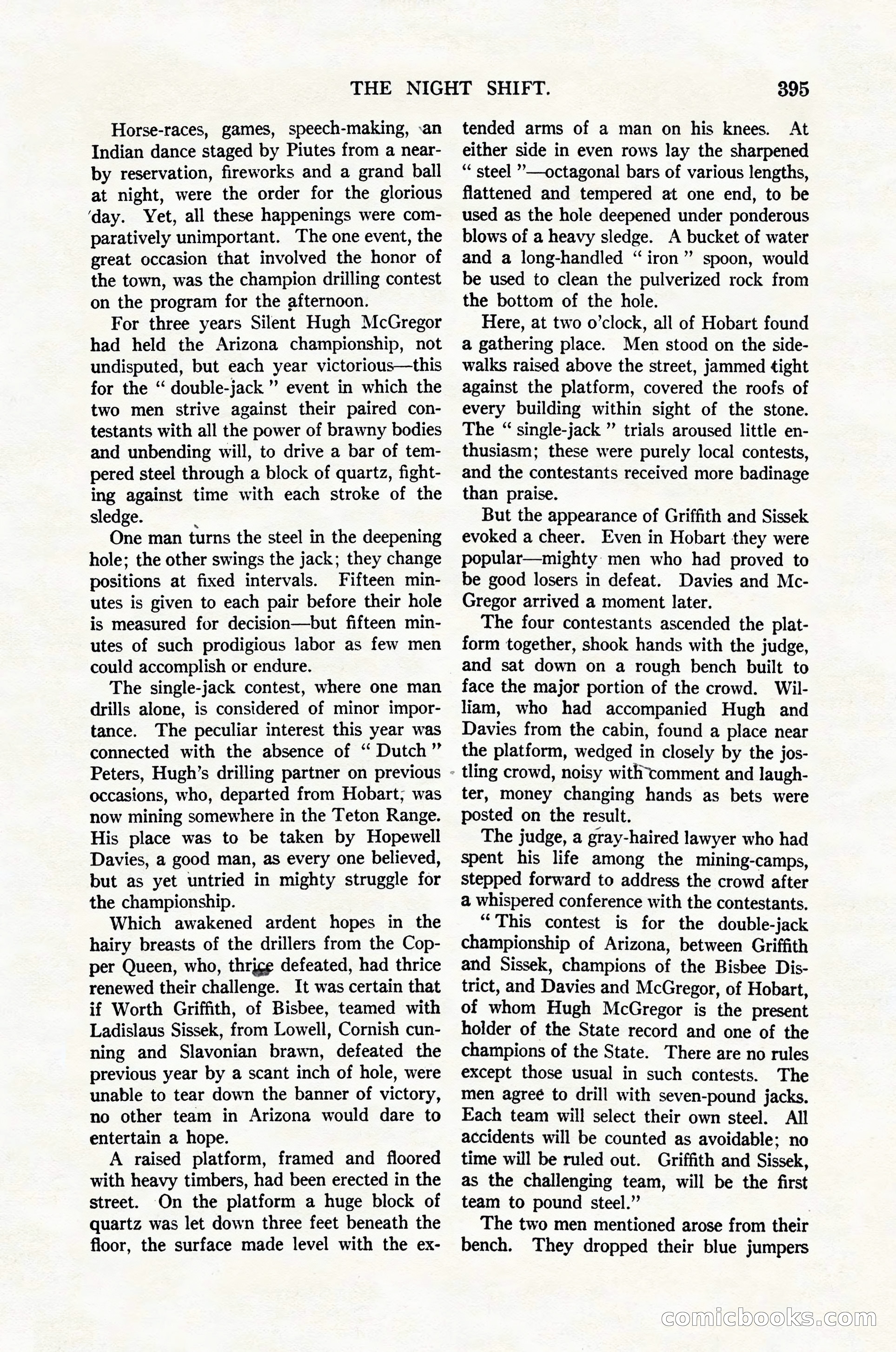
A restored page from Pulp Fiction, 1922. Page through the whole issue in the reader above.
📄 Transcribed text from this page (OCR, searchable)
Machine-transcribed from the original scan — historical spelling and the odd misread are preserved.
THE NIGHT SHIFT. Horse-races, games, speech-making, :an Indian dance staged by Piutes from a near- by reservation, fireworks and a grand ball at night, were the order for the glorious ‘day. Yet, all these happenings were com- paratively unimportant. The one event, the great occasion that involved the honor of the town, was the champion drilling contest on the program for the afternoon. For three years Silent Hugh McGregor had held the Arizona championship, not undisputed, but each year victorious—this for the “ double-jack ’’ event in which the two men strive against their paired con- testants with all the power of brawny bodies and unbending will, to drive a bar of tem- pered steel through a block of quartz, fight- ing against time with each stroke of the sledge. ‘ One man turns the steel in the deepening hole; the other swings the jack; they change positions at fixed intervals. Fifteen min- utes is given to each pair before their hole is measured for decision—but fifteen min- utes of such prodigious labor as few men could accomplish or endure. The single-jack contest, where one man drills alone, is considered of minor impor- tance. The peculiar interest this year was connected with the absence of ‘ Dutch” Peters, Hugh’s drilling partner on previous occasions, who, departed from Hobart; was now mining somewhere in the Teton Range. His place was to be taken by Hopewell Davies, a good man, as every one believed, but as yet untried in mighty struggle for the championship. Which awakened ardent hopes in the hairy breasts of the drillers from the Cop- per Queen, who, thrice defeated, had thrice renewed their challenge. It was certain that if Worth Griffith, of Bisbee, teamed with Ladislaus Sissek, from Lowell, Cornish cun- ning and Slavonian brawn, defeated the previous year by a scant inch of hole, were unable to tear down the banner of victory, no other team in Arizona would dare to entertain a hope. A raised platform, framed and floored with heavy timbers, had been erected in the street. On the platform a huge block of quartz was let down three feet beneath the floor, the surface made level with the ex- 395 tended arms of a man on his knees. At either side in even rows lay the sharpened “* steel ”—octagonal bars of various lengths, flattened and tempered at one end, to be used as the hole deepened under ponderous blows of a heavy sledge. A bucket of water and a long-handled “iron ”’ spoon, would be used to clean the pulverized rock from the bottom of the hole. Here, at two o’clock, all of Hobart found a gathering place. Men stood on the side- walks raised above the street, jammed tight against the platform, covered the roofs of every building within sight of the stone. The “ single-jack ” trials aroused little en- thusiasm; these were purely local contests, and the contestants received more badinage than praise. But the appearance of Griffith and Sissek evoked a cheer. Even in Hobart they were popular—mighty: men who had proved to be good losers in defeat. Davies and Mc- Gregor arrived a moment later. The four contestants ascended the plat- form together, shook hands with the judge, and sat down on a rough bench built to face the major portion of the crowd. Wil- liam, who had accompanied Hugh and Davies from the cabin, found a place near the platform, wedged in closely by the jos- - tling crowd, noisy with comment and laugh- ter, money changing hands as bets were posted on the result. The judge, a gray-haired lawyer who had spent his life among the mining-camps, stepped forward to address the crowd after a whispered conference with the contestants. “This contest is for the double-jack championship of Arizona, between Griffith and Sissek, champions of the Bisbee Dis- trict, and Davies and McGregor, of Hobart, of whom Hugh McGregor is the present holder of the State record and one of the champions of the State. There are no rules except those usual in such contests. The men agree to drill with seven-pound jacks. Each team will select their own steel. All accidents will be counted as avoidable; no time will be ruled out. Griffith and Sissek, as the challenging team, will be the first team to pound steel.” The two men mentioned arose from their bench. They dropped their blue jumpers COmiclbooks.CGom