
Pulp Fiction, 1922 · page 83 of 178
Argosy All-Story Weekly, February 4, 1922 — page 83: what you’re looking at
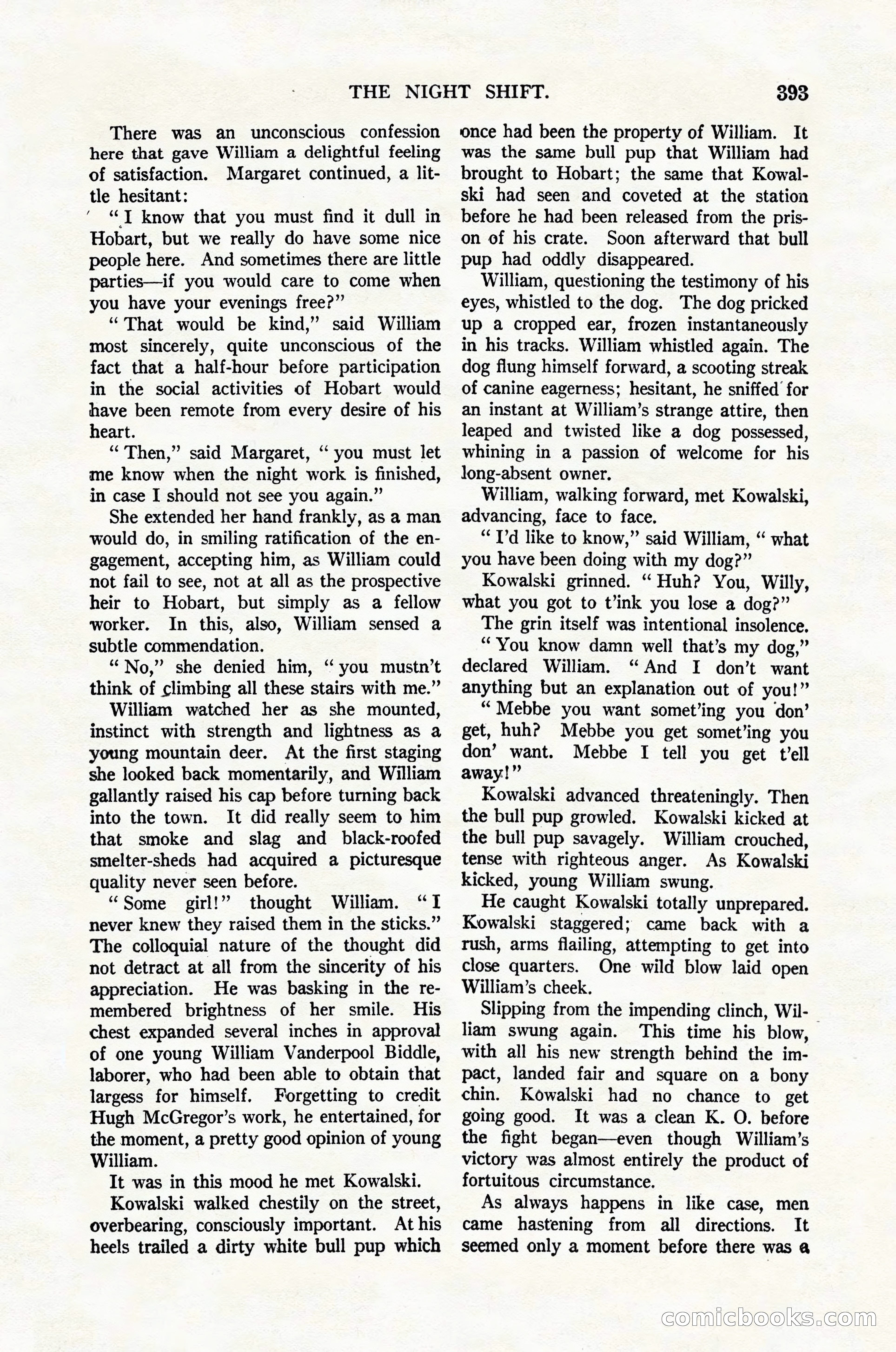
A restored page from Pulp Fiction, 1922. Page through the whole issue in the reader above.
📄 Transcribed text from this page (OCR, searchable)
Machine-transcribed from the original scan — historical spelling and the odd misread are preserved.
THE NIGHT SHIFT. There was an unconscious confession here that gave William a delightful feeling of satisfaction. Margaret continued, a lit- tle hesitant: ‘ “TY know that you must find it dull in Hobart, but we really do have some nice people here. And sometimes there are little parties—if you would care to come when you have your evenings free?” “That would be kind,” said William most sincerely, quite unconscious of the fact that a half-hour before participation in the social activities of Hobart would have been remote from every desire of his heart. “‘ Then,” said Margaret, ‘“‘ you must let me know when the night work is finished, in case I should not see you again.” She extended her hand frankly, as a man would do, in smiling ratification of the en- gagement, accepting him, as William could not fail to see, not at all as the prospective heir to Hobart, but simply as a fellow worker. In this, also, William sensed a subtle commendation. “No,” she denied him, ‘ you mustn’t think of climbing all these stairs with me.” William watched her as she mounted, instinct with strength and lightness as a young mountain deer. At the first staging she looked back momentarily, and William gallantly raised his cap before turning back into the town. It did really seem to him that smoke and slag and_ black-roofed smelter-sheds had acquired a picturesque quality never seen before. “Some girl!” thought William. “I never knew they raised them in the sticks.” The colloquial nature of the thought did not detract at all from the sincerity of his appreciation. He was basking in the re- membered brightness of her smile. His chest expanded several inches in approval of one young William Vanderpool Biddle, laborer, who had been able to obtain that largess for himself. Forgetting to credit Hugh McGregor’s work, he entertained, for the moment, a pretty good opinion of young William. It was in this mood he met Kowalski. Kowalski walked chestily on the street, overbearing, consciously important. At his heels trailed a dirty white bull pup which 393 once had been the property of William. It was the same bull pup that William had brought to Hobart; the same that Kowal- ski had seen and coveted at the station before he had been released from the pris- on of his crate. Soon afterward that bull pup had oddly disappeared. William, questioning the testimony of his eyes, whistled to the dog. The dog pricked up a cropped ear, frozen instantaneously in his tracks. William whistled again. The dog flung himself forward, a scooting streak of canine eagerness; hesitant, he sniffed for an instant at William’s strange attire, then leaped and twisted like a dog possessed, whining in a passion of welcome for his long-absent owner. William, walking forward, met Kowalski, advancing, face to face. “Td like to know,” said William, “ what you have been doing with my dog?” Kowalski grinned. “ Huh? You, Willy, what you got to t’ink you lose a dog?” The grin itself was intentional insolence. “You know damn well that’s my dog,” declared William. “And I don’t want anything but an explanation out of you!” ““Mebbe you want somet’ing you don’ get, huh? Mebbe you get somet’ing you don’ want. Mebbe I tell you get tell away!” Kowalski advanced threateningly. Then the bull pup growled. Kowalski kicked at the bull pup savagely. William crouched, tense with righteous anger. As Kowalski kicked, young William swung. He caught Kowalski totally unprepared. Kowalski staggered; came back with a rush, arms flailing, attempting to get into close quarters. One wild blow laid open William’s cheek. Slipping from the impending clinch, Wil- liam swung again. This time his blow, with all his new strength behind the im- pact, landed fair and square on a bony chin. Kowalski had no chance to get going good. It was a clean K. O. before the fight began—even though William’s victory was almost entirely the product of fortuitous circumstance. As always happens in like case, men came hastening from all directions. It seemed only a moment before there was @ COmiclbooks.CGom