
Pulp Fiction, 1922 · page 57 of 178
Argosy All-Story Weekly, February 4, 1922 — page 57: what you’re looking at
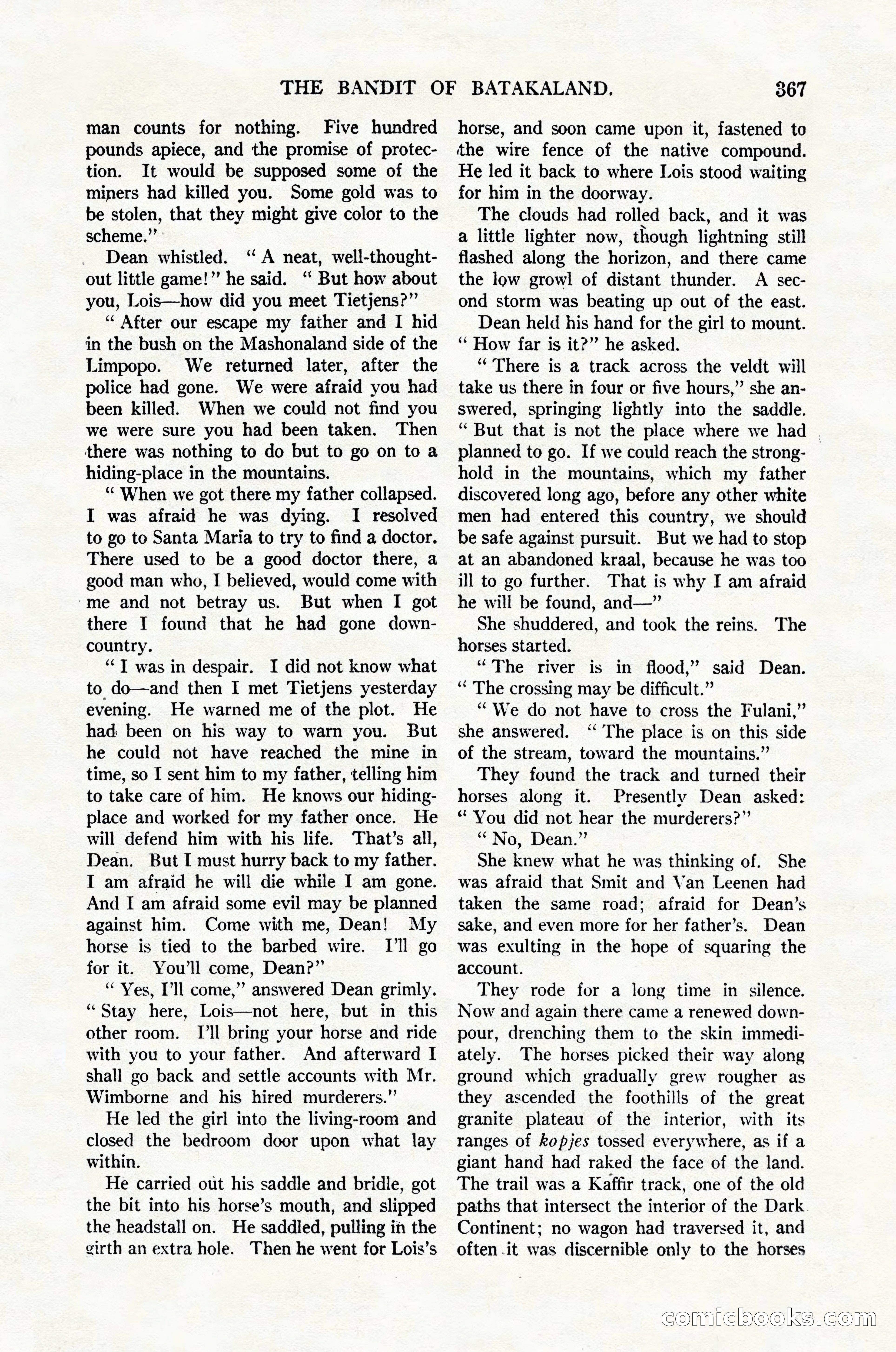
A restored page from Pulp Fiction, 1922. Page through the whole issue in the reader above.
📄 Transcribed text from this page (OCR, searchable)
Machine-transcribed from the original scan — historical spelling and the odd misread are preserved.
THE BANDIT OF BATAKALAND, man counts for nothing. Five hundred pounds apiece, and the promise of protec- tion. It would be supposed some of the miners had killed you. Some gold was to be stolen, that they might give color to the scheme.” _ Dean whistled. “A neat, well-thought- out little game!” he said. ‘“‘ But how about you, Lois—how did you meet Tietjens?”’ “ After our escape my father and I hid in the bush on the Mashonaland side of the Limpopo. We returned later, after the police had gone. We were afraid you had been killed. When we could not find you we were sure you had been taken. Then there was nothing to do but to go on to a hiding-place in the mountains. “When we got there my father collapsed. I was afraid he was dying. I resolved to go to Santa Maria to try to find a doctor. There used to be a good doctor there, a good man who, I believed, would come with ‘me and not betray us. But when I got there I found that he had gone down- country. ‘“‘T was in despair. I did not know what to do—and then I met Tietjens yesterday evening. He warned me of the plot. He had: been on his way to warn you. But he could not have reached the mine in time, so [ sent him to my father, telling him to take care of him. He knows our hiding- place and worked for my father once. He will defend him with his life. That’s all, Dean. But I must hurry back to my father. I am afraid he will die while I am gone. And I am afraid some evil may be planned against him. Come with me, Dean! My horse is tied to the barbed wire. I'll go for it. You'll come, Dean?” “Yes, I'll come,” answered Dean grimly. “Stay here, Lois—not here, but in this other room. I'll bring your horse and ride with you to your father. And afterward I shall go back and settle accounts with Mr. Wimborne and his hired murderers.” He led the girl into the living-room and closed the bedroom door upon what lay within. He carried out his saddle and bridle, got the bit into his horse’s mouth, and slipped the headstall on. He saddled, pulling in the girth an extra hole. Then he went for Lois’s 367 horse, and soon came upon it, fastened to the wire fence of the native compound. He led it back to where Lois stood waiting for him in the doorway. The clouds had rolled back, and it was a little lighter now, though lightning still flashed along the horizon, and there came the low growl of distant thunder. A sec- ond storm was beating up out of the east. Dean held his hand for the girl to mount. ‘“* How far is it?”’ he asked. “There is a track across the veldt will take us there in four or five hours,” she an- swered, springing lightly into the saddle. “ But that is not the place where we had | planned to go. If we could reach the strong- hold in the mountains, which my father discovered long ago, before any other white men had entered this country, we should be safe against pursuit. But we had to stop at an abandoned kraal, because he was too ill to go further. That is why I am afraid he will be found, and—”’ She shuddered, and took the reins. The horses started. “The river is in flood,” said Dean. “ The crossing may be difficult.” ‘We do not have to cross the Fulani,” she answered. ‘‘ The place is on this side of the stream, toward the mountains.” They found the track and turned their horses along it. Presently Dean asked: “You did not hear the murderers?” ‘No, Dean.” She knew what he was thinking of. She was afraid that Smit and Van Leenen had taken the same road; afraid for Dean’s sake, and even more for her father’s. Dean was exulting in the hope of squaring the account. They rode for a long time in silence. Now and again there came a renewed down- pour, drenching them to the skin immedi- ately. The horses picked their way along ground which gradually grew rougher as they ascended the foothills of the great granite plateau of the interior, with its ranges of kopjes tossed everywhere, as if a giant hand had raked the face of the land. The trail was a Kaffir track, one of the old paths that intersect the interior of the Dark. Continent; no wagon had traversed it, and often it was discernible only to the horses COmiclbooks.Com