
Pulp Fiction, 1922 · page 125 of 178
Argosy All-Story Weekly, February 4, 1922 — page 125: what you’re looking at
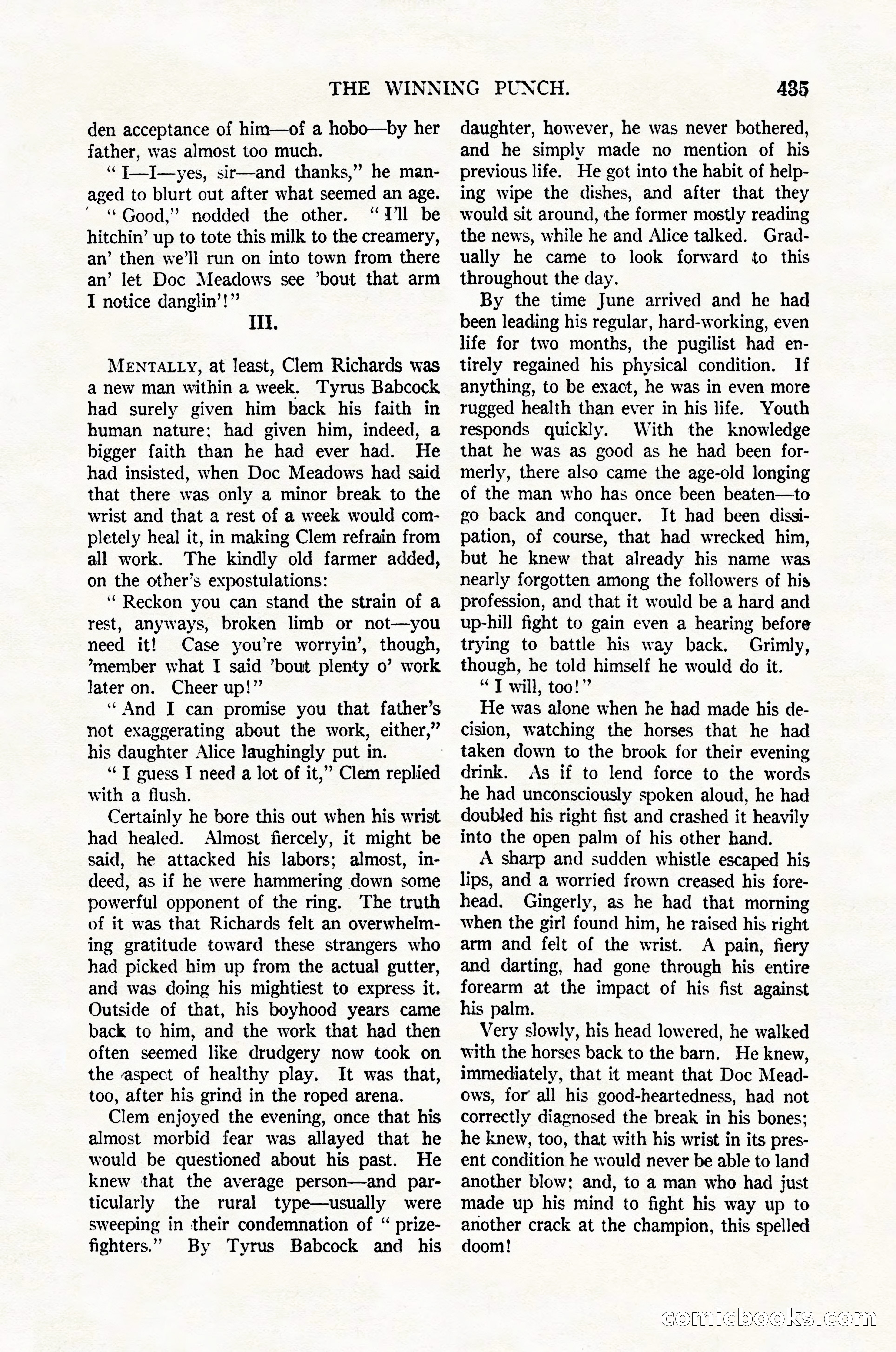
A restored page from Pulp Fiction, 1922. Page through the whole issue in the reader above.
📄 Transcribed text from this page (OCR, searchable)
Machine-transcribed from the original scan — historical spelling and the odd misread are preserved.
THE WINNING PUNCH. den acceptance of him—of a hobo—by her father, was almost too much. ‘“ T_J—-yes, sir—and thanks,” he man- aged to blurt out after what seemed an age. ‘“Good,” nodded the other. “I'll be hitchin’ up to tote this milk to the creamery, an’ then we’ll run on into town from there an’ let Doc Meadows see ’bout that arm I notice danglin’!”’ TIT. MENTALLY, at least, Clem Richards was a new man within a week. Tyrus Babcock had surely given him back his faith in human nature; had given him, indeed, a bigger faith than he had ever had. He had insisted, when Doc Meadows had said that there was only a minor break to the wrist and that a rest of a week would com- pletely heal it, in making Clem refrain from all work. The kindly old farmer added, on the other’s expostulations: ‘“Reckon you can stand the strain of a rest, anyways, broken limb or not—you need it! Case you’re worryin’, though, ’member what I said "bout plenty o’ work later on. Cheer up!” ‘And I can- promise you that father’s not exaggerating about the work, either,” his daughter Alice laughingly put in. ‘“T guess I need a lot of it,” Clem replied with a flush. Certainly he bore this out when his wrist had healed. Almost fiercely, it might be said, he attacked his labors; almost, in- deed, as if he were hammering down some powerful opponent of the ring. The truth of it was that Richards felt an overwhelm- ing gratitude toward these strangers who had picked him up from the actual gutter, and was doing his mightiest to express it. Outside of that, his boyhood years came back to him, and the work that had then often seemed like drudgery now took on the aspect of healthy play. It was that, too, after his grind in the roped arena. Clem enjoyed the evening, once that his almost morbid fear was allayed that he would be questioned about his past. He knew that the average person—and par- ticularly the rural type—usually were Sweeping in their condemnation of “ prize- fighters.” By Tyrus Babcock and his 435 daughter, however, he was never bothered, and he simply made no mention of his previous life. He got into the habit of help- ing wipe the dishes, and after that they would sit around, the former mostly reading the news, while he and Alice talked. Grad- ually he came to look forward to this throughout the day. By the time June arrived and he had been leading his regular, hard-working, even life for two months, the pugilist had en- tirely regained his physical condition. If anything, to be exact, he was in even more rugged health than ever in his life. Youth responds quickly. With the knowledge that he was as good as he had been for- merly, there also came the age-old longing of the man who has once been beaten—to go back and conquer. It had been dissi- pation, of course, that had wrecked him, but he knew that already his name was nearly forgotten among the followers of his profession, and that it would be a hard and up-hill fight to gain even a hearing before trying to battle his way back. Grimly, though, he told himself he would do it. “J will, too!” He was alone when he had made his de- cision, watching the horses that he had taken down to the brook for their evening drink. As if to lend force to the words he had unconsciously spoken aloud, he had doubled his right fist and crashed it heavily into the open palm of his other hand. A sharp and sudden whistle escaped his lips, and a worried frown creased his fore- head. Gingerly, as he had that morning when the girl found him, he raised his right arm and felt of the wrist. A pain, fiery and darting, had gone through his entire forearm at the impact of his fist against his palm. Very slowly, his head lowered, he walked with the horses back to the barn. He knew, immediately, that it meant that Doc Mead- ows, for all his good-heartedness, had not correctly diagnosed the break in his bones; he knew, too, that with his wrist in its pres- ent condition he would never be able to land another blow: and, to a man who had just made up his mind to fight his way up to another crack at the champion, this spelled doom! COmiclbooks.Gonn