
Pulp Fiction, 1922 · page 123 of 178
Argosy All-Story Weekly, February 4, 1922 — page 123: what you’re looking at
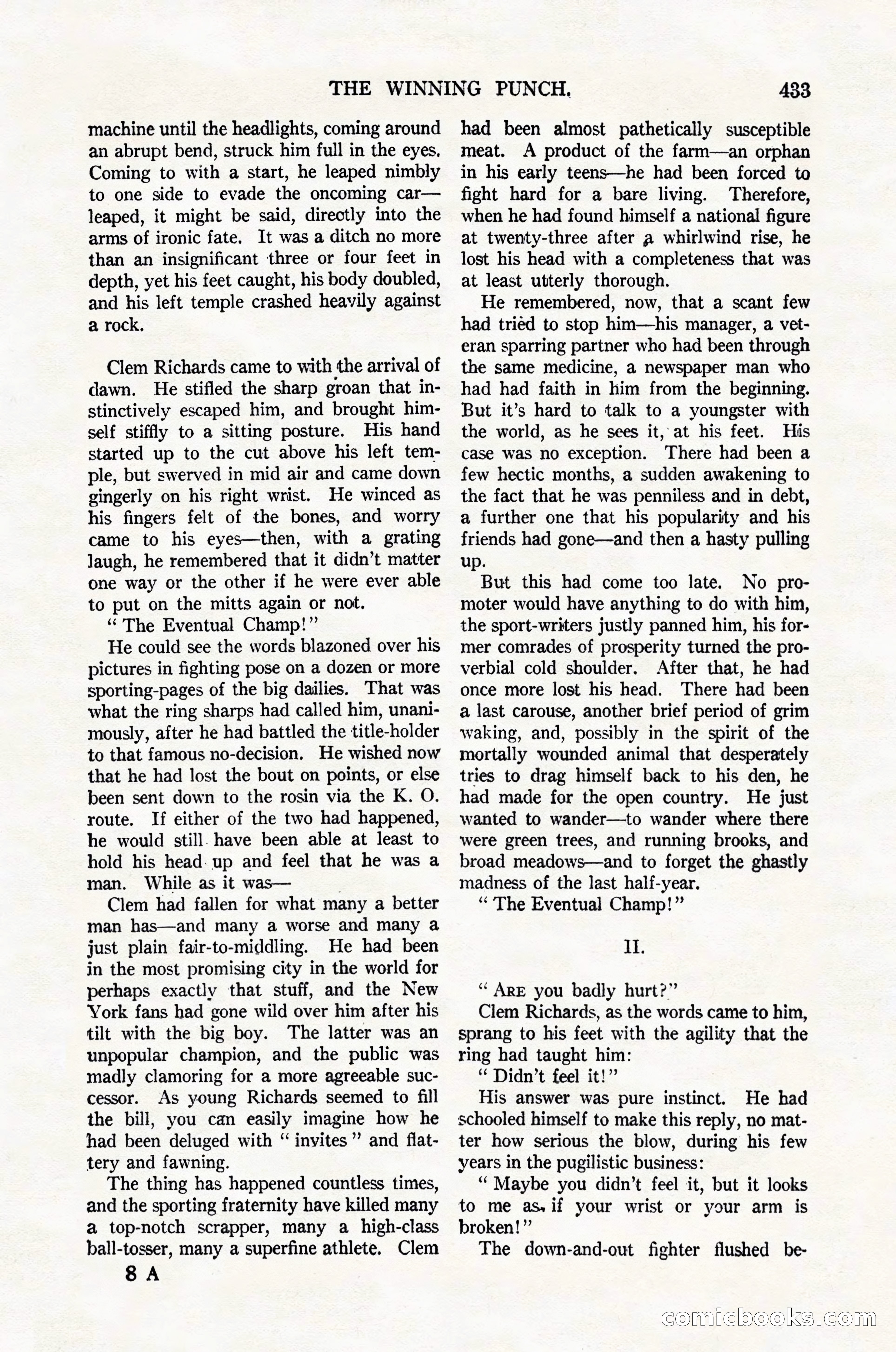
A restored page from Pulp Fiction, 1922. Page through the whole issue in the reader above.
📄 Transcribed text from this page (OCR, searchable)
Machine-transcribed from the original scan — historical spelling and the odd misread are preserved.
THE WINNING PUNCH. machine until the headlights, coming around an abrupt bend, struck him full in the eyes, Coming to with a start, he leaped nimbly to one side to evade the oncoming car— leaped, it might be said, directly into the arms of ironic fate. It was a ditch no more than an insignificant three or four feet in depth, yet his feet caught, his body doubled, and his left temple crashed heavily against a rock. Clem Richards came to with the arrival of dawn. He stifled the sharp groan that in- stinctively escaped him, and brought him- self stiffly to a sitting posture. His hand started up to the cut above his left tem- ple, but swerved in mid air and came down gingerly on his right wrist. He winced as his fingers felt of the bones, and worry came to his eyes—then, with a grating laugh, he remembered that it didn’t matter one way or the other if he were ever able to put on the mitts again or not. “The Eventual Champ!” He could see the words blazoned over his pictures in fighting pose on a dozen or more sporting-pages of the big dailies. That was what the ring sharps had called him, unani- mously, after he had battled the title-holder to that famous no-decision, He wished now that he had lost the bout on points, or else been sent down to the rosin via the K. O. - route. If either of the two had happened, he would still. have been able at least to hold his head. up and feel that he was a man. While as it was— Clem had fallen for what many a better man has—and many a worse and many a just plain fair-to-middling. He had been in the most promising city in the world for perhaps exactly that stuff, and the New York fans had gone wild over him after his tilt with the big boy. The latter was an unpopular champion, and the public was madly clamoring for a more agreeable suc- cessor. As young Richards seemed to fill the bill, you can easily imagine how he had been deluged with “ invites ” and flat- tery and fawning. The thing has happened countless times, and the sporting fraternity have killed many a top-notch scrapper, many a high-class ball-tosser, many a superfine athlete. Clem 8 A 433 had been almost pathetically susceptible meat. A product of the farm—an orphan in his early teens—he had been forced to fight hard for a bare living. Therefore, when he had found himself a national figure at twenty-three after a whirlwind rise, he lost his head with a completeness that was at least utterly thorough. He remembered, now, that a scant few had tried to stop him—his manager, a vet- eran sparring partner who had been through the same medicine, a newspaper man who had had faith in him from the beginning. But it’s hard to talk to a youngster with the world, as he sees it, at his feet. His case was no exception. There had been a few hectic months, a sudden awakening to the fact that he was penniless and in debt, a further one that his popularity and his friends had gone—and then a hasty pulling up. But this had come too late. No pro- moter would have anything to do with him, the sport-writers justly panned him, his for- mer comrades of prosperity turned the pro- verbial cold shoulder. After that, he had once more lost his head. ‘There had been a last carouse, another brief period of grim waking, and, possibly in the spirit of the mortally wounded animal that desperately tries to drag himself back to his den, he had made for the open country. He just wanted to wander—to wander where there were green trees, and running brooks, and broad meadows—and to forget the ghastly madness of the last half-year. “ The Eventual Champ!” II. “ ARE you badly hurt?” Clem Richards, as the words came to him, sprang to his feet with the agility that the ring had taught him: ‘ Didn’t feel it!” His answer was pure instinct. He had schooled himself to make this reply, no mat- ter how serious the blow, during his few years in the pugilistic business: “Maybe you didn’t feel it, but it looks to me as.if your wrist or your arm is broken! ”’ The down-and-out fighter flushed be- COmiclbooks.Gom