
Pulp Fiction, 1922 · page 101 of 178
Argosy All-Story Weekly, February 4, 1922 — page 101: what you’re looking at
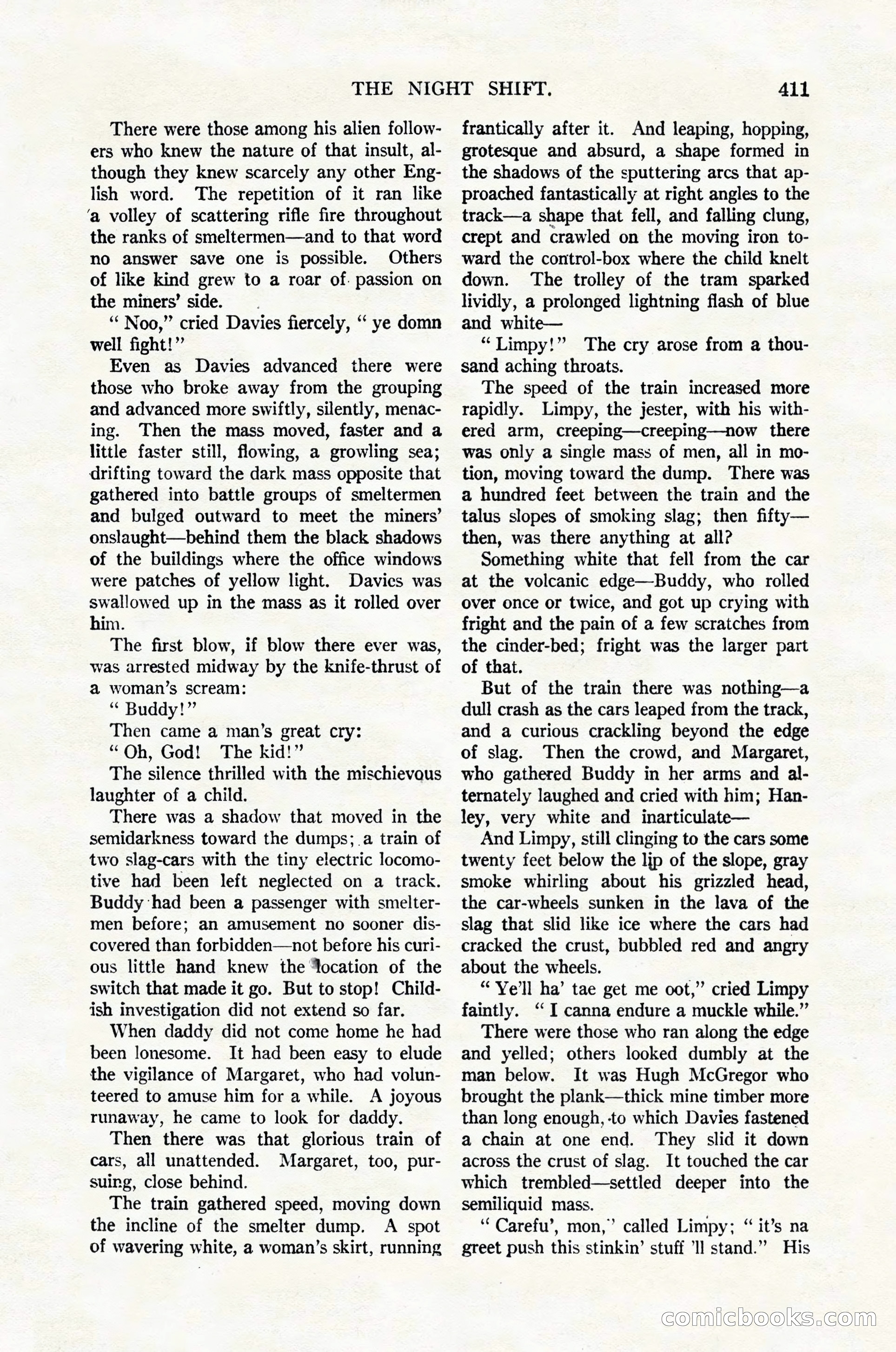
A restored page from Pulp Fiction, 1922. Page through the whole issue in the reader above.
📄 Transcribed text from this page (OCR, searchable)
Machine-transcribed from the original scan — historical spelling and the odd misread are preserved.
THE NIGHT SHIFT. There were those among his alien follow- ers who knew the nature of that insult, al- though they knew scarcely any other Eng- lish word. The repetition of it ran like ‘a volley of scattering rifle fire throughout the ranks of smeltermen—and to that word no answer save one is possible. Others of like kind grew to a roar of. passion on the miners’ side. “Noo,” cried Davies fiercely, “‘ ye domn well fight!” Even as Davies advanced there were those who broke away from the grouping and advanced more swiftly, silently, menac- ing. Then the mass moved, faster and a little faster still, flowing, a growling sea; drifting toward the dark mass opposite that gathered into battle groups of smeltermen and bulged outward to meet the miners’ onslaught—behind them the black shadows of the buildings where the office windows were patches of yellow light. Davies was swallowed up in the mass as it rolled over him. The first blow, if blow there ever was, was arrested midway by the knife-thrust of a woman’s scream: ‘“* Buddy!” Then came a man’s great cry: “Oh, God! The kid!” The silence thrilled with the mischievous laughter of a child. There was a shadow that moved in the semidarkness toward the dumps; a train of two slag-cars with the tiny electric locomo- tive had been left neglected on a track. Buddy ‘had been a passenger with smelter- men before; an amusement no sooner dis- covered than forbidden—not before his curi- ous little hand knew the Yocation of the switch that made it go. But to stop! Child- ish investigation did not extend so far. When daddy did not come home he had been lonesome. It had been easy to elude the vigilance of Margaret, who had volun- teered to amuse him for a while. A joyous runaway, he came to look for daddy. Then there was that glorious train of cars, all unattended. Margaret, too, pur- suing, close behind. The train gathered speed, moving down the incline of the smelter dump. A spot of wavering white, a woman’s skirt, running 411 frantically after it. And leaping, hopping, grotesque and absurd, a shape formed in the shadows of the sputtering arcs that ap- proached fantastically at right angles to the track—a shape that fell, and falling clung, crept and crawled on the moving iron to- ward the control-box where the child knelt down. The trolley of the tram sparked lividly, a prolonged lightning flash of blue and white— “Limpy!” The cry arose from a thou- sand aching throats. The speed of the train increased more rapidly. Limpy, the jester, with his with- ered arm, creeping—creeping—now there was only a single mass of men, all in mo- tion, moving toward the dump. There was a hundred feet between the train and the talus slopes of smoking slag; then fifty— then, was there anything at all? Something white that fell from the car at the volcanic edge—Buddy, who rolled over once or twice, and got up crying with fright and the pain of a few scratches from the cinder-bed; fright was the larger part of that. But of the train there was nothing—a dull crash as the cars leaped from the track, and a curious crackling beyond the edge of slag. Then the crowd, and Margaret, who gathered Buddy in her arms and al- ternately laughed and cried with him; Han- ley, very white and inarticulate— And Limpy, still clinging to the cars some twenty feet below the lip of the slope, gray smoke whirling about his grizzled head, the car-wheels sunken in the lava of the slag that slid like ice where the cars had cracked the crust, bubbled red and angry about the wheels. ““'Ye'll ha’ tae get me oot,” cried Limpy faintly. “I canna endure a muckle while.” There were those who ran along the edge and yelled; others looked dumbly at the man below. It was Hugh McGregor who brought the plank—thick mine timber more than long enough, -to which Davies fastened a chain at one end. They slid it down across the crust of slag. It touched the car which trembled—settled deeper into the semiliquid mass. ‘“Carefu’, mon,’ called Limpy; “ it’s na greet push this stinkin’ stuff ‘ll stand.” His COmiCbMooks.GoOnn