
Pulp Fiction, 1921 · page 93 of 146
Argosy All-Story Weekly, February 5, 1921 — page 93: what you’re looking at
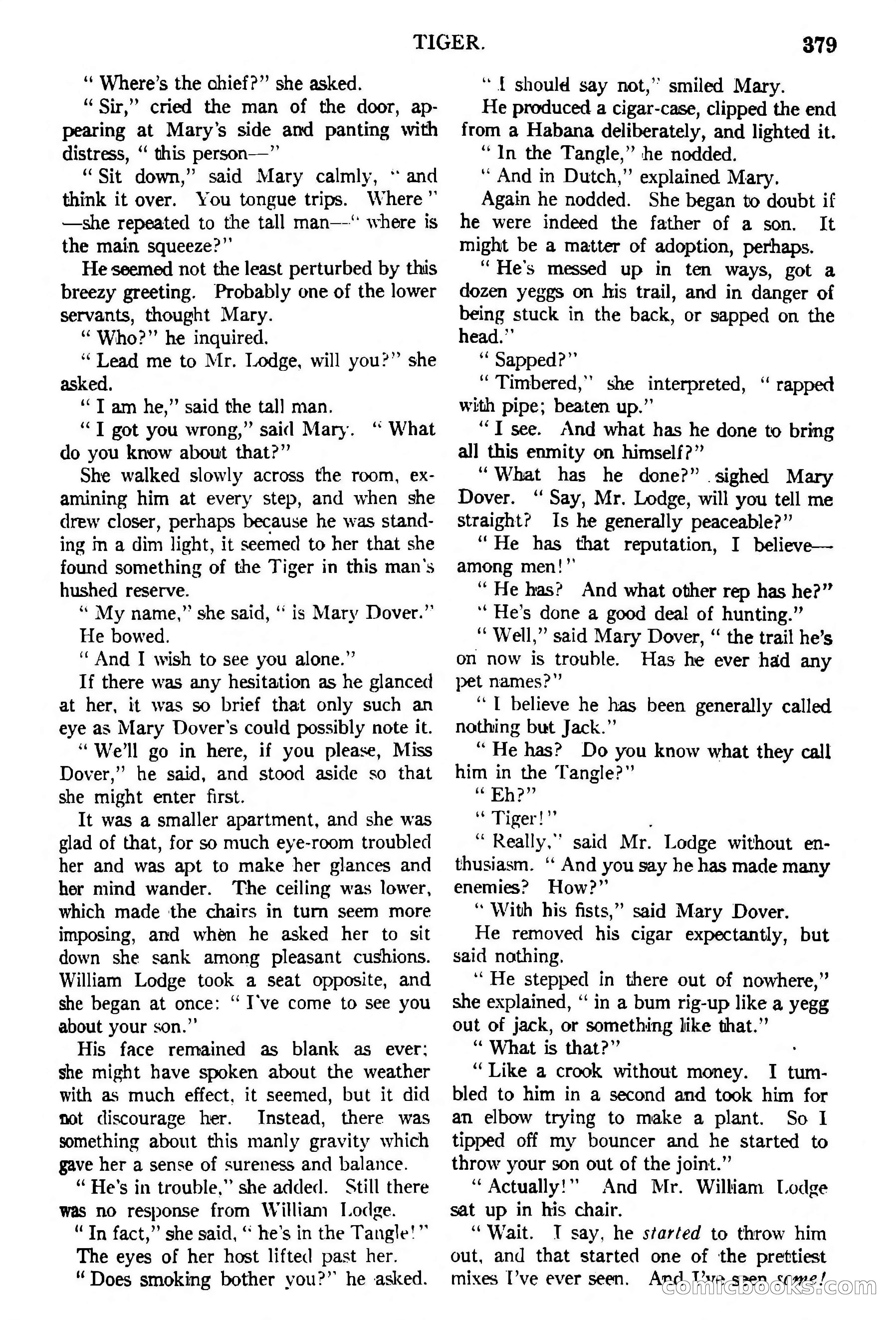
A restored page from Pulp Fiction, 1921. Page through the whole issue in the reader above.
📄 Transcribed text from this page (OCR, searchable)
Machine-transcribed from the original scan — historical spelling and the odd misread are preserved.
TIGER. 379 ‘‘ Where’s the chief?” she asked. “Sir,” cried the man of the door, ap- pearing at Mary’s side and panting with distress, “‘ this person—”’ “Sit down,” said Mary calmly, “ and think it over. You tongue trips. Where ” —she repeated to the tall man—-“ where ts the main squeeze?”’ He seemed not the least perturbed by this breezy greeting. Probably one of the lower servants, thought Mary. “Who?” he inquired. “Lead me to Mr. Lodge, will you?” she asked. ‘“‘T am he,” said the tal] man. ‘““T got you wrong,” said Mary. ‘ What do you know about that?” She walked slowly across the room, ex- amining him at every step, and when she drew closer, perhaps because he was stand- ing m a dim light, it seemed to her that she found something of the Tiger in this man’s hushed reserve. ‘“ My name,”’ she said, “ is Mary Dover.” He bowed. “And I wish to see you alone.” If there was any hesitation as he glanced at her, it was so brief that only such an eye as Mary Dover's could possibly note it. “We'll go in here, if you please, Miss Dover,’”’ he said, and stood aside so that she might enter first. It was a smaller apartment, and she was glad of that, for so much eye-room troubled her and was apt to make her glances and her mind wander. The ceiling was lower, which made the chairs in turn seem more imposing, amd when he asked her to sit down she sank among pleasant cushions. William Lodge took a seat opposite, and she began at once: “ I’ve come to see you about your son.” His face remained as blank as ever; she might have spoken about the weather with as much effect, it seemed, but it did mot discourage her. Instead, there was something about this manly gravity which gave her a sense of sureness and balance. “ He's in trouble,” she added. Still there was no response from William Lodge. “Tn fact,” she said, “ he’s in the Tangle!” The eyes of her host liftec! past her. “Does smoking bother vou?” he asked. “ { should say not,” smiled Mary. He produced a cigar-case, clipped the end from a Habana deliberately, and lighted it. ‘In the Tangle,” he nodded. ‘And in Dutch,” explained Mary. Again he nodded. She began to doubt if he were indeed the father of a son. It might be a matter of adoption, perhaps. ‘‘ He’s messed up in ten ways, got a dozen yeggs on his trail, and in danger of being stuck in the back, or sapped on the head.”’ ‘“ Sapped?”’ ‘Timbered,”’ she interpreted, ‘“ rapped with pipe; beaten up.”’ “I see. s\And what has he done to bring all this enmity on himself?” “What has he done?” sighed Mary Dover. ‘“ Say, Mr. Lodge, will you tell me Straight? Is he generally peaceable?”’ ‘“He has that reputation, I believe— among men!’’ ‘He has? And what other rep has he?” ‘‘ He’s done a good deal of hunting.” ‘ Well,” said Mary Dover, “ the trail he’s on now is trouble. Has he ever had any pet names?” ‘I believe he has been generally called nothing but Jack.”’ ‘“ He has? Do you know what they call him in the Tangle?” Ts Eh?”’ ‘ Tiger!” : “ Really, said Mr. Lodge without en- thusiasm. ‘‘ And you say he has made many enemies? How?’ “ With his fists,” said Mary Dover. He removed his cigar expectantly, but said nothing. ‘“ He stepped in there out of nowhere,” she explained, “‘ in a bum rig-up like a yegg out of jack, or something like that.” ‘What is that?” “Like a crook without money. I tum- bled to him in a second and took him for an elbow trying to make a plant. So I tipped off my bouncer and he started to throw your son out of the joint.” “Actually!” And Mr. William Lodge sat up in his chair. “Wait. I say, he started to throw him out, and that started one of the prettiest mixes T’ve ever seen. And Up sren scant lac