
Pulp Fiction, 1921 · page 79 of 146
Argosy All-Story Weekly, February 5, 1921 — page 79: what you’re looking at
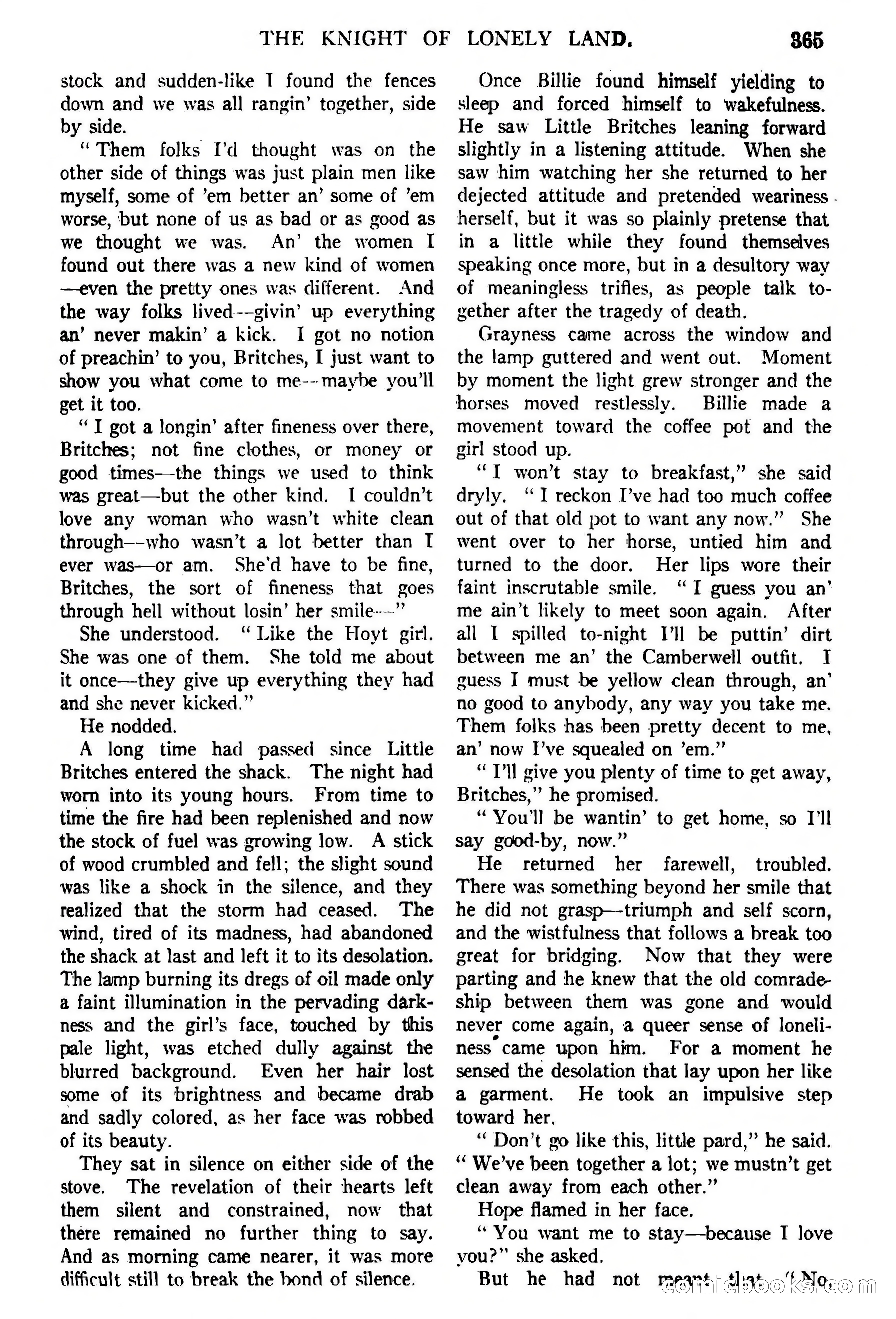
A restored page from Pulp Fiction, 1921. Page through the whole issue in the reader above.
📄 Transcribed text from this page (OCR, searchable)
Machine-transcribed from the original scan — historical spelling and the odd misread are preserved.
THE KNIGHT OF LONELY LAND. 365 stock and sudden-like I found the fences down and we was all rangin’ together, side by side. “Them folks I'd thought was on the other side of things was just plain men like myself, some of ’em better an’ some of ’em worse, ‘but none of us as bad or as good as we thought we was. An’ the women I found out there was a new kind of women —even the pretty ones was different. And the way folks lived--givin’ up everything an’ never makin’ a kick. I got no notion of preachin’ to you, Britches, I just want to show you what come to me--- maybe you'll get it too. ‘“T got a longin’ after fineness over there, Britches; not fine clothes, or money or good times—the things we used to think was great—but the other kind. I couldn’t love any woman who wasn’t white clean through—-who wasn’t a lot better than I ever was—or am. She'd have to be fine, Britches, the sort of fineness that goes through hell without losin’ her smile--”’ She understood. ‘Like the Hoyt girl. She was one of them. She told me about it once—they give up everything they had and she never kicked.”’ He nodded. A long time had passed since Little Britches entered the shack. The night had worn into its young hours. From time to time the fire had been replenished and now the stock of fuel was growing low. A stick of wood crumbled and fell; the slight sound was like a shock in the silence, and they realized that the storm had ceased. The wind, tired of its madness, had abandoned the shack at last and left it to its desolation. The lamp burning its dregs of oil made only a faint illumination in the pervading dark- ness and the girl’s face, touched by this pale light, was etched dully against the blurred background. Even her hair lost some of its brightness and became drab and sadly colored, as her face was robbed of its beauty. They sat in silence on either side of the stove. The revelation of their hearts left them silent and constrained, now that there remained no further thing to say. And as morning came nearer, it was more difficult still to break the bond of silence. Once Billie found himself yielding to sleep and forced himself to wakefulness. He saw Little Britches leaning forward slightly in a listening attitude. When she saw him watching her she returned to her dejected attitude and pretended weariness - herself, but it was so plainly pretense that in a little while they found themselves speaking once more, but in a desultory way of meaningless trifles, as people talk to- gether after the tragedy of death. Grayness came across the window and the lamp guttered and went out. Moment by moment the light grew stronger and the horses moved restlessly. Billie made a movement toward the coffee pot and the girl stood up. ‘““T won’t stay to breakfast,” she said dryly. ‘I reckon I’ve had too much coffee out of that old pot to want any now.” She went over to her horse, untied him and turned to the door. Her lips wore their faint inscrutable smile. ‘I guess you an’ me ain’t likely to meet soon again. After all I spilled to-night I’ll be puttin’ dirt between me an’ the Camberwell outfit. I guess I must be yellow clean through, an’ no good to anybody, any way you take me. Them folks has been pretty decent to me, an’ now I’ve squealed on ’em.” “Til give you plenty of time to get away, Britches,” he promised. “You'll be wantin’ to get home, so I'll say good-by, now.” He returned her farewell, troubled. There was something beyond her smile that he did not grasp—-triumph and self scorn, and the wistfulness that follows a break too great for bridging. Now that they were parting and he knew that the old comrade ship between them was gone and would never come again, a queer sense of loneli- ness came upon him. For a moment he sensed the desolation that lay upon her like a garment. He took an impulsive step toward her. “Don’t go like this, little pard,” he said. ‘““ We’ve been together a lot; we mustn’t get clean away from each other.” Hope flamed in her face. ‘You want me to stay—because I love vou?” she asked, But he had not meaty dlatyolt Noro