
Pulp Fiction, 1921 · page 57 of 146
Argosy All-Story Weekly, February 5, 1921 — page 57: what you’re looking at
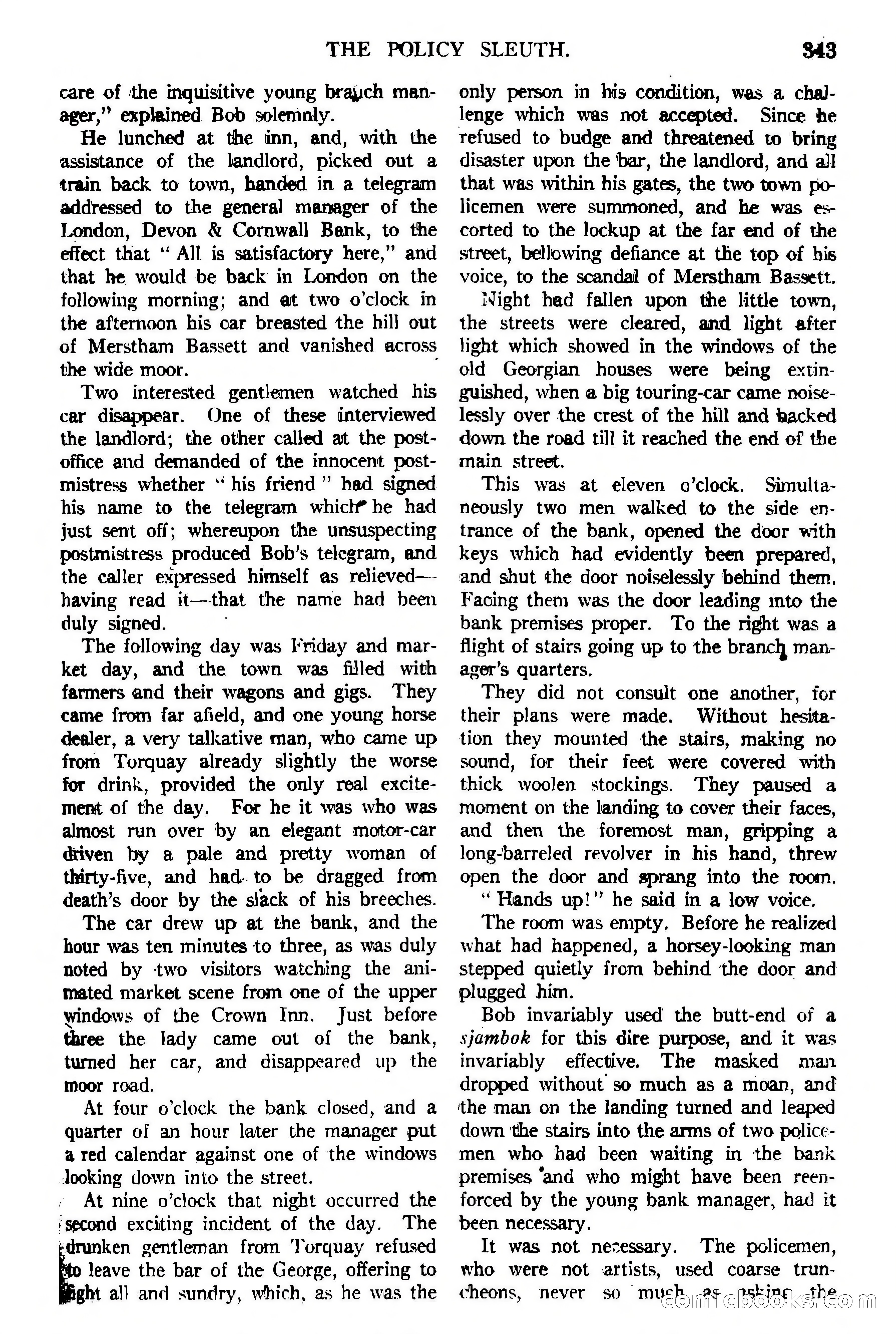
A restored page from Pulp Fiction, 1921. Page through the whole issue in the reader above.
📄 Transcribed text from this page (OCR, searchable)
Machine-transcribed from the original scan — historical spelling and the odd misread are preserved.
THE POLICY care of the inquisitive young braych men- ager,’”’ explained Bob solemnly. He lunched at the inn, and, with the assistance of the landlord, picked out a train back to town, handed in a telegram addressed to the general manager of the London, Devon & Cornwall Bank, to the effect that ‘‘ All is satisfactory here,” and that he would be back in London on the following morning; and at two o'clock in the afternoon his car breasted the hill out of Merstham Bassett and vanished across the wide moor. Two interested gentlemen watched his car disappear. One of these interviewed the landlord; the other called at the post- office and demanded of the innocent post- mistress whether ‘‘ his friend” had signed his name to the telegram which’ he had just sent off; whereupon the unsuspecting postmistress produced Bob’s telegram, and the caller expressed himself as relieved— having read it—-that the name had heen duly signed. The following day was I*nday and mar- ket day, and the town was filled with farmers and their wagons and gigs. They came from far afield, and one young horse dealer, a very talkative man, who came up from Torquay already slightly the worse for drink, provided the only real excite- memt of the day. For he it was who was almost run over by an elegant motor-car driven by a pale and pretty woman of thirty-five, and had. to be dragged from death’s door by the slack of his breeches. The car drew up at the bank, and the hour was ten minutes to three, as was duly noted by two visitors watching the ani- mated market scene from one of the upper windows of the Crown Inn. Just before three the lady came out of the bank, turned her car, and disappeared up the moor road. At four o’clock the bank closed, and a quarter of an hour later the manager put a red calendar against one of the windows looking down into the street. At nine o’clock that night occurred the ‘second exciting incident of the day. The rdrunken gentleman from ‘Torquay refused pe ev the bar of the George, offering to ght all and sundry, which, as he was the $43 only person in his condition, was a chal- lenge which was not accepted. Since he refused to budge and threatened to bring disaster upon the bar, the landlord, and a] that was within his gates, the two town po- licemen were summoned, and he was es- corted to the lockup at the far end of the street, bellowing defiance at the top of his voice, to the scandal of Merstham Bassett. Wight had fallen upon the little town, the streets were cleared, and light after light which showed in the windows of the old Georgian houses were being extin- guished, when a big touring-car came noise- lessly over the crest of the hill and hacked down the road till it reached the end of the main. street. This was at eleven o’clock. Simulta- neously two men walked to the side en- trance of the bank, opened the door with keys which had evidently been prepared, and shut the door noiselessly behind them. Facing them was the door leading into the bank premises proper. To the right was a flight of stairs going up to the branch man- ager’s quarters. They did not consult one another, for their plans were made. Without hesita- tion they mounted the stairs, making no sound, for their feet were covered with thick woolen stockings. They paused a moment on the landing to cover their faces, and then the foremost man, gripping a Jong-barreled revolver in his hand, threw open the door and sprang into the room. ‘Hands up!’”’ he said in a low voice. The room was empty. Before he realized what had happened, a horsey-looking man stepped quietly from behind the door and plugged him. Bob invariably used the butt-end of a sjambok for this dire purpose, and it was invariably effective. The masked man dropped without so much as a moan, and ‘the man on the landing turned and leaped down ‘the stairs into the arms of two police- men who had been waiting in the bank premises ‘and who might have been reen- forced by the young bank manager, had it been necessary. It was not necessary. The pclicemen, who were not artists, used coarse trun- SLEUTH. cheons, never so mush) as -2skineiccth@o im