
Pulp Fiction, 1921 · page 55 of 146
Argosy All-Story Weekly, February 5, 1921 — page 55: what you’re looking at
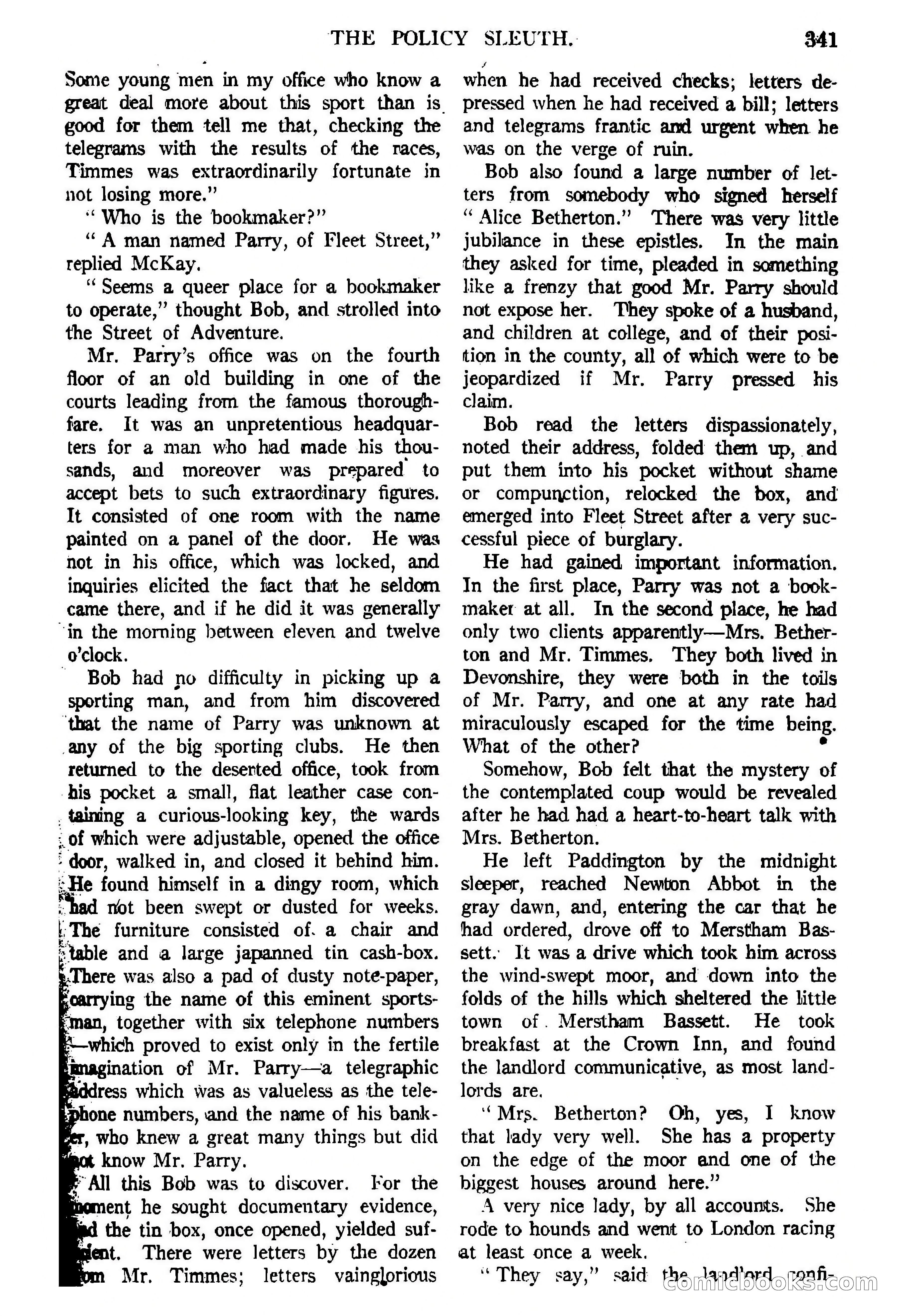
A restored page from Pulp Fiction, 1921. Page through the whole issue in the reader above.
📄 Transcribed text from this page (OCR, searchable)
Machine-transcribed from the original scan — historical spelling and the odd misread are preserved.
‘THE POLICY SLEUTH. Some young men in my office who know a great deal more about this sport than is good for them tell me that, checking the telegrams with the results of the races, Timmes was extraordinarily fortunate in not losing more.” ‘“Who is the bookmaker?” ‘‘ A man named Parry, of Fleet Street,” replied McKay. “Seems a queer place for a bookmaker to operate,” thought Bob, and strolled into the Street of Adventure. Mr. Parry’s office was on the fourth floor of an old building in one of the courts leading from the famous thorough- fare. It was an unpretentious headquar- ters for a man who had made his thou- sands, and moreover was prepared to accept bets to such extraordinary figures. It consisted of one room with the name painted on a panel of the door. He was not in his office, which was locked, and inquiries elicited the fact that he seldom came there, and if he did it was generally “in the morning between eleven and twelve o'clock. Bob had no difficulty in picking up a sporting man, and from him discovered ‘that the name of Parry was unknown at any of the big sporting clubs. He then returned to the deserted office, took from his pocket a small, flat leather case con- .taining a curious-looking key, the wards of which were adjustable, opened the office : door, walked in, and closed it behind him. «He found himself in a dingy room, which 4 mot been swept or dusted for weeks. | The furniture consisted of. a chair and table and a large japanned tin cash-box. :-There was also a pad of dusty note-paper, roarrying the name of this eminent sports- ;man, together with six telephone numbers e—which proved to exist only in the fertile smnagination of Mr. Parry—a telegraphic baddress which was as valueless as the tele- tphone numbers, and the name of his bank- Fer, who knew a great many things but did weak know Mr. Parry. F All this Bob was to discover. For the Bnoment he sought documentary evidence, ad the tin box, once opened, yielded suf- There were letters by the dozen Mr. Timmes; letters vainglorious 341 when he had received checks; letters de- pressed when he had received a bill; letters and telegrams frantic and urgent when he was on the verge of ruin. Bob also found a large number of let- ters from somebody who signed herself “Alice Betherton.” There was very little jubilance in these epistles. In the main they asked for time, pleaded in something like a frenzy that good Mr. Parry should not expose her. They spoke of a husband, and children at college, and of their posi- tion in the county, all of which were to be jeopardized if Mr. Parry pressed his claim. Bob read the letters dispassionately, noted their address, folded them up, and put them into his pocket without shame or compunction, relocked the box, and emerged into Fleet Street after a very suc- cessful piece of burglary. He had gained important information. In the first place, Parry was not a book- maker at all. In the second place, he had only two clients apparently—Mrs. Bether- ton and Mr. Timmes, They both lived in Devonshire, they were both in the toils of Mr. Parry, and one at any rate had miraculously escaped for the time being. What of the other? Somehow, Bob felt that the mystery of the contemplated coup would be revealed after he had had a heart-to-heart talk with Mrs. Betherton. He left Paddington by the midnight sleeper, reached Newton Abbot in the gray dawn, and, entering the car that he had ordered, drove off to Merstham Bas- sett. It was a drive which took him across the wind-swept moor, and down into the folds of the hills which sheltered the little town of. Merstham Bassett. He took breakfast at the Crown Inn, and found the landlord communicative, as most land- lords are. ‘“Mrs. Betherton? Oh, yes, I know that lady very well. She has a property on the edge of the moor and one of the biggest houses around here.” A very nice lady, by all accounts. She rode to hounds and went to London racing at least once a week.