
Pulp Fiction, 1921 · page 39 of 146
Argosy All-Story Weekly, February 5, 1921 — page 39: what you’re looking at
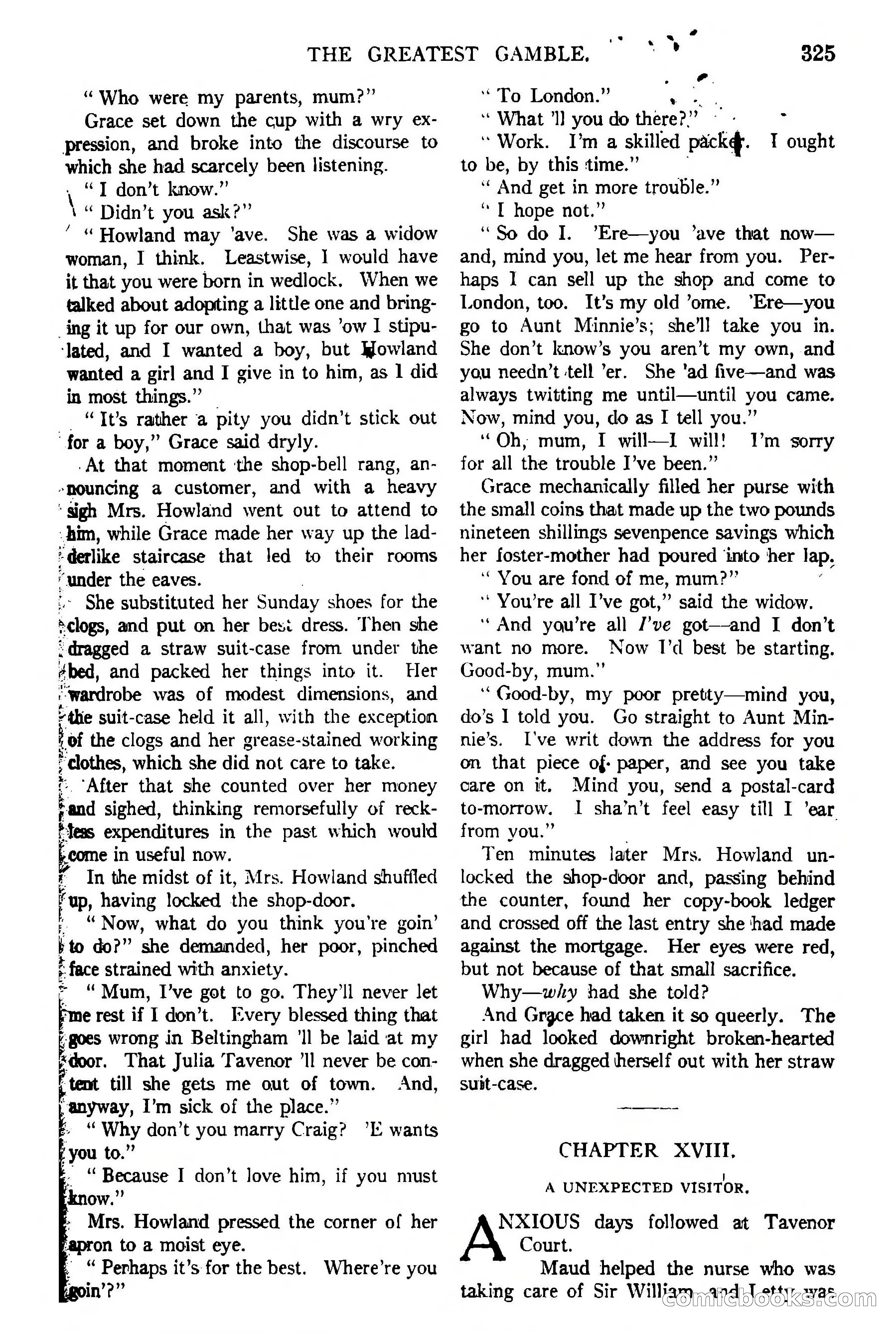
A restored page from Pulp Fiction, 1921. Page through the whole issue in the reader above.
📄 Transcribed text from this page (OCR, searchable)
Machine-transcribed from the original scan — historical spelling and the odd misread are preserved.
THE GREATEST GAMBLE, “Who were my parents, mum?” Grace set down the cup with a wry ex- pression, and broke into the discourse to which she had scarcely been listening. , “T don’t know.” \ “ Didn’t you ask?” ‘ “ Howland may ‘ave. She was a widow woman, I think. Leastwise, 1 would have it that you were born in wedlock. When we talked about adopting a little one and bring- _ing it up for our own, that was ‘ow I stipu- ‘lated, and I wanted a boy, but Howland wanted a girl and I give in to him, as | did in most things.” — “Tt’s rather a pity you didn’t stick out ‘for a boy,” Grace said dryly. .At that moment the shop-bell rang, an- -pouncing a customer, and with a heavy ‘sigh Mrs. Howland went out to attend to Am, while Grace made her way up the lad- -detlike staircase that led to their rooms “under the eaves. - She substituted her Sunday shoes for the dogs, and put on her bes: dress. Then she . dragged a straw suit-case from under the bed, and packed her things into it. Her wardrobe was of modest dimensions, and “the suit-case held it all, with the exception of the clogs and her grease-stained working : * clothes, which she did not care to take. “After that she counted over her money + and sighed, thinking remorsefully of reck- Teas expenditures in the past which would -come in useful now. * In the midst of it, Mrs. Howland shuffled } UP, having locked the shop-door. ' “Now, what do you think you're goin’ } to do?” she demanded, her poor, pinched ; face strained with anxiety. - “Mum, I’ve got to go. They'll never let Sme rest if I don’t. Every blessed thing that goes wrong in Beltingham 'll be laid at my a, That Julia Tavenor ’ll never be con- tent till she gets me out of town. And, anyway, I’m sick of the place.” ; “Why don’t you marry Craig? Z you to.” :. “ Because I don’t love him, if you must know.” Mrs. Howland pressed the corner of her ‘apron to a moist eye. . “ Perhaps it’s for the best. 4 in’?”’ TL wants Where’re you = * 325 o ‘To London.” 7 ‘* What ’l] you do there?” a : “Work. I’ma skilled packe. T ought to be, by this time.” ‘“ And get in more trouble.” “ T hope not.” ‘So do I. ’Ere—you ’ave that now— and, mind you, let me hear from you. Per- haps I can sell up the shop and come to London, too. It’s my old ’ome. ‘'Ere—you go to Aunt Minnie’s; she'll take you in. She don’t know’s you aren’t my own, and you needn’t tell ’er. She ‘ad five—and was always twitting me until—until you came. Now, mind you, do as I tell you.” ‘“Oh, mum, I will—I will! I’m sorry for all the trouble I’ve been.” Grace mechanically filled her purse with the small coins that made up the two pounds nineteen shillings sevenpence savings which her foster-mother had poured ‘into her lap, ‘You are fond of me, mum?”’ ‘‘ Youre all I’ve got, ; said the widow. ‘“And you’re all /’ve got—-and I don’t want no more. Now I’d best be starting. Good-by, mum.”’ ‘“Good-by, my poor pretty—mind you, do’s I told you. Go straight to Aunt Min- nie’s. I've writ down the address for you on that piece of: paper, and see you take care on it. Mind you, send a postal-card to- ‘morrow. I sha’n’t feel easy till I ’ear from you.’ Ten minutes later Mrs. Howland un- locked the shop-door and, passing behind the counter, found her copy-book ledger and crossed off the last entry she had made against the mortgage. Her eyes were red, but not because of that small sacrifice. Why—wihy had she told? And Grgce had taken it so queerly. The girl had looked downright broken-hearted when she dragged herself out with her straw Suit-case. CHAPTER XVIII, A UNEXPECTED VISITOR, NXIOUS days followed at Tavenor Court. Maud helped the nurse who was taking care of Sir William andiletsyavass inn