
Pulp Fiction, 1921 · page 31 of 146
Argosy All-Story Weekly, February 5, 1921 — page 31: what you’re looking at
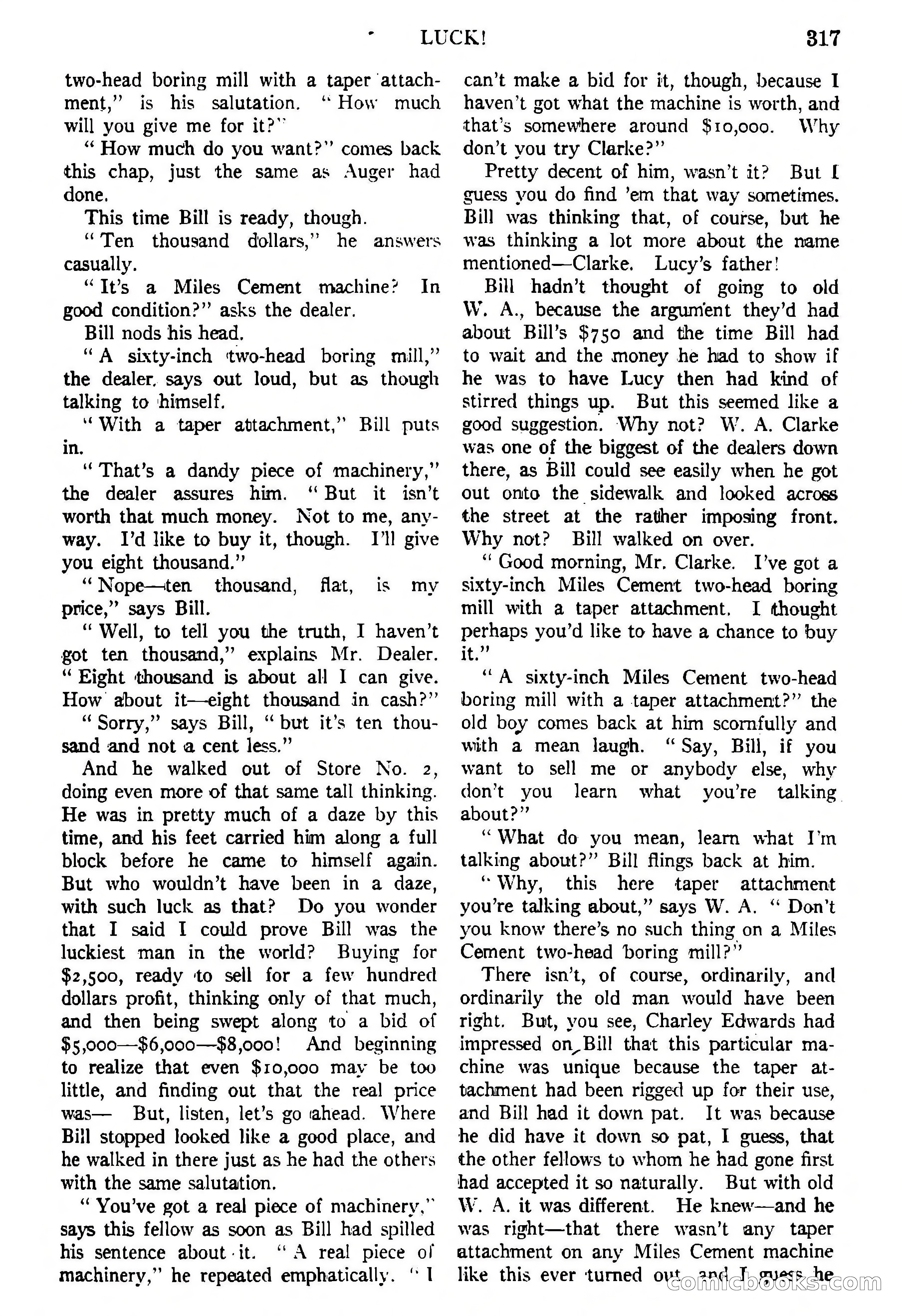
A restored page from Pulp Fiction, 1921. Page through the whole issue in the reader above.
📄 Transcribed text from this page (OCR, searchable)
Machine-transcribed from the original scan — historical spelling and the odd misread are preserved.
. LUCK! two-head boring mill with a taper ‘attach- ment,” is his salutation. ‘* How much will you give me for it?” ‘“* How much do you want?” comes back this chap, just the same as Auger had done. This time Bill is ready, though. “Ten thousand dollars,” he answers casually. “Tt’s a Miles Cement machine’ In good condition?”’ asks the dealer. Bill nods his head. “ A sixty-inch two-head boring mill,” the dealer. says out loud, but as though talking to ‘himself. “With a taper attachment,” Bill puts in. ‘“That’s a dandy piece of machinery,” the dealer assures him. ‘But it isn’t worth that much money. Not to me, any- way. I’d like to buy it, though. I'll give you eight thousand.” ‘““Nope—ten thousand, flat, is price,” says Bill. “Well, to tell you the truth, I haven’t got ten thousand,” explains Mr. Dealer. “Eight thousand is about all I can give. How about it—eight thousand in cash?” “ Sorry,” says Bill, ‘but it’s ten thou- sand and not a cent less.”’ And he walked out of Store No. 2, doing even more of that same tall thinking. He was in pretty much of a daze by this time, and his feet carried him along a full block before he came to himself again. But who wouldn’t have been in a daze, with such luck as that? Do you wonder that I said I could prove Bill was the luckiest man in the world? Buying for $2,500, ready ‘to sell for a few hundred dollars profit, thinking only of that much, and then being swept along to a bid of $5,000—$6,000—$8,o00! And _ beginning to realize that even $10,000 may be too little, and finding out that the real price was— But, listen, let’s go ahead. Where Bil stopped looked like a good place, and he walked in there just as he had the others with the same salutation. “You've got a real piece of machinery,” says this fellow as soon as Bill had spilled his sentence about -it. ‘‘ A real piece o/ machinery,” he repeated emphatically. ° I my 317 can’t make a bid for it, though, because I haven’t got what the machine is worth, and that’s somewhere around $10,000. Why don’t vou try Clarke?” Pretty decent of him, wasn’t it? But [ guess vou do find ’em that way sometimes. Bill was thinking that, of course, but he was thinking a lot more about the name mentioned—Clarke. Lucy’s father! Bill hadn’t thought of going to old W. A., because the argument they’d had about Bill’s $750 and the time Bill had to wait and the money he had to show if he was to have Lucy then had kind of stirred things up. But this seemed like a good suggestion. Why not? W. A. Clarke was one of the biggest of the dealers down there, as Bill could see easily when he got out onto the sidewalk and looked across the street at the rather imposing front. Why not? Bill walked on over. “Good morning, Mr. Clarke. I’ve got a sixty-inch Miles Cement two-head boring mill with a taper attachment. I thought perhaps you’d like to have a chance to buy it.”’ “A sixty-inch Miles Cement two-head boring mill with a taper attachment?” the old boy comes back at him scornfully and with a mean Jaugh. “Say, Bill, if you want to sell me or anybody else, why don’t you learn what about?” “What do you mean, learn what I’m talking about?” Bill flings back at him. “Why, this here taper attachment you’re talking about,” says W. A. “ Don’t you know there’s no such thing on a Miles Cement two-head boring mill?” There isn’t, of course, ordinarily, and ordinarily the old man would have been right. But, vou see, Charley Edwards had impressed on_ Bill that this particular ma- chine was unique because the taper at- tachment had been rigged up for their use, and Bill had it down pat. It was because he did have it down so pat, I guess, that the other fellows to whom he had gone first had accepted it so naturally. But with old W. A. it was different. He knew—and he was right—that there wasn’t any taper attachment on any Miles Cement machine like this ever ‘turned oYto and dimers dieas you're talking