
Pulp Fiction, 1921 · page 16 of 146
Argosy All-Story Weekly, February 5, 1921 — page 16: what you’re looking at
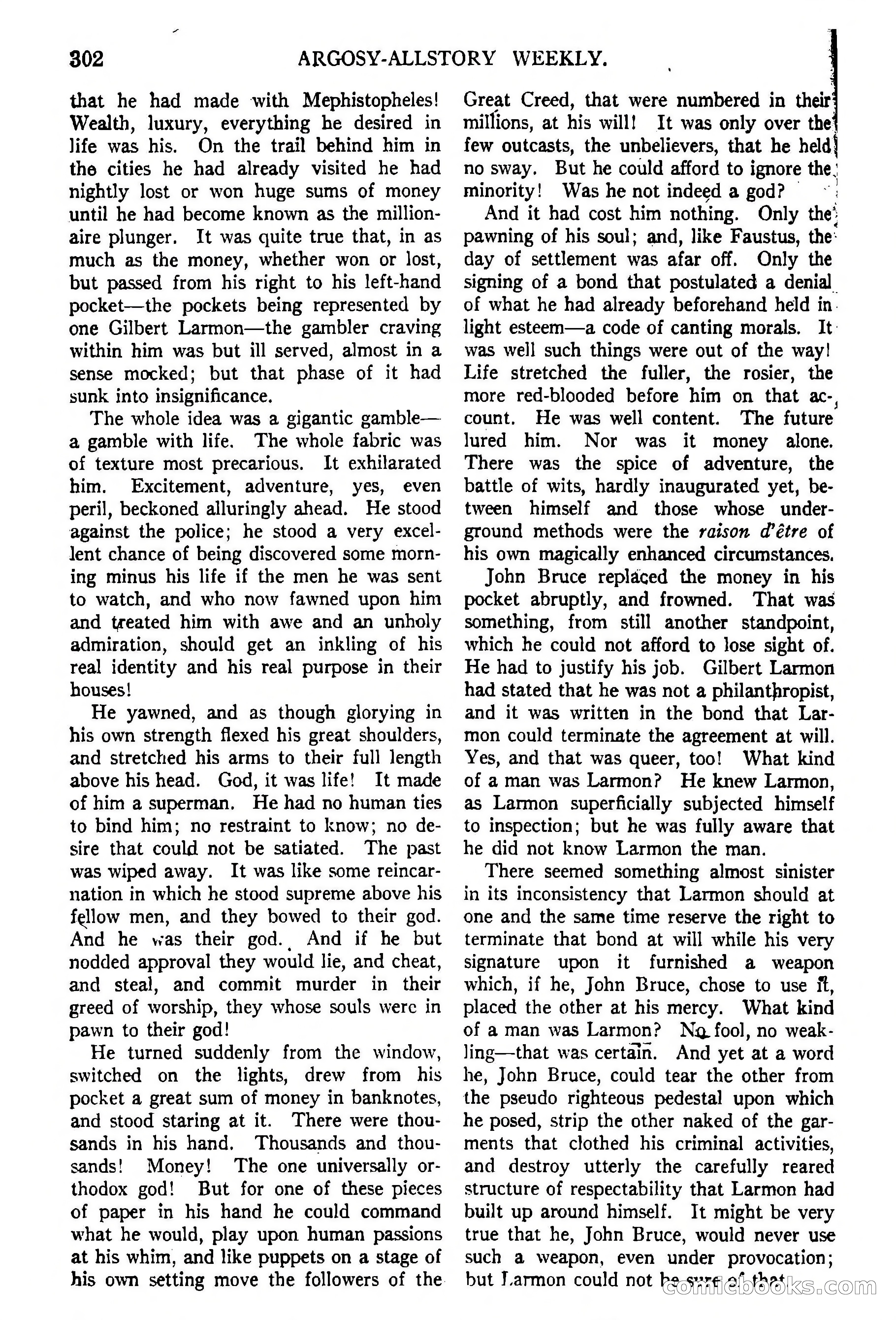
A restored page from Pulp Fiction, 1921. Page through the whole issue in the reader above.
📄 Transcribed text from this page (OCR, searchable)
Machine-transcribed from the original scan — historical spelling and the odd misread are preserved.
302 that he had made with Mephistopheles! Wealth, luxury, everything he desired in life was his. On the trail behind him in the cities he had already visited he had nightly lost or won huge sums of money until he had become known as the million- aire plunger. It was quite true that, in as much as the money, whether won or lost, but passed from his right to his left-hand pocket—the pockets being represented by one Gilbert Larmon—the gambler craving within him was but ill served, almost in a sense mocked; but that phase of it had sunk into insignificance. The whole idea was a gigantic gamble— a gamble with life. The whole fabric was of texture most precarious. It exhilarated him. Excitement, adventure, yes, even peril, beckoned alluringly ahead. He stood against the police; he stood a very excel- lent chance of being discovered some morn- ing minus his life if the men he was sent to watch, and who now fawned upon him and treated him with awe and an unholy admiration, should get an inkling of his real identity and his real purpose in their houses! He yawned, and as though glorying in his own strength flexed his great shoulders, and stretched his arms to their full length above his head. God, it was life! It made of him a superman. He had no human ties to bind him; no restraint to know; no de- sire that could not be satiated. The past was wiped away. It was like some reincar- nation in which he stood supreme above his fellow men, and they bowed to their god. And he was their god. And if he but nodded approval they would lie, and cheat, and steal, and commit murder in their greed of worship, they whose souls were in pawn to their god! He turned suddenly from the window, switched on the lights, drew from his pocket a great sum of money in banknotes, and stood staring at it. There were thou- sands in his hand. Thousands and thou- sands! Money! The one universally or- thodox god! But for one of these pieces of paper in his hand he could command what he would, play upon human passions at his whim, and like puppets on a stage of his own setting move the followers of the. ARGOSY-ALLSTORY WEEKLY. Great Creed, that were numbered in their millions, at his will! It was only over the’ few outcasts, the unbelievers, that he held! no sway. But he could afford to ignore the: minority! Was he not indeed a god? ~ And it had cost him nothing. Only the’ pawning of his soul; and, like Faustus, the: day of settlement was afar off. Only the signing of a bond that postulated a denial of what he had already beforehand held in. light esteem—a code of canting morals. It: was well such things were out of the way! Life stretched the fuller, the rosier, the more red-blooded before him on that ac-, count. He was well content. The future lured him. Nor was it money alone. There was the spice of adventure, the battle of wits, hardly inaugurated yet, be- tween himself and those whose under- ground methods were the raison d’étre of his own magically enhanced circumstances. John Bruce replaced the money in his pocket abruptly, and frowned. That was something, from still another standpoint, which he could not afford to lose sight of. He had to justify his job. Gilbert Larmon had stated that he was not a philanthropist, and it was written in the bond that Lar- mon could terminate the agreement at will. Yes, and that was queer, too! What kind of a man was Larmon? He knew Larmon, as Larmon superficially subjected himself to inspection; but he was fully aware that he did not know Larmon the man. There seemed something almost sinister in its inconsistency that Larmon should at one and the same time reserve the right to terminate that bond at will while his very signature upon it furnished a weapon which, if he, John Bruce, chose to use ft, placed the other at his mercy. What kind of a man was Larmon? Ng fool, no weak- ling—that was certain. And yet at a word he, John Bruce, could tear the other from the pseudo righteous pedestal upon which he posed, strip the other naked of the gar- ments that clothed his criminal activities, and destroy utterly the carefully reared structure of respectability that Larmon had built up around himself. It might be very true that he, John Bruce, would never use such a weapon, even under provocation; but Larmon could not beware alsthaticc CO