
Pulp Fiction, 1921 · page 112 of 146
Argosy All-Story Weekly, February 5, 1921 — page 112: what you’re looking at
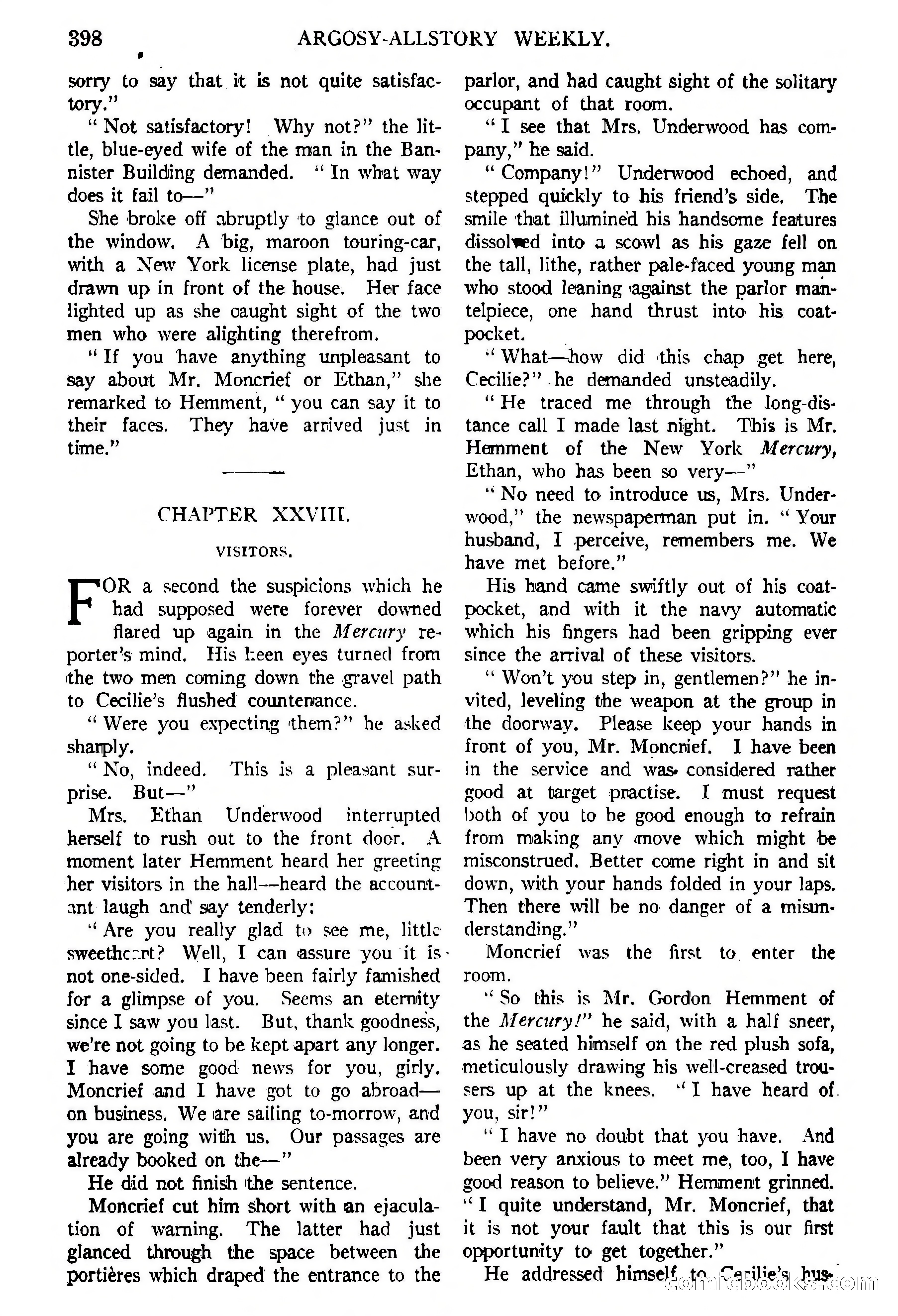
A restored page from Pulp Fiction, 1921. Page through the whole issue in the reader above.
📄 Transcribed text from this page (OCR, searchable)
Machine-transcribed from the original scan — historical spelling and the odd misread are preserved.
398 r sorry to say that it is not quite satisfac- tory.” “Not satisfactory! Why not?” the lit- tle, blue-eyed wife of the man in the Ban- nister Building demanded. ‘‘ In what way does it fail to—” She broke off abruptly to glance out of the window. A big, maroon touring-car, with a New York license plate, had just drawn up in front of the house. Her face lighted up as she caught sight of the two men who were alighting therefrom. ‘“Tf you have anything unpleasant to say about Mr. Moncrief or Ethan,” she remarked to Hemment, ‘“‘ you can say it to their faces. They have arrived just in time.” CHAPTER XXVIII. VISITORS. OR a second the suspicions which he had supposed were forever downed flared up again in the AMfercury re- porter’s mind. His keen eyes turned from tthe two men coming down the gravel path to Cecilie’s flushed countenance. ‘Were you expecting them?” he asked sharply. ‘No, indeed. This is a pleasant sur- prise. But—” Mrs. Ethan Underwood _ interrupted herself to rush out to the front docr. A moment later Hemment heard her greeting her visitors in the hall-—heard the account- ant laugh and say tenderly: ‘Are you really glad to see me, little sweethc-rt? Well, I can assure you ‘it is- not one-sided. I have been fairly famished for a glimpse of you. Seems an eternity since I saw you last. But, thank goodness, we're not going to be kept apart any longer. I have some good news for you, girly. Moncrief and I have got to go abroad— on business. We are sailing to-morrow, and you are going with us. Our passages are already booked on the—” He did not finish 'the sentence. Moncrief cut him short with an ejacula- tion of warning. The latter had just glanced through the space between the portieres which draped the entrance to the ARGOSY-ALLSTORY WEEKLY. parlor, and had caught sight of the solitary occupant of that room. ‘IT see that Mrs. Underwood has com- pany,” he said. “Company!” Underwood echoed, and stepped quickly to his friend’s side. The smile that illumined his handsome features dissolwed into a scowl as his gaze fell on the tall, lithe, rather pale-faced young man who stood leaning against the parlor man- telpiece, one hand thrust into his coat- pocket. | ‘“What—how did this chap get here, Cecilie?” .he demanded unsteadily. ‘“He traced me through the long-dis- tance call I made last night. This is Mr. Hemment of the New York Mercury, Ethan, who has been so very—”’ ‘“No need to introduce us, Mrs. Under- wood,” the newspaperman put in. ‘ Your husband, I perceive, remembers me. We have met before.” His hand came swiftly out of his coat- pocket, and with it the navy automatic which his fingers had been gripping ever since the arrival of these visitors. ‘Won't you step in, gentlemen?” he in- vited, leveling the weapon at the group in the doorway. Please keep your hands in front of you, Mr. Moncrief. I have been in the service and was considered rather good at target practise. I must request both of you to be good enough to refrain from making any move which might be misconstrued. Better come right in and sit down, with your hands folded in your laps. Then there will be no danger of a misun- clerstanding.” Moncrief was the first to enter the room. “So this is Mr. Gordon Hemment of the Afercury/” he said, with a half sneer, as he seated himself on the red plush sofa, meticulously drawing his well-creased trou- sers up at the knees. you, sir!” ‘“T have no doubt that you have. And been very anxious to meet me, too, I have good reason to believe.’”? Hemment grinned. ‘“T quite understand, Mr. Moncrief, that It is not your fault that this is our first opportunity to get together.’ He addressed himself ta. Cerilie’s bug. ‘“T have heard of.