
Pulp Fiction, 1921 · page 104 of 146
Argosy All-Story Weekly, February 5, 1921 — page 104: what you’re looking at
A restored page from Pulp Fiction, 1921. Page through the whole issue in the reader above.
📄 Transcribed text from this page (OCR, searchable)
Machine-transcribed from the original scan — historical spelling and the odd misread are preserved.
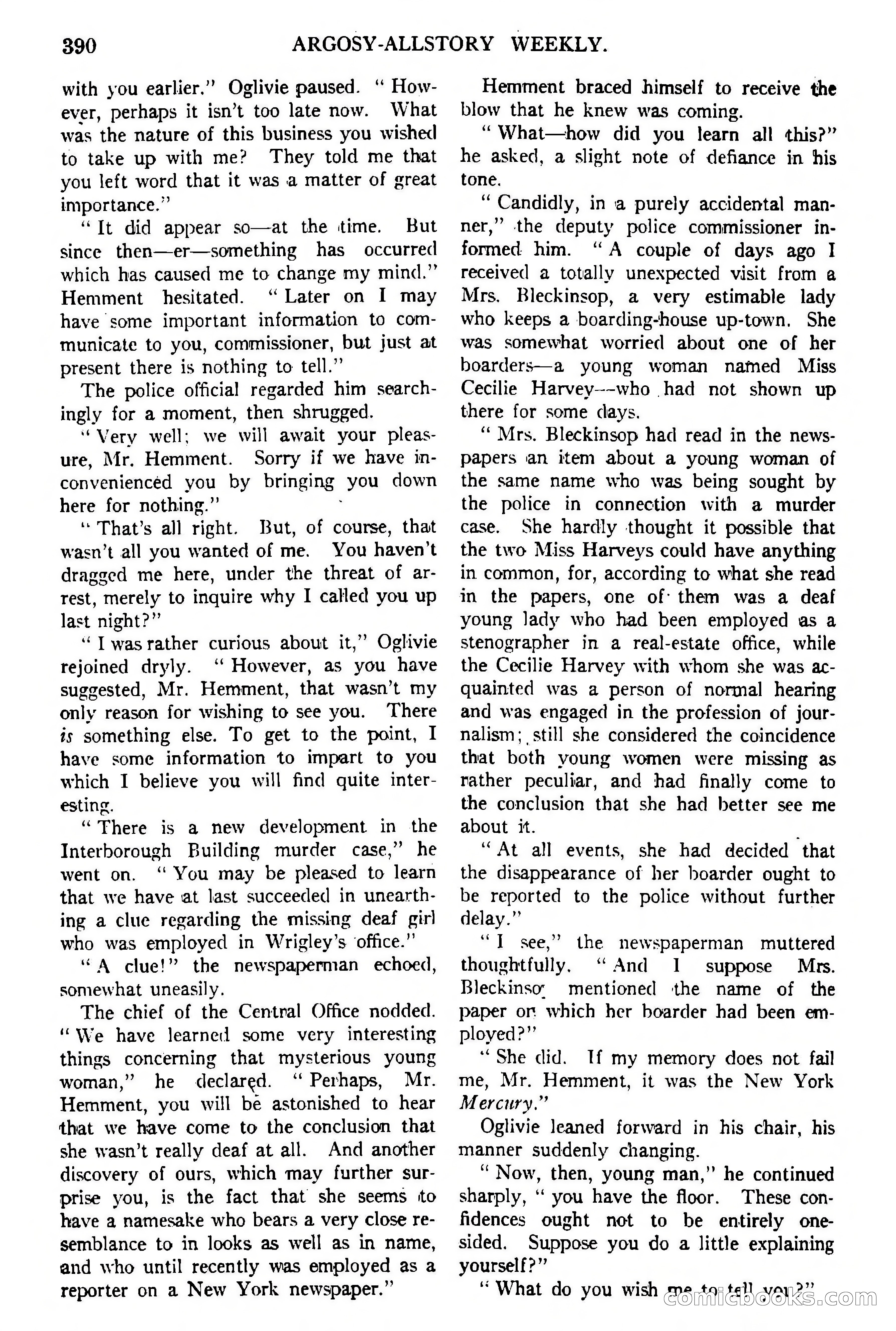
390 with you earlier.” Oglivie paused. “ How- ever, perhaps it isn’t too late now. What was the nature of this business you wished to take up with me? They told me that you left word that it was a matter of great importance. ” “Tt did appear so—at the time. But since then—er—something has occurred which has caused me to change my mind.” Hemment hesitated. “Later on I may have some important information to com- municate to you, commissioner, but just at present there is nothing to tell.” The police official regarded him search- ingly for a moment, then shrugged. ‘Very well: we will await your pleas- ure, Mr. Hemment. Sorry if we have in- conveniencéd you by bringing you down here for nothing.” “ That’s all right. But, of course, that wasn’t all you wanted of me. You haven't dragged me here, under the threat of ar- rest, merely to inquire why I called you up last night?” ‘“T was rather curious about it,” Oglivie rejoined dryly. ‘‘ However, as you have suggested, Mr. Hemment, that wasn’t my only reason for wishing to see you. There is something else. To get to the point, I have some information to impart to you which I believe you will find quite inter- esting. “There is a new development in the Interborough Building murder case,” he went on. ‘‘ You may be pleased to learn that we have at last succeeded in unearth- ing a clue regarding the missing deaf girl who was employed in Wrigley’s office.” “A clue!” the newspaperman echoed, somewhat uneasily. The chief of the Central Office nodded. ‘“We have learned some very interesting things concerning that mysterious young woman,” he declared. ‘“ Perhaps, Mr. Hemment, you will be astonished to hear that we have come to the conclusion that she wasn’t really deaf at all. And another discovery of ours, which may further sur- prise you, is the fact that she seems to have a namesake who bears a very close re- semblance to in looks as well as in name, and who until recently was employed as a reporter on a New York newspaper.” ARGOSY-ALLSTORY WEEKLY. Hemment braced himself to receive the blow that he knew was coming. ‘““What—how did you learn all this?” he asked, a slight note of defiance in his tone. ‘“ Candidly, in a purely accidental man- ner,” the deputy police commissioner in- formed him. “A couple of days ago I received a totally unexpected visit from a Mrs. Bleckinsop, a very estimable lady who keeps a boarding-house up-town. She was somewhat worried about one of her boarders—a young woman nafmed Miss Cecilie Harvey--who had not shown up there for some days. “Mrs. Bleckinsop had read in the news- papers an item about a young woman of the same name who was being sought by the police in connection with a murder case. She hardly thought it possible that the two Miss Harveys could have anything in common, for, according to what she read m the papers, one of: them was a deaf young lady who had been employed as a stenographer in a real-estate office, while the Cecilie Harvey with whom she was ac- quainted was a person of normal hearing and was engaged in the profession of jour- nalism; still she considered the coincidence that both young women were missing as rather peculiar, and had finally come to the conclusion that she had better see me about it. ‘““At all events, she had decided that the disappearance of her boarder ought to be reported to the police without further delay.” ‘J see,” the newspaperman muttered thoughtfully, ‘“ And 1 suppose Mrs. Bleckinso. mentioned ‘the name of the paper or which her boarder had been em- ployed?”’ “She did. If my memory does not fail me, Mr. Hemment, it was the New York Mercury.” Oglivie leaned forward in his chair, his manner suddenly changing. “ Now, then, young man,” he continued sharply, ‘“‘ you have the floor. These con- fidences ought not to be entirely one- sided. Suppose you do a little explaining yourself ?”’ ‘What do you wish NAIGIOG. 2a e®