
Pulp Fiction, 1920 · page 46 of 208
Argosy All-Story Weekly — "The Purple Limited" — page 46: what you’re looking at
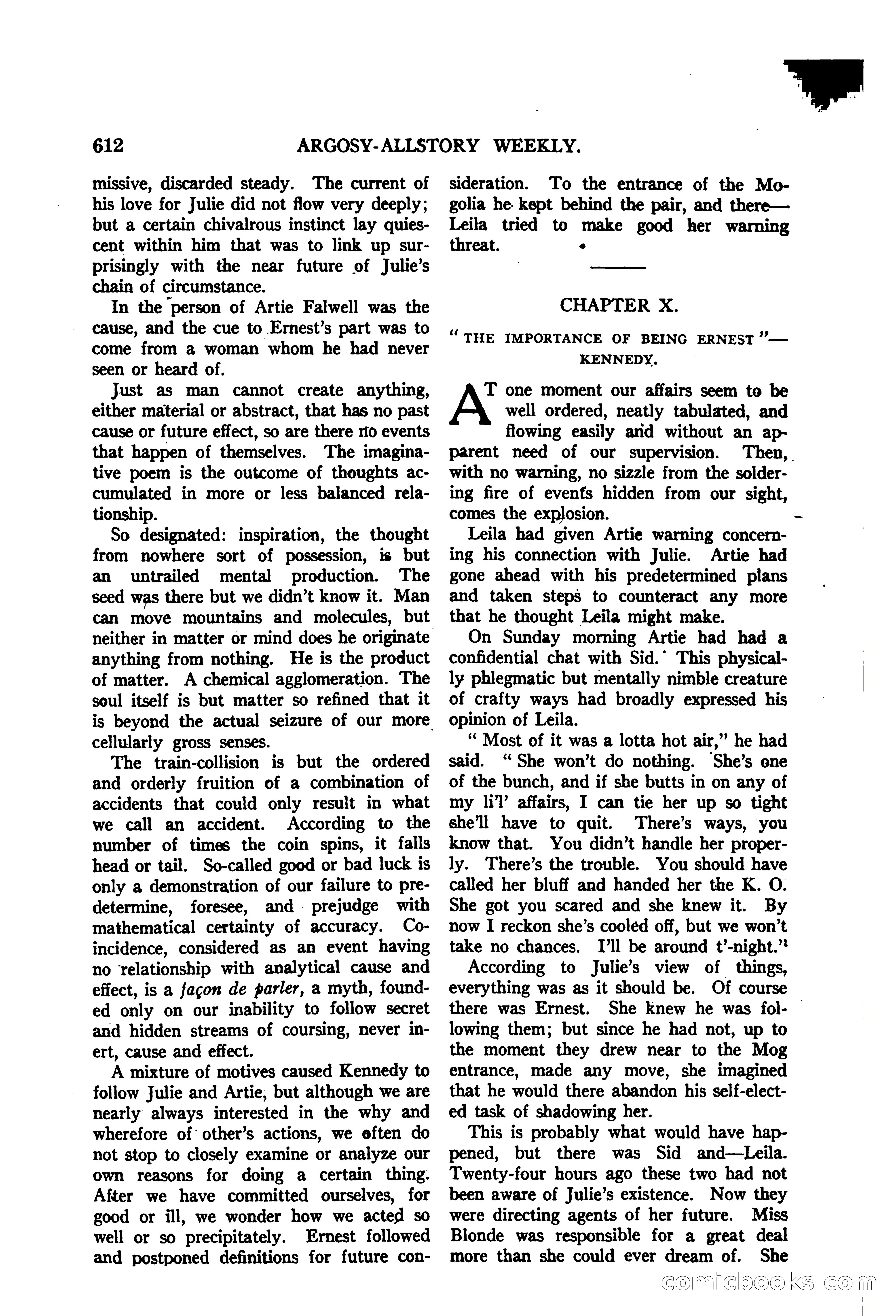
A restored page from Pulp Fiction, 1920. Page through the whole issue in the reader above.
📄 Transcribed text from this page (OCR, searchable)
Machine-transcribed from the original scan — historical spelling and the odd misread are preserved.
612 missive, discarded steady. The current of his love for Julie did not flow very deeply; but a certain chivalrous instinct lay quies- cent within him that was to link up sur- prisingly with the near future of Julie’s chain of circumstance. In the person of Artie Falwell was the cause, and the cue to Ernest’s part was to come from a woman whom he had never seen or heard of. Just as man cannot create anything, either material or abstract, that has no past cause or future effect, so are there rio events that happen of themselves. The imagina- tive poem is the outcome of thoughts ac- cumulated in more or less balanced rela- tionship. So designated: inspiration, the thought from nowhere sort of possession, is but an untrailed mental production. The seed was there but we didn’t know it. Man can move mountains and molecules, but neither in matter or mind does he originate anything from nothing. He is the product of matter. A chemical agglomeration. The soul itself is but matter so refined that it is beyond the actual seizure of our more cellularly gross senses. The train-collision is but the ordered and orderly fruition of a combination of accidents that could only result in what we call an accident. According to the number of times the coin spins, it falls head or tail. So-called good or bad luck is only a demonstration of our failure to pre- determine, foresee, and prejudge with mathematical certainty of accuracy. Co- incidence, considered as an event having no relationship with analytical cause and effect, is a fagon de parler, a myth, found- ed only on our inability to follow secret and hidden streams of coursing, never in- ert, cause and effect. A mixture of motives caused Kennedy to follow Julie and Artie, but although we are nearly always interested in the why and wherefore of other’s actions, we often do not stop to closely examine or analyze our own reasons for doing a certain thing. After we have committed ourselves, for good or ill, we wonder how we acted so well or so precipitately. Ernest followed and postponed definitions for future con- | - az ARGOSY-ALLSTORY WEEKLY. sideration. To the entrance of the Mo- golia he. kept behind the pair, and there— Leila tried to make good her warning threat. e CHAPTER X. “THE IMPORTANCE OF BEING ERNEST ’— KENNEDY. T one moment our affairs seem to be well ordered, neatly tabulated, and flowing easily and without an ap- parent need of our supervision. with no warning, no sizzle from the solder- ing fire of evenfs hidden from our sight, comes the explosion. Leila had given Artie warning concern- ing his connection with Julie. Artie had gone ahead with his predetermined plans and taken steps to counteract any more that he thought Leila might make. On Sunday morning Artie had had a confidential chat with Sid.” This physical- ly phlegmatic but mentally nimble creature of crafty ways had broadly expressed his opinion of Leila. ‘* Most of it was a lotta hot air,” he had said. “‘She won’t do nothing. She’s one of the bunch, and if she butts in on any of my lil’ affairs, I can tie her up so tight she’ll have to quit. There’s ways, you know that. You didn’t handle her proper- ly. There’s the trouble. You should have called her bluff and handed her the K. O. She got you scared and she knew it. By now I reckon she’s cooled off, but we won’t take no chances. I'll be around t’-night.” According to Julie’s view of things, everything was as it should be. Of course there was Ernest. lowing them; but since he had not, up to the moment they drew near to the Mog entrance, made any move, she imagined that he would there abandon his self-elect- ed task of shadowing her. This is probably what would have hap- pened, but there was Sid and—Leila. Twenty-four hours ago these two had not been aware of Julie’s existence. Now they Then, She knew he was fol- | were directing agents of her future. Miss Blonde was responsible for a great deal more than she could ever dream of. She COMmMicOOOkKS.EO