
Pulp Fiction, 1920 · page 135 of 208
Argosy All-Story Weekly — "The Purple Limited" — page 135: what you’re looking at
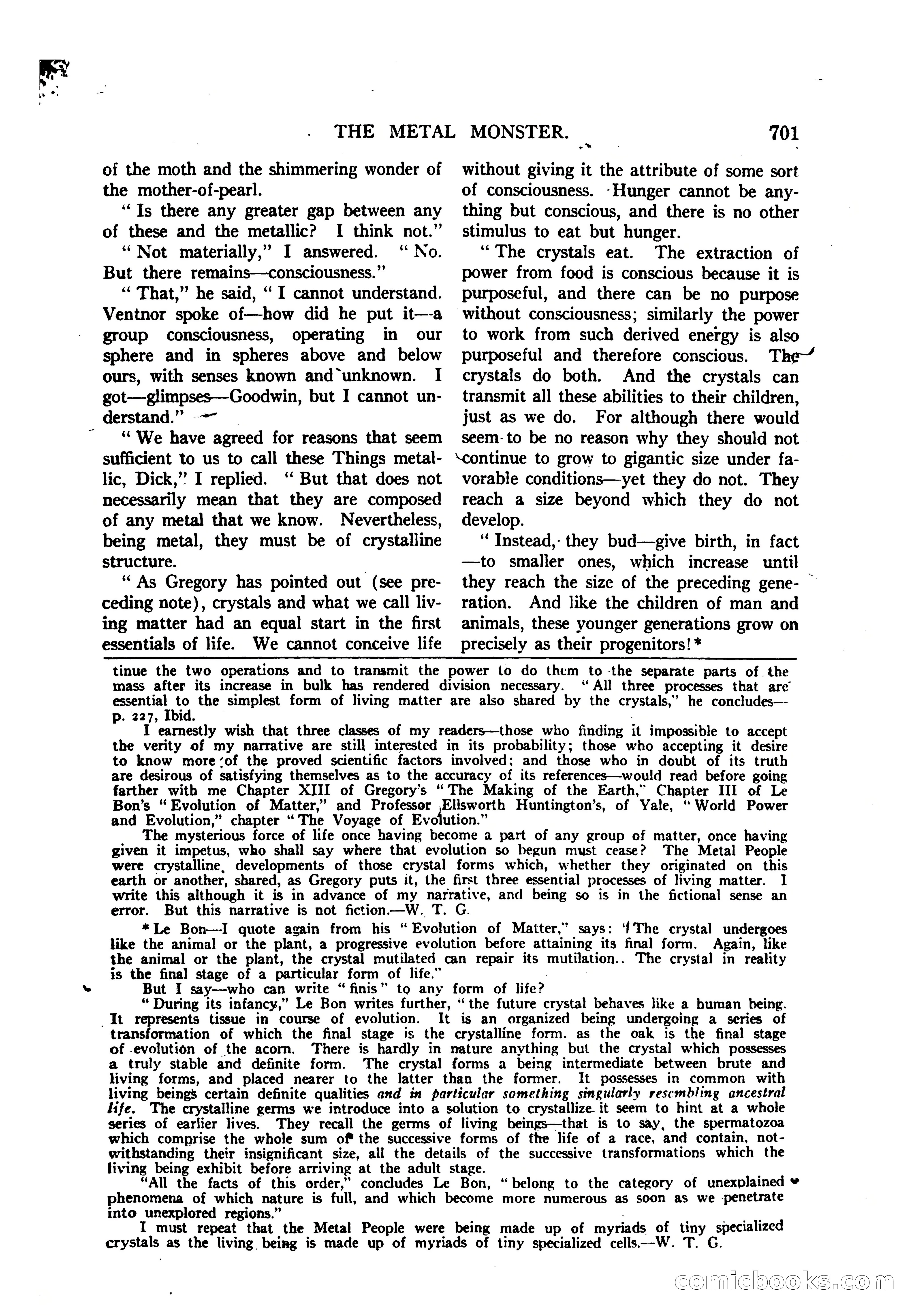
A restored page from Pulp Fiction, 1920. Page through the whole issue in the reader above.
📄 Transcribed text from this page (OCR, searchable)
Machine-transcribed from the original scan — historical spelling and the odd misread are preserved.
THE METAL MONSTER. of the moth and the shimmering wonder of the mother-of-pearl. ‘Is there any greater gap between any of these and the metallic? I think not.” “Not materially,” I answered. ‘No. But there remains—consciousness.” ‘“‘ That,” he said, “ I cannot understand. Ventnor spoke of—how did he put it—-a group consciousness, operating in our sphere and in spheres above and below ours, with senses known and unknown. I got—glimpses—Goodwin, but I cannot un- derstand.” | ‘“‘ We have agreed for reasons that seem sufficient to us to call these Things metal- lic, Dick,” I replied. ‘“‘ But that does not necessarily mean that they are composed of any metal that we know. Nevertheless, being metal, they must be of crystalline structure. | ‘“‘ As Gregory has pointed out (see pre- ceding note), crystals and what we call liv- at 701 without giving it the attribute of some sort of consciousness. -Hunger cannot be any- thing but conscious, and there is no other stimulus to eat but hunger. ‘The crystals eat. The extraction of power from food is conscious because it is purposeful, and there can be no purpose without consciousness; similarly the power to work from such derived energy is also purposeful and therefore conscious. crystals do both. And the crystals can transmit all these abilities to their children, Just as we do. For although there would seem-to be no reason why they should not \continue to grow to gigantic size under fa- vorable conditions—yet they do not. They reach a size beyond which they do not develop. ‘ Instead,- they bud—give birth, in fact —to smaller ones, they reach the size of the preceding gene- ration. And like the children of man and The which increase until animals, these vounger generations grow on precisely as their progenitors! * ing matter had an equal start in the first essentials of life. We cannot conceive life tinue the two operations and to transmit the power to do them to -the separate parts of the mass after its increase in bulk has rendered division necessary. ‘All three processes that are oY to the simplest form of living matter are also shared by the crystals, ’* he concludes—- p. 227, Ibid. | I earnestly wish that three classes of my readers—those who finding it impossible to accept the verity of my narrative are still interested in its probability; those who accepting it desire to know more ‘of the proved scientific factors involved; and those who in doubt of its truth are desirous of satisfying themselves as to the accuracy of its references—would read before going farther with me Chapter XIII of Gregory’s “The Making of the Earth,” Chapter III of Le Bon’s “Evolution of Matter,” and Professer ,Elisworth Huntington’s, of Yale, “World Power and Evolution,” chapter “The Voyage of Evolution.” The mysterious force of life once having become a part of any group of matter, once having given it impetus, who shall say where that evolution so begun must cease? The Metal People were crystalline, developments of those crystal forms which, whether they originated on this earth or another, shared, as Gregory puts it, the first three essential processes of living matter. I write this although it is in advance of my narrative, and being so is in the fictional sense an error. But this narrative is not fiction—W. T. G. *Le Bon—I quote again from his “ Evolution of Matter,” says: ‘The crystal undergoes like the animal or the plant, a progressive evolution before attaining its final form. Again, like the animal or the plant, the crystal mutilated can repair its mutilation. . The crystal in reality is the final stage of a particular form of life.” But I say—who can write “finis” to any form of life? “ During its infancy,” Le Bon writes further, “the future crystal behaves like a human being. _It represents tissue in course of evolution. It is an organized being undergoing a series of transformation of which the final stage is the crystalline form. as the oak is the final stage of -evolution of the acorn. There is hardly in nature anything but the crystal which possesses a truly stable and definite form. The crystal forms a being intermediate between brute and living forms, and placed nearer to the latter than the former. It possesses in common with living beings certain definite qualities and in particular something singularly rescmbling ancestral life. The crystalline germs we introduce into a solution to crystallize it seem to hint at a whole series of earlier lives. They recall the germs of living beings—that is to say, the spermatozoa which comprise the whole sum of the successive forms of fhe life of a race, ‘and contain, not- withstanding their insignificant size, all the details of the successive transformations which the living being exhibit before arriving at the adult stage. “All the facts of this order,” concludes Le Bon, “belong to the category of unexplained » phenomena of which nature is full, and which become more numerous as soon as we penetrate into unexplored regions.” I must repeat that the Metal People were being made up of myriads of tiny specialized crystals as the living being is made up of myriads of tiny specialized cells——W. T. G. (C 6)(0)O) nn) KS (C(O) (C(O)