
Pulp Fiction, 1920 · page 12 of 208
Argosy All-Story Weekly — "The Purple Limited" — page 12: what you’re looking at
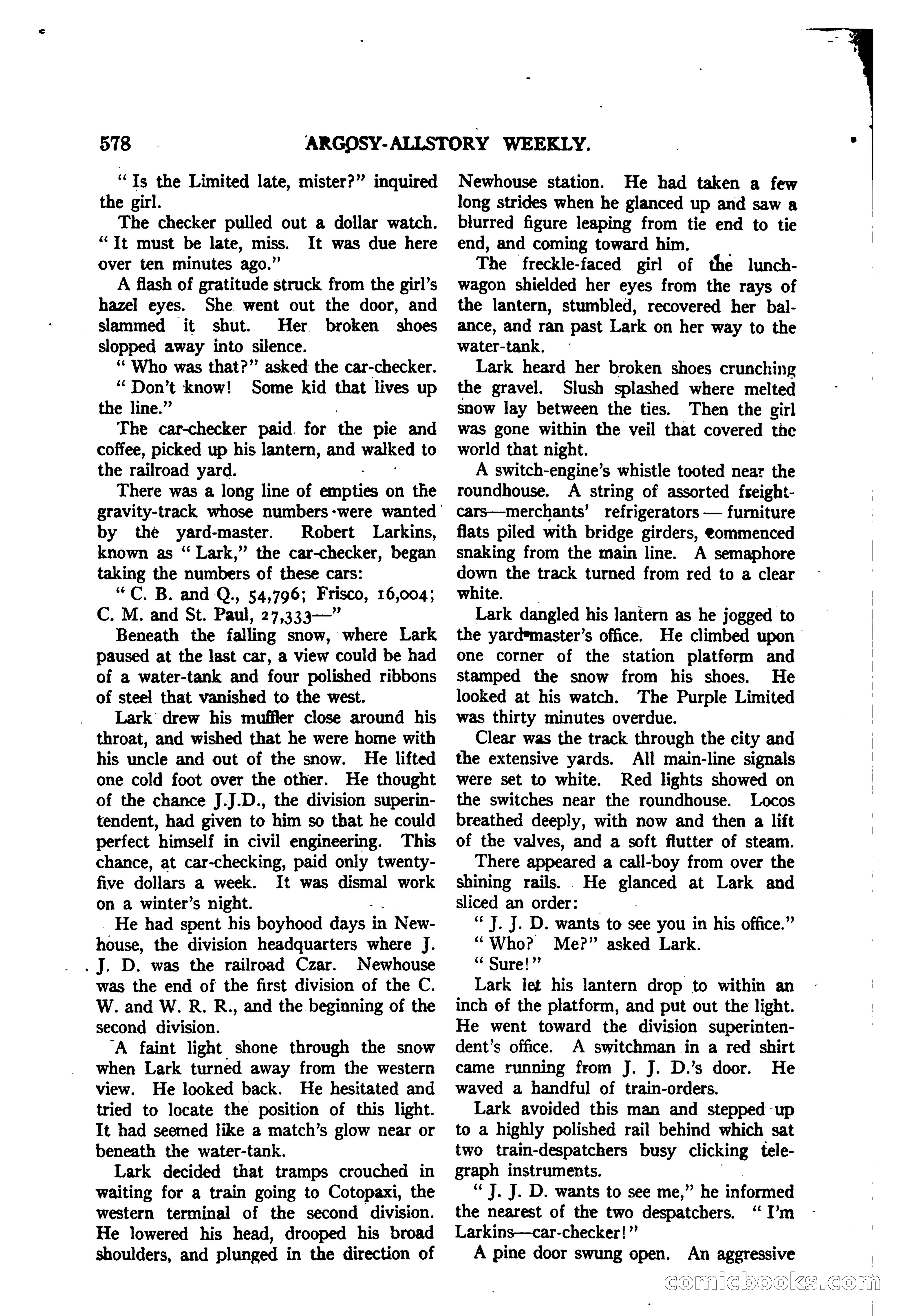
A restored page from Pulp Fiction, 1920. Page through the whole issue in the reader above.
📄 Transcribed text from this page (OCR, searchable)
Machine-transcribed from the original scan — historical spelling and the odd misread are preserved.
578 “Is the Limited late, mister?” inquired the girl. The checker pulled out a dollar watch. ““It must be late, miss. It was due here over ten minutes ago.’’ A flash of gratitude struck from the girl’s hazel eyes. She went out the door, and slammed it shut. Her broken shoes slopped away into silence. “Who was that?” asked the car-checker. “Don’t know! Some kid that lives up the line.” The car-checker paid. for the pie and coffee, picked up his lantern, and walked to the railroad yard. There was a long line of emptien on the gravity-track whose numbers:were wanted by the yard-master. Robert Larkins, known as “ Lark,” the car-checker, began taking the numbers of these cars: “C. B. and Q., 54,796; Frisco, 16,004; C. M. and St. Paul, 27,333—” Beneath the falling snow, where Lark paused at the last car, a view could be had of a water-tank and four polished ribbons of steel that vanished to the west. . Lark’ drew his muffler close around his throat, and wished that he were home with his uncle and out of the snow. He lifted one cold foot over the other. He thought of the chance J.J.D., the division superin- tendent, had given to him so that he could perfect himself in civil engineering. This chance, at car-checking, paid only twenty- five dollars a week. It was dismal work on a winter’s night. He had spent his boyhood days i in 1 New- house, the division headquarters where J. . J. D. was the railroad Czar. Newhouse was the end of the first division of the C. W. and W. R. R., and the beginning of the second division. ‘A faint light shone through the snow when Lark turned away from the western view. He looked back. He hesitated and tried to locate the position of this light. It had seemed like a match’s glow near or beneath the water-tank. Lark decided that tramps crouched in waiting for a train going to Cotopaxi, the western terminal of the second division. He lowered his head, drooped his broad shoulders, and plunged in the direction of ARGOSY-ALLSTORY WEEKLY. Newhouse station. He had taken a few long strides when he glanced up and saw a blurred figure leaping from tie end to tie end, and coming toward him. The freckle-faced girl of the lunch- wagon shielded her eyes from the rays of the lantern, stumbled, recovered her bal- ance, and ran past Lark on her way to the water-tank. Lark heard her broken shoes crunching the gravel. Slush splashed where melted snow lay between the ties. Then the girl was gone within the veil that covered the world that night. A switch-engine’s whistle tooted near the roundhouse. A string of assorted freight- cars—merchants’ refrigerators — furniture flats piled with bridge girders, @ommenced snaking from the main line. A semaphore down the track turned from red to a clear white. Lark dangled his lantern as he jogged to the yard*master’s office. He climbed upon one corner of the station platferm and stamped the snow from his shoes. He looked at his watch. The Purple Limited was thirty minutes overdue. Clear was the track through the city and the extensive yards. All main-line signals were set to white. Red lights showed on the switches near the roundhouse. Locos breathed deeply, with now and then a lift of the valves, and a soft flutter of steam. There appeared a call-boy from over the Shining rails. He glanced at Lark and sliced an order; st “J. J. D. wants to see you in his office.” “Who? Me?” asked Lark. “¢ Sure!”’ Lark let his lantern drop to within an inch ef the platform, and put out the light. He went toward the division superinten- dent’s office. A switchman in a red shirt came running from J. J. D.’s door. He waved a handful of train-orders. Lark avoided this man and stepped -up to a highly polished rail behind which sat two train-despatchers busy clicking tele- graph instruments. ‘“‘ J. J. D. wants to see me,” he informed the nearest of the two despatchers. “Tm Larkins—car-checker!” A pine door swung open. An aggressive S CO COMmiclboo