
Pulp Fiction, 1920 · page 104 of 208
Argosy All-Story Weekly — "The Purple Limited" — page 104: what you’re looking at
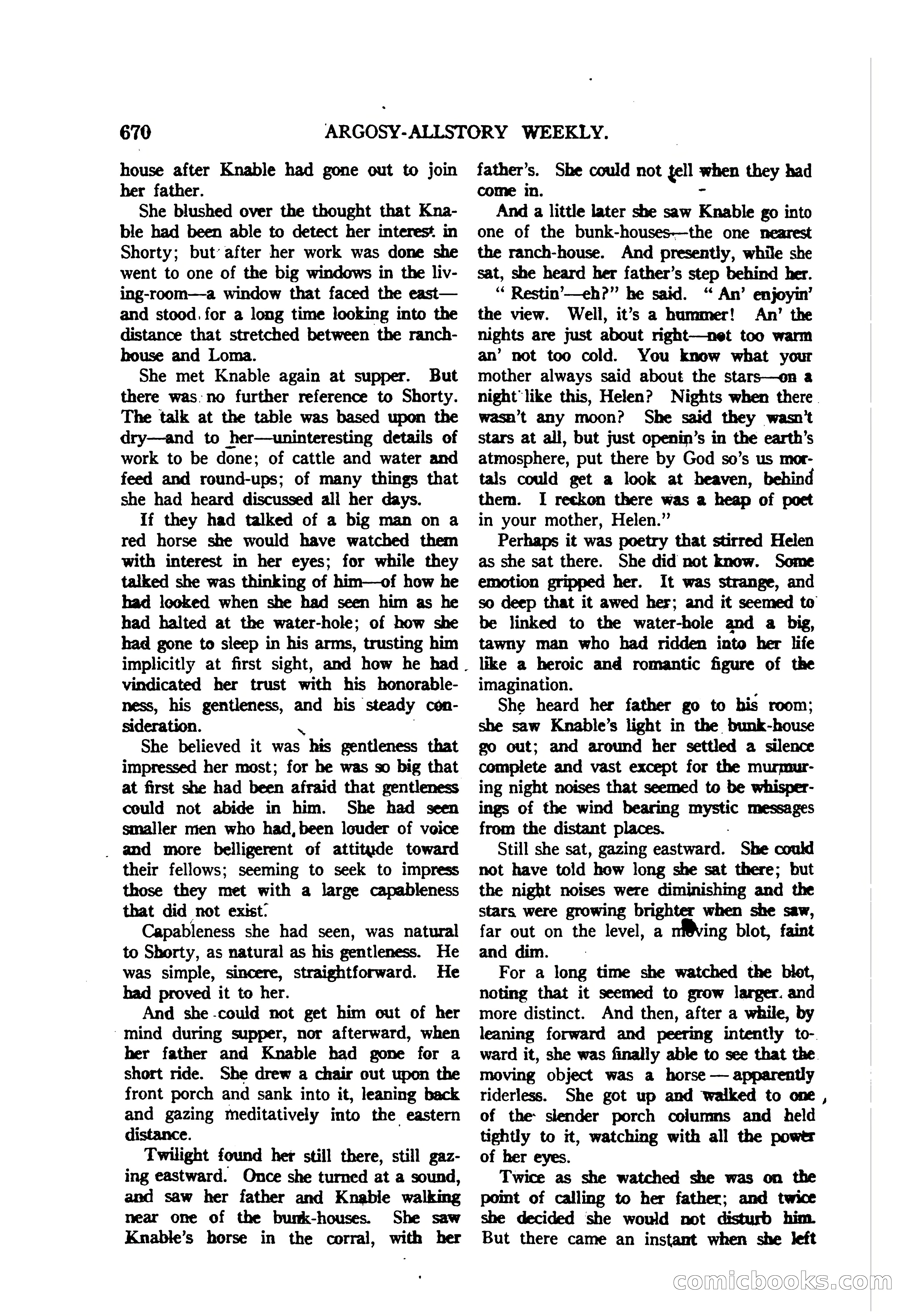
A restored page from Pulp Fiction, 1920. Page through the whole issue in the reader above.
📄 Transcribed text from this page (OCR, searchable)
Machine-transcribed from the original scan — historical spelling and the odd misread are preserved.
670 house after Knable had gone out to join her father. She blushed over the thought that Kna- ble had been able to detect her interest in Shorty; but’ after her work was done she went to one of the big windows in the liv- ing-room—a window that faced the east— and stood. for a long time looking into the distance that stretched between the ranch- house and Loma. She met Knable again at supper. But there was:no further reference to Shorty. The talk at the table was based upon the dry—and to her—uninteresting details of work to be done; of cattle and water and feed and round-ups; of many things that she had heard discussed all her days. if they had talked of a big man on a red horse she would have watched them with interest in her eyes; for while they talked she was thinking of him—of how he had looked when she had seen him as he had halted at the water-hole; of how she had gone to sleep in his arms, trusting him implicitly at first sight, and how he had. vindicated her trust with his honorable- ness, his gentleness, and his steady con- sideration. 7 She believed it was his gentleness that impressed her most; for he was so big that at first she had been afraid that gentleness could not abide in him. She had seen smaller men who had, been louder of voice _ and more belligerent of attitude toward their fellows; seeming to seek to impress those they met with a large capableness that did not exist: Capableness she had seen, was natural to Shorty, as natural as his gentleness. He was simple, sincere, straightforward. He had proved it to her. And she could not get him out of her -mind during supper, nor afterward, when her father and Knable had gone for a short ride. She drew a chair out upon the front porch and sank into it, leaning back and gazing meditatively into the eastern distance. Twilight found her still there, still gaz- ing eastward. Once she turned at a sound, and saw her father and Knable walking near one of the burk-houses. She saw Knable’s horse in the corral, with her ARGOSY-ALLSTORY WEEKLY. father’s. come in. And a little later she saw Knable go into one of the bunk-houses—the one nearest the ranch-house. And presently, while she sat, she heard her father’s step behind her. ‘ Restin’—eh?”’ he said. “ An’ enjoyin’ the view. Well, it’s a hummer! An’ the nights are just about right—net too warm an’ not too cold. You know what your mother always said about the stars—on a She could not fell when they had night like this, Helen? Nights when there | wasn’t any moon? She said they wasn’t stars at all, but just openin’s in the earth’s atmosphere, put there by God so’s us mor- tals could get a look at heaven, behind them. I reckon there was a heap of poet in your mother, Helen.” Perhaps it was poetry that stirred Helen as she sat there. She did not know. Some emotion gripped her. It was strange, and so deep that it awed her; and it seemed to be linked to the water-hole and a big, tawny man who had ridden into her life like a heroic and romantic figure of the imagination. . She heard her father go to his room; she saw Knable’s light in the bunk-house go out; and around her settled a silence complete and vast except for the murmur- ing night noises that seemed to be whisper- ings of the wind bearing mystic messages from the distant places. Still she sat, gazing eastward. She could not have told how long she sat there; but the night noises were diminishing and the stars were growing brighter when she saw, far out on the level, a nfWing blot, faint and dim. : | For a long time she watched the bit, noting that it seemed to grow larger. and more distinct. And then, after a while, by leaning forward and peering intently to-. ward it, she was finally able to see that the moving object was a horse — apparently riderless. She got up and walked to one of the slender porch columns and held tightly to it, watching with all the power of her eyes. Twice as she watched she was on the poimt of calling to her father; and twice she decided she would not disturb him. But there came an instant when she left (C(O) nn) (C 6)(0)O) S (C(O)