
Pulp Fiction, 1920 · page 89 of 160
Argosy, Vol. 120, No. 1 — page 89: what you’re looking at
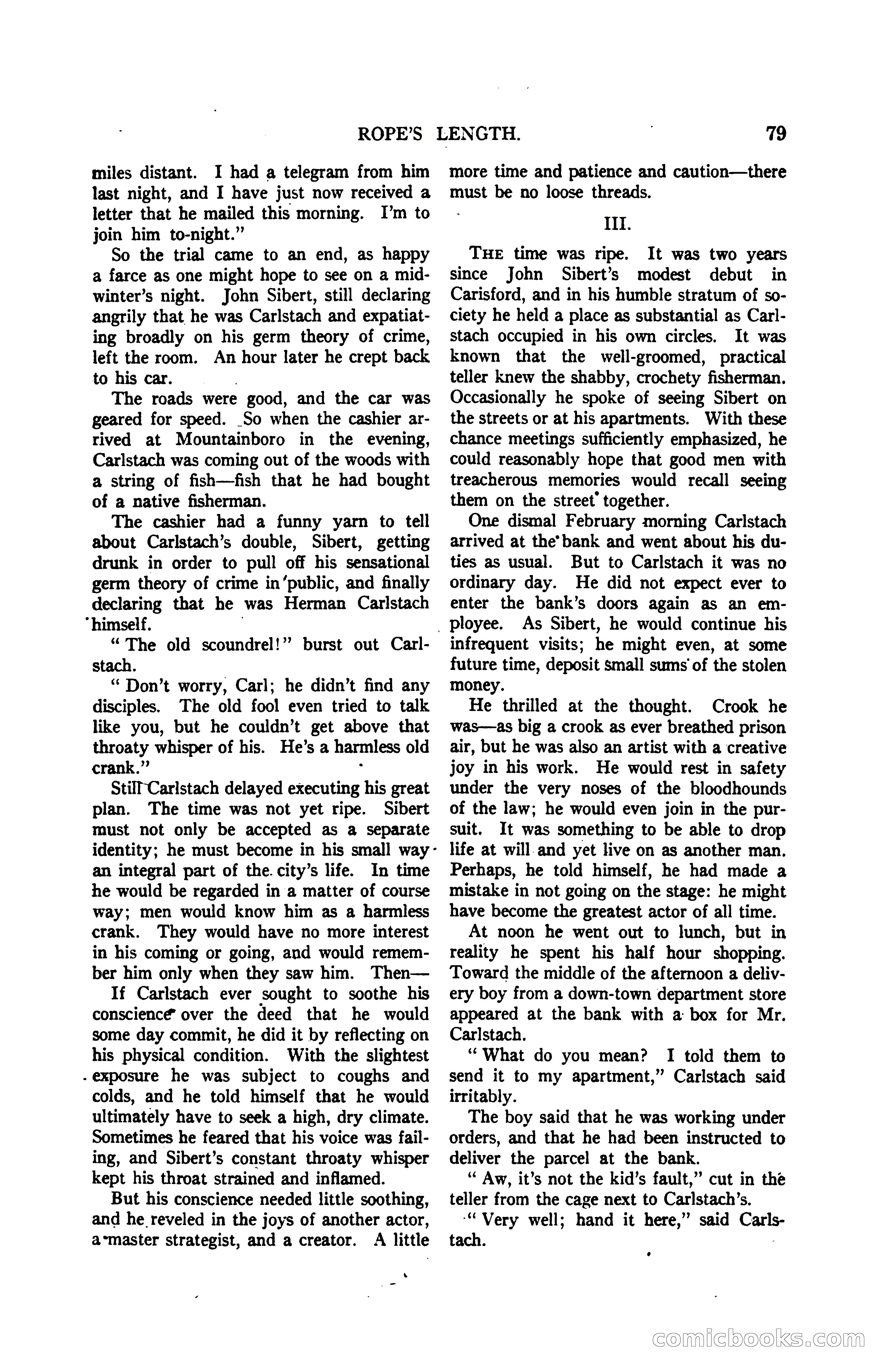
A restored page from Pulp Fiction, 1920. Page through the whole issue in the reader above.
📄 Transcribed text from this page (OCR, searchable)
Machine-transcribed from the original scan — historical spelling and the odd misread are preserved.
ROPE’S LENGTH. miles distant. I had a telegram from him last night, and I have just now received a letter that he mailed this morning. I’m to join him to-night.” So the trial came to an end, as happy a farce as one might hope to see on a mid- winter’s night. John Sibert, still declaring angrily that, he was Carlstach and expatiat- ing broadly on his germ theory of crime, left the room. An hour later he crept back The roads were good, and the car was geared for speed. So when the cashier ar- rived at Mountainboro in the evening, Carlstach was coming out of the woods with a string of fish—fish that he had bought of a native fisherman. The cashier had a funny yarn to tell about Carlstach’s double, Sibert, getting drunk in order to pull off his sensational germ theory of crime in ‘public, and finally declaring that he was Herman Carlstach “himself. “ The old scoundrel!” burst out Carl- stach. “ Don’t worry, Carl; he didn’t find any disciples. The old fool even tried to talk like you, but he couldn’t get above that throaty whisper of his. He’s a harmless old crank.” ; Still Carlstach delayed executing his great plan. The time was not yet ripe. Sibert must not only be accepted as a separate identity; he must become in his small way- an integral part of the. city’s life. In time he would be regarded in a matter of course way; men would know him as a harmless crank. They would have no more interest in his coming or going, and would remem- ber him only when they saw him. Then— If Carlstach ever sought to soothe his conscience’ over the deed that he would some day commit, he did it by reflecting on his physical condition. With the slightest . exposure he was subject to coughs and colds, and he told himself that he would ultimately have to seek a high, dry climate. Sometimes he feared that his voice was fail- ing, and Sibert’s constant throaty whisper kept his throat strained and inflamed. But his conscience needed little soothing, and he reveled in the joys of another actor, acmaster strategist, and a creator. A little LS - 79 more time and patience and caution—there must be no loose threads. If. THE time was ripe. It was two years since John Sibert’s modest debut in Carisford, and in his humble stratum of so- ciety he held a place as substantial as Carl- Stach occupied in his own circles. It was known that the well-groomed, practical teller knew the shabby, crochety fisherman. Occasionally he spoke of seeing Sibert on the streets or at his apartments. With these chance meetings sufficiently emphasized, he could reasonably hope that good men with treacherous memories would recall seeing them on the street’ together. One dismal February morning Carlstach arrived at the’bank and went about his du- ties as usual. But to Carlstach it was no ordinary day. He did not expect ever to enter the bank’s doors again as an em- _ ployee. As Sibert, he would continue his infrequent visits; he might even, at some future time, deposit Small sums of the stolen money. He thrilled at the thought. Crook he was—as big a crook as ever breathed prison air, but he was also an artist with a creative joy in his work. He would rest in safety under the very noses of the bloodhounds of the law; he would even join in the pur- suit. It was something to be able to drop life at will.and yet live on as another man. Perhaps, he told himself, he had made a mistake in not going on the stage: he might have become the greatest actor of all time. At noon he went out to lunch, but in reality he spent his half hour shopping. Toward the middle of the afternoon a deliv- ery boy from a down-town department store appeared at the bank with a box for Mr. Carlstach. ‘What do you mean? I told them to send it to my apartment,’’ Carlstach said irritably. The boy said that he was working under orders, and that he had been instructed to deliver the parcel at the bank. ‘* Aw, it’s not the kid’s fault,” cut in the teller from the cage next to Carlstach’s. “Very well; hand it here,” said Carls- tach. COMicdoo S CO@