
Pulp Fiction, 1920 · page 82 of 160
Argosy, Vol. 120, No. 1 — page 82: what you’re looking at
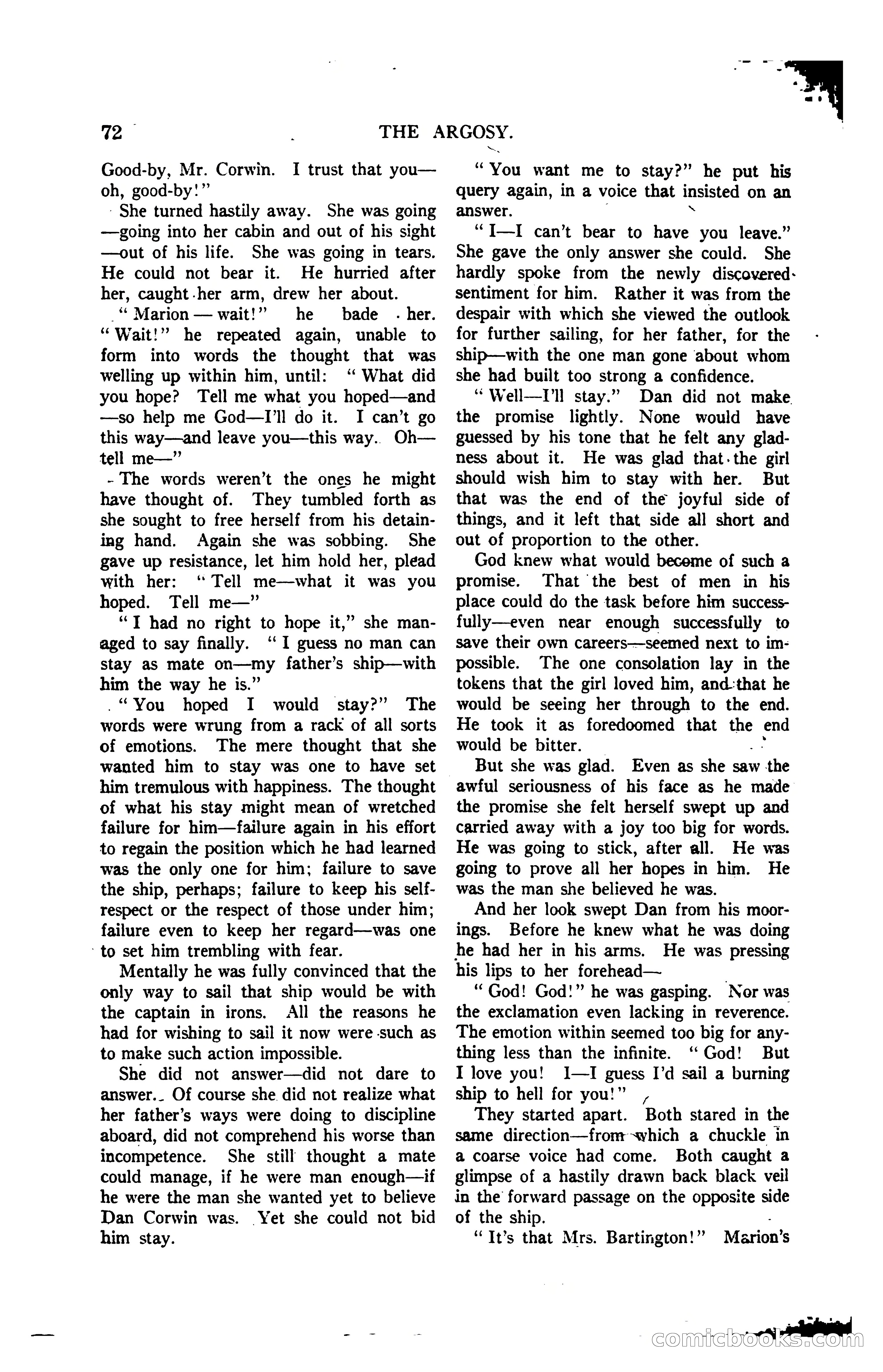
A restored page from Pulp Fiction, 1920. Page through the whole issue in the reader above.
📄 Transcribed text from this page (OCR, searchable)
Machine-transcribed from the original scan — historical spelling and the odd misread are preserved.
T2 Good-by, Mr. Corwin. oh, good-by!”’ ' She turned hastily away. She was going —going into her cabin and out of his sight —out of his life. She was going in tears. He could not bear it. He hurried after her, caught her arm, drew her about. _“ Marion — wait!” he bade .. her. “Wait!” he repeated again, unable to form into words the thought that was welling up within him, until: ‘‘ What did you hope? Tell me what you hoped—and —so help me God—I’ll do it. I can’t go this way—and leave you—this way.. Oh— tell me—”’ - The words weren’t the ones he might have thought of. They tumbled forth as she sought to free herself from his detain- ing hand. Again she was sobbing. She gave up resistance, let him hold her, plead with her: ‘ Tell me—what it was you hoped. Tell me—”’ “T had no right to hope it,” she man- aged to say finally. ‘I guess no man can stay as mate on—my father’s ship—with him the way he is.” .“You hoped I would stay?” The words were wrung from a rack of all sorts of emotions. The mere thought that she I trust that you— wanted him to stay was one to have set — him tremulous with happiness. The thought of what his stay might mean of wretched failure for him—failure again in his effort to regain the position which he had learned was the only one for him; failure to save the ship, perhaps; failure to keep his self- respect or the respect of those under him; failure even to keep her regard—was one ‘to set him trembling with fear. Mentally he was fully convinced that the only way to sail that ship would be with the captain in irons. All the reasons he had for wishing to sail it now were such as to make such action impossible. She did not answer—did not dare to answer.. Of course she did not realize what her father’s ways were doing to discipline aboard, did not comprehend his worse than incompetence. She still thought a mate could manage, if he were man enough—if he were the man she wanted yet to believe Dan Corwin was. Yet she could not bid him stay. “You want me to stay?” he put his query again, in a voice that insisted on an answer. : ‘““I—I can’t bear to have you leave.” She gave the only answer she could. She hardly spoke from the newly discovered: sentiment for him. Rather it was from the despair with which she viewed the outlook for further sailing, for her father, for the ship—with the one man gone about whom she had built too strong a confidence. * Well—I’ll stay.” Dan did not make. the promise lightly. None would have guessed by his tone that he felt any glad- ness about it. He was glad that-the girl should wish him to stay with her. But that was the end of the joyful side of things, and it left that side all short and out of proportion to the other. God knew what would beceme of such a promise. That the best of men in his place could do the task before him success- fully—even near enough successfully to save their own careers—seemed next to im- possible. The one consolation lay in the tokens that the girl loved him, and-that he would be seeing her through to the end. He took it as foredoomed that the end would be bitter. _ -@ But she was glad. Even as she saw the awful seriousness of his face as he made the promise she felt herself swept up and carried away with a joy too big for words. He was going to stick, after all. He was going to prove all her hopes in him. He was the man she believed he was. And her look swept Dan from his moor- ings. Before he knew what he was doing he had her in his arms. He was pressing his lips to her forehead— | “God! God!” he was gasping. Nor was the exclamation even lacking in reverence. The emotion within seemed too big for any- thing less than the infinite. ‘“‘God! But I love you! I—TI guess I’d sail a burning ship to hell for you!” They started apart. Both stared in the same direction—from which a chuckle in a coarse voice had come. Both caught a glimpse of a hastily drawn back black veil in the forward passage on the opposite side of the ship. “It’s that Mrs. Bartington!”’ THE ARGOSY. Marion’s ~ CONIC! poe SOI