
Pulp Fiction, 1920 · page 79 of 160
Argosy, Vol. 120, No. 1 — page 79: what you’re looking at
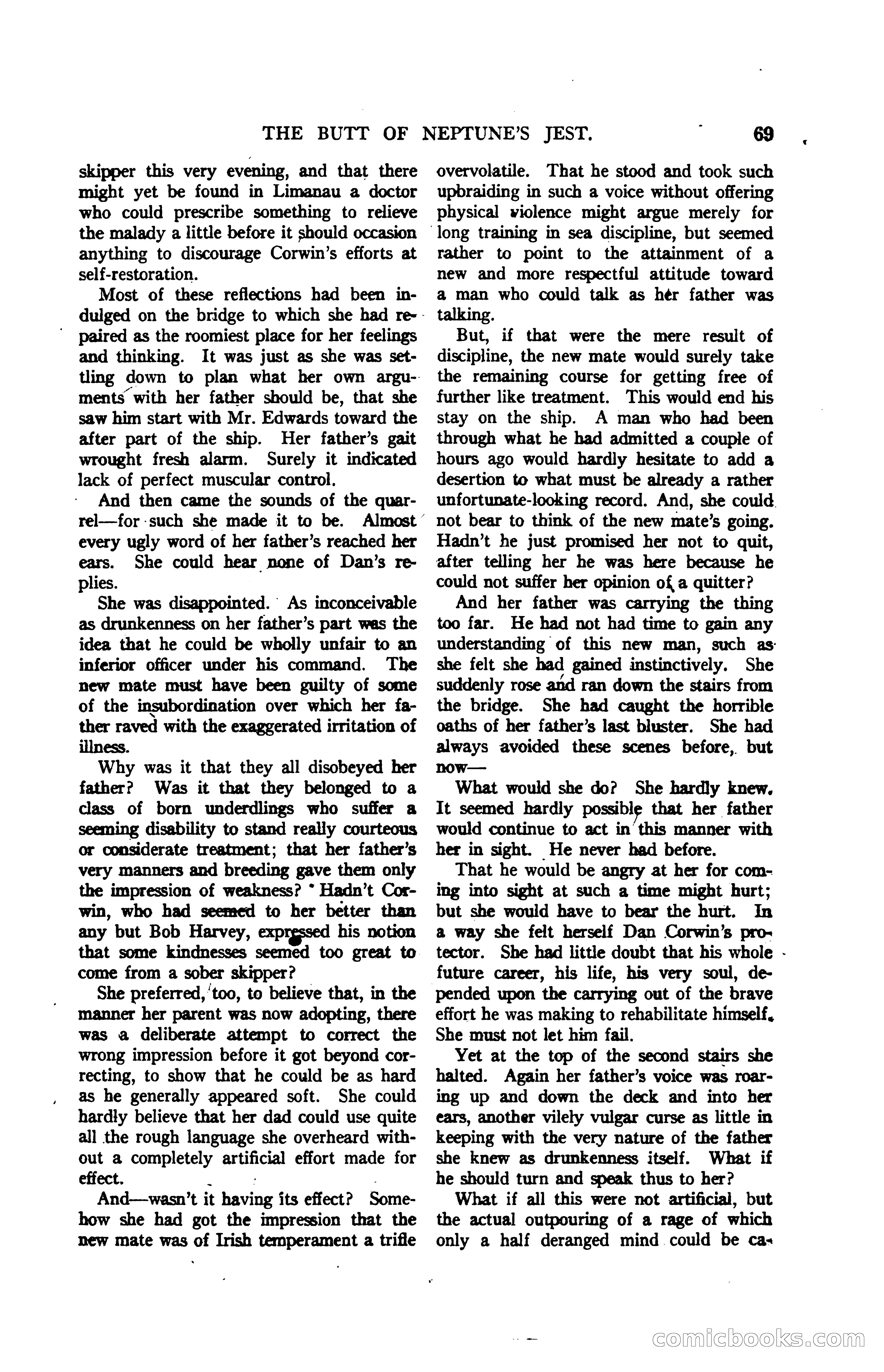
A restored page from Pulp Fiction, 1920. Page through the whole issue in the reader above.
📄 Transcribed text from this page (OCR, searchable)
Machine-transcribed from the original scan — historical spelling and the odd misread are preserved.
THE BUTT OF NEPTUNE’S JEST. skipper this very evening, and that there might yet be found in Limanau a doctor who could prescribe something to relieve the malady a little before it should occasion anything to discourage Corwin’s efforts at self-restoration. Most of these reflections had been in- 69 overvolatile. That he stood and took such upbraiding in such a voice without offering physical wiolence might argue merely for long training in sea discipline, but seemed rather to point to the attainment of a new and more respectful attitude toward a man who could talk as hér father was dulged on the bridge to which she had re-- talking paired as the roomiest place for her feelings and thinking. It was just as she was set- tling down to plan what her own argu- ments with her father should be, that she saw him start with Mr. Edwards toward the after part of the ship. Her father’s gait wrought fresh alarm. Surely it indicated lack of perfect muscular control. And then came the sounds of the quar- rel—for such she made it to be. Almost’ every ugly word of her father’s reached her ears. She could hear none of Dan’s re- plies. She was disappointed. As inconceivable as drunkenness on her father’s part was the idea that he could be wholly unfair to an inferior officer under his command. The new mate must have been guilty of some of the insubordination over which her fa- ther raved with the exaggerated irritation of illness. Why was it that they all disobeyed her fathere Was it that they belonged to a class of born underdlings who suffer a seeming disability to stand really courteous or considerate treatment; that her father’s very manners and breeding gave them only the impression of weakness? “ Hadn’t Cor- win, who had seemed to her better than any but Bob Harvey, exprgssed his notion that some kindnesses seemed too great to come from a sober skipper? She preferred, ‘too, to believe that, in the manner her parent was now adopting, there was a deliberate attempt to correct the wrong impression before it got beyond cor- recting, to show that he could be as hard as he generally appeared soft. She could hardly believe that her dad could use quite all the rough language she overheard with- out a completely artificial effort made for And—wasn’t it having its effect? Some- how she had got the impression that the new mate was of Irish temperament a trifle But, if that were the mere result of discipline, the new mate would surely take the remaining course for getting free of further like treatment. This would end his stay on the ship. A man who had been through what he had admitted a couple of hours ago would hardly hesitate to add a desertion to what must be already a rather unfortunate-looking record. And, she could. not bear to think of the new mate’s going. Hadn’t he just promised her not to quit, after telling her he was here because he could not suffer her opinion of a quitter? And her father was carrying the thing too far. He had not had time to gain any understanding of this new man, such as: she felt she had gained instinctively. She suddenly rose and ran down the stairs from the bridge. She had caught the horrible oaths of her father’s last bluster. She had always avoided these scenes before, but now— What would she do? She hardly knew. It seemed hardly possible that her father would continue to act in this manner with her in sight. He never had before. That he would be angry at her for com- ing into sight at such a time might hurt; but she would have to bear the hurt. In a way she felt herself Dan Corwin’s pro- tector. She had little doubt that his whole - future career, his life, his very soul, de- pended upon the carrying out of the brave effort he was making to rehabilitate himself, She must not let him fail. Yet at the top of the second stairs she halted. Again her father’s voice was roar- ing up and down the deck and into her ears, another vilely vulgar curse as little in keeping with the very nature of the father she knew as drunkenness itself. What if he should turn and speak thus to her? What if all this were not artificial, but the actual outpouring of a rage of which only a half deranged mind could be cas = EO 1NOO (-) S CO@