
Pulp Fiction, 1920 · page 70 of 160
Argosy, Vol. 120, No. 1 — page 70: what you’re looking at
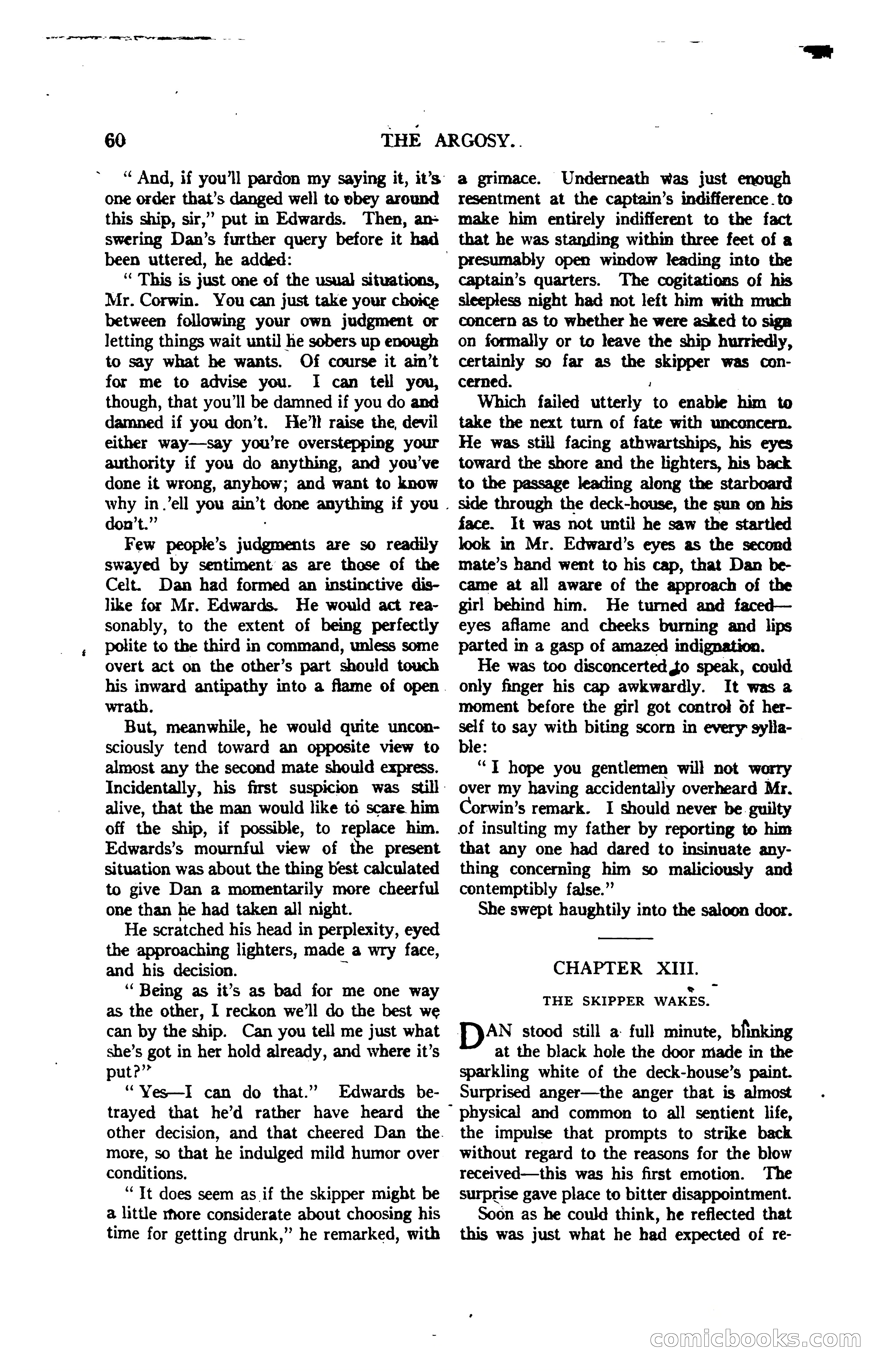
A restored page from Pulp Fiction, 1920. Page through the whole issue in the reader above.
📄 Transcribed text from this page (OCR, searchable)
Machine-transcribed from the original scan — historical spelling and the odd misread are preserved.
60 “ And, if you’ll pardon my saying it, it’s one order that’s danged well to obey around this ship, sir,’’ put in Edwards. Then, an- swering Dan’s further query before it had been uttered, he added: ‘This is just one of the usual situations, Mr. Corwin. You can just take your choice between following your own judgment or letting things wait until he sobers up enough to say what he wants. Of course it am’t for me to advise you. I can tell you, though, that you'll be damned if you do and damned if you don’t. He'll raise the, devil either way—say you're overstepping your authority if you do anything, and you’ve done it wrong, anyhow; and want to know why in.’ell you ant done anything if you . don’ t. PP] Few people’s ‘idemnenits are so readily swayed by sentiment as are those of the Celt. Dan had formed an instinctive dis- like for Mr. Edwards. He would act rea- sonably, to the extent of being perfectly polite to the third in command, unless some overt act on the other’s part should touch his inward antipathy into a flame of open. wrath. But, meanwhile, he would quite uncon- sciously tend toward an opposite view to almost any the second mate should express. Incidentally, his first suspicion was still. alive, that the man would like to scare him off the ship, if possible, to replace him. Edwards’s mournful view of the present situation was about the thing best calculated to give Dan a momentarily more cheerful one than he had taken all night. He scratched his head in perplexity, eyed the approaching lighters, made a wry face, and his decision. ‘“ Being as it’s as bad for me one way as the other, I reckon we’ll do the best we can by the ship. Can you tell me just what she’s got in her hold already, and where it’s put?’ “Yes—I can do that.” Edwards be- trayed that he’d rather have heard the — other decision, and that cheered Dan the. more, so that he indulged mild humor over conditions. ‘Tt does seem as if the skipper might be a little more considerate about choosing his time for getting drunk,” he remarked, with THE ARGOSY.. a grimace. Underneath was just enough resentment at the captain’s indifference to make him entirely indifferent to the fact that he was standing within three feet of a _ presumably open window leading into the captain’s quarters. The cogitations of his sleepless night had not left him with much concern as to whether he were asked to sign on formally or to leave the ship hurriedly, certainly so far as the ‘Skipper was con- cerned. Which failed utterly ite enable him to take the next turn of fate with unconcern. He was still facing athwartships, his eyes toward the shore and the lighters, his back to the passage leading along the starboard side through the deck-house, the sun on his face. It was not until he saw the startled look in Mr. Edward’s eyes as the second mate’s hand went to his cap, that Dan be- came at all aware of the approach of the girl behind him. He turned and faced— eyes aflame and cheeks burning and lips parted in a gasp of amazed indignation. He was too disconcerted fo speak, could only finger his cap awkwardly. It was a moment before the girl got control of her- self to say with biting scorn in every sylia- ble: “I hope you gentlemen will not worry over my having accidentally overheard Mr. Corwin’s remark. I Should never be. guilty of insulting my father by reporting to him that any one had dared to insinuate any- thing concerning him so maliciously and contemptibly false.” She swept haughtily into the saloon door. CHAPTER XIII. e - THE SKIPPER WAKES. D‘N stood still a: full minute, bfinking at the black hole the door made in the sparkling white of the deck-house’s paint. Surprised anger—the anger that is almost physical and common to all sentient life, the impulse that prompts to strike back without regard to the reasons for the blow received—this was his first emotion. The surprise gave place to bitter disappointment. Soon as he could think, he reflected that this was just what he had expected of re- CoOMmiicloo CO@